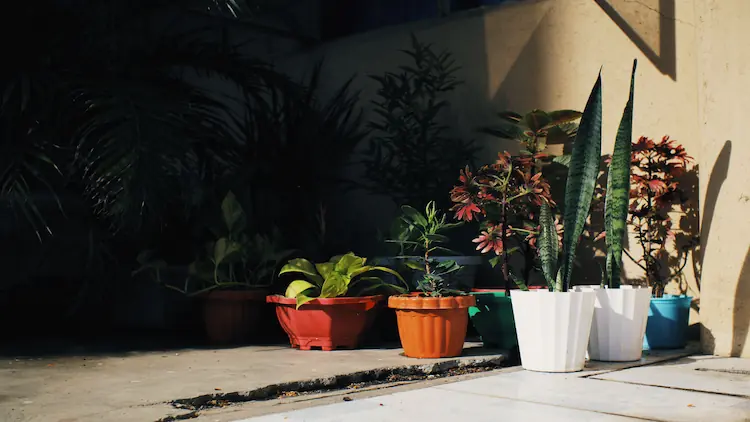
Ever notice how your snake plant just sits there in December, looking exactly the same as it did in October?

That’s not your imagination it’s the biggest clue to answering how often to water snake plant in winter. Once you understand why it happens, the whole question gets simple.
I’ve kept snake plants through several winters, and the short version is: less water, longer gaps, and more patience than you would think.
Why Your Snake Plant’s Water Needs Drop Once Fall Ends
Once Fall wraps up and the days get shorter, your snake plant slows way down. Less daylight means less photosynthesis, which means the plant just isn’t pulling moisture out of the soil the way it did in summer.
- Growth practically stops, so there’s no new tissue demanding water.
- Cooler room temperatures slow evaporation, so soil stays damp longer.
- Lower light means the plant’s internal engine is running on idle.
For most homes in the U.S., this dormant stretch runs roughly from late October through February, lining up with shorter daylight hours rather than a fixed date on the calendar. Once you notice new growth pushing up again in early spring, that’s your cue the dormant window has closed.
Here’s a fact I find genuinely interesting: snake plants use a process called CAM photosynthesis, where they open their pores at night instead of during the day.
This is the same water-saving trick cacti use, and it’s a big part of why this plant can go weeks without a drink even when it’s actively growing let alone in winter when it’s basically dormant.
How Often to Water Snake Plant in Winter: The Real Number
For most homes, the answer is once every 3 to 4 weeks. But that’s a starting point, not a rule carved in stone. Your actual snake plant winter watering schedule depends on a handful of things in your specific room.
| Condition | Adjust Frequency To |
|---|---|
| Terracotta pot (dries faster) | Every 3 weeks |
| Plastic or glazed ceramic pot | Every 4-5 weeks |
| Room with central heating running | Every 3 weeks |
| Cool, unheated room | Every 5-6 weeks |
| Large pot (2+ gallon nursery pot) | Every 5-6 weeks |
I think the pot size trips people up the most. A snake plant in a small 1-gallon pot dries out faster than one in a 3-gallon pot, so don’t water both on the same schedule just because winter started.
How to Check the Soil Before You Water
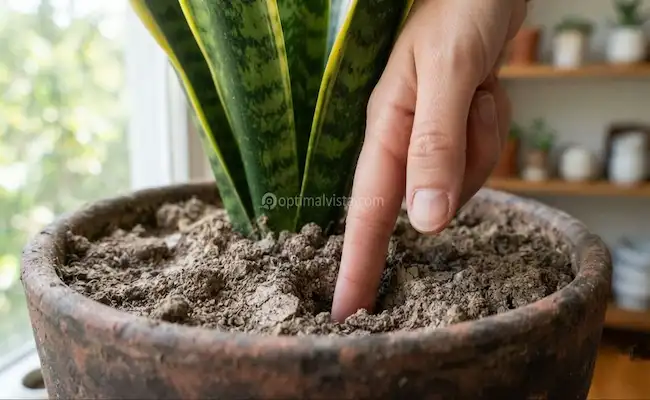
Don’t just water on a calendar. Check first, every single time:
- Stick a finger 2 inches into the soil if it’s still cool or damp, wait.
- Use a cheap soil moisture meter if you don’t like guessing with your finger.
- Lift the pot a dry pot feels noticeably lighter than a freshly watered one.
- Look at the bottom drainage hole; if soil is still dark and clumped there, hold off.
The Right Way to Water a Snake Plant in Cold Weather
Watering snake plant in cold weather isn’t just about frequency, how you water matters just as much.
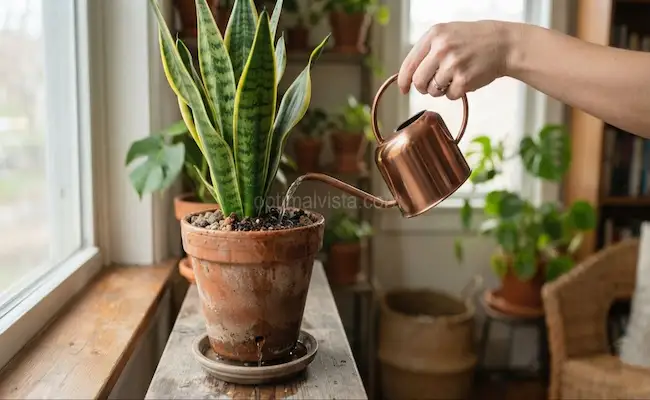
- Soak and dry: water thoroughly until it runs out the drainage holes, then don’t touch it again until the soil is dry.
- Bottom watering: set the pot in a shallow tray of water for about an hour, then drain the excess.
- Spot watering: pour at the base, never into the center rosette where leaves meet, since trapped water there causes rot.
- Skip light sprinkles: a little water every few days does more harm than one deep soak every few weeks.
Water Temperature and Quality
Use room-temperature water, not cold straight from the tap cold water can shock roots that are already slow in winter.
Tap water is fine for most homes; if your water is heavily softened or very high in chlorine, letting it sit out overnight before using it is an easy fix.
Overwatering vs Underwatering: How to Tell the Difference
Both problems can look similar at first glance droopy, sad leaves which is exactly why so many people make the wrong call.
| Sign | Overwatering | Underwatering |
|---|---|---|
| Leaf color | Yellowing, especially at the base | Leaves stay green but dull |
| Leaf texture | Soft, mushy | Dry, wrinkled, brittle |
| Smell | Musty or sour odor from soil | No odor |
| Roots | Soft, brown, falling apart | Firm but shriveled |
| Growth | Wilting despite wet soil | Slow, curling leaf tips |
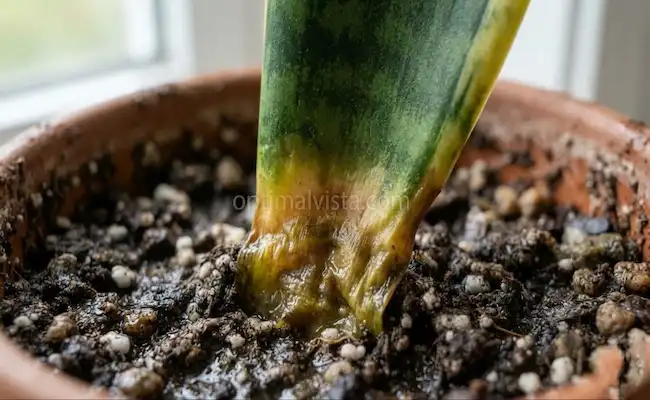
If you’re seeing yellowing along with soft leaves, that combination almost always points to too much water rather than too little.
An Expert-Backed Tip Worth Following
Extension horticulturists and professional growers tend to agree on one point that I’ve come to trust completely: check soil moisture by hand before every single watering instead of trusting a fixed date on the calendar.
Winter conditions shift with every cold snap, every heater cycle, and every gray week with no sun, so the schedule is only ever a rough guide your finger in the soil is the real test.
My Root Rot Rescue Steps
If you’ve already overwatered and the roots are mushy, don’t panic I’ve brought plants back from this exact spot before.
- Pull the plant out and rinse off all the old soil.
- Cut away any brown, soft, or slimy roots with clean pruners.
- Let the remaining healthy roots air-dry for a few hours.
- Repot into fresh, dry, well-draining mix and a clean pot.
- Hold off watering for at least a week after repotting.
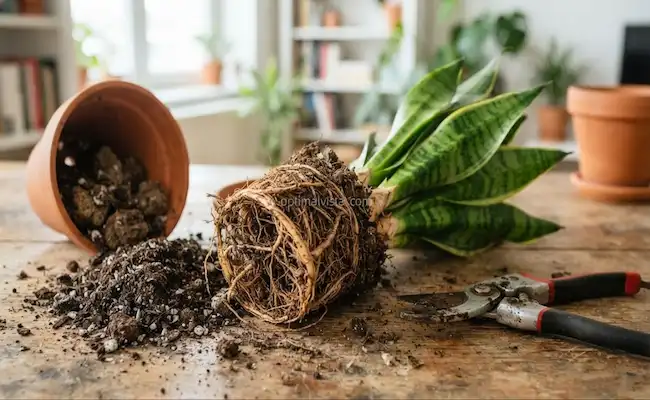
Root rot is driven by fungi and water molds like Pythium and Phytophthora, which move in once soggy soil starves the roots of oxygen a process well documented by university extension plant pathology programs. Toss the trimmed, rotted roots straight in the trash don’t compost them, since the pathogens can survive and spread.
Common Mistakes That Wreck a Winter Watering Routine
- Sticking to a summer schedule out of habit.
- Watering the leaves or center rosette instead of the soil.
- Ignoring drainage holes in the pot.
- Watering in the evening when a cold windowsill keeps soil damp overnight.
- Fertilizing in winter, which pushes growth the plant isn’t ready for.
Does the Variety Change the Watering Frequency?
Not by much. Dracaena trifasciata, the cylindrical variety, and laurentii all store water in the same thick, fleshy way, so how much water snake plant needs in winter stays roughly the same across varieties. The cylindrical type is slightly more drought-tolerant thanks to its rounder, more compact leaves, so you can lean toward the longer end of the 3-4 week range with it.
If you also keep a ZZ plant, the logic carries over almost exactly our guide on ZZ plant winter watering walks through the same soil-check approach with its own numbers.
What About Snake Plants Kept Outdoors?
If you’re a community gardener or just keep pots on the porch, snake plants only survive outdoors year-round in USDA Zones 10 and 11, where winter temperatures rarely drop below 40°F.
In Zones 4, 5, 6, 7, and 8, any snake plant left outside once temps near 32°F needs to come into the house no amount of careful watering saves it from a hard freeze. That’s a big difference from something like potted mums, which can actually shrug off a light outdoor frost; snake plants have zero cold tolerance by comparison.
More Winter Care Tips Worth Doing Alongside Watering
- Keep pots away from cold drafts near backyard-facing windows and doors.
- Use a well-draining mix built for succulents or cacti, not regular potting soil.
- Skip fertilizer completely until new growth shows up in spring.
- Run a humidity tray nearby if your heater dries out the room, though snake plants tolerate low humidity fine.
Much like ZZ plant winter care, keeping the pot away from drafts and skipping the fertilizer matters more than people expect.
Going on a Trip This Winter?
This is honestly one of the best plants to own if you travel. Water it deeply right before you leave, and it’ll comfortably handle 4 to 6 weeks alone with zero attention.
If you’re gone longer than that, ask a neighbor to check the soil once, rather than water it on a fixed date a dry pot on day 42 is fine, a wet one is not.
Final Thoughts:
Getting how often to water snake plant in winter right comes down to one habit: check the soil 2 inches deep before watering, soak it deeply, then let it dry out completely, and treat soft yellow leaves as your first warning sign. Keep the pot away from cold drafts, skip winter fertilizer, and this plant basically takes care of itself until spring. In my experience, most winter losses come from too much care, not too little.