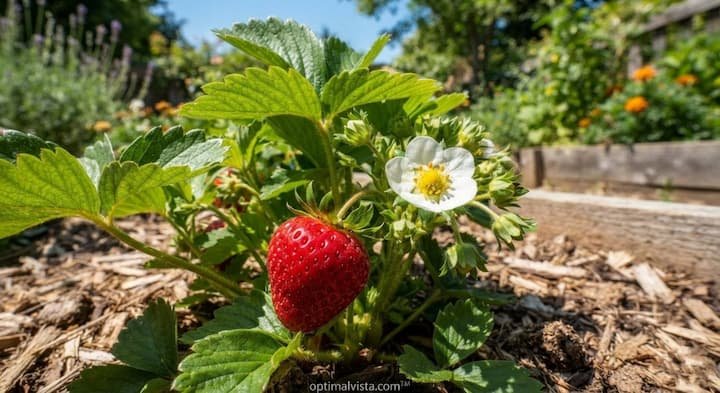
Why do some baskets spill over with red berries while others give you leaves, runners, and maybe three tiny fruits?
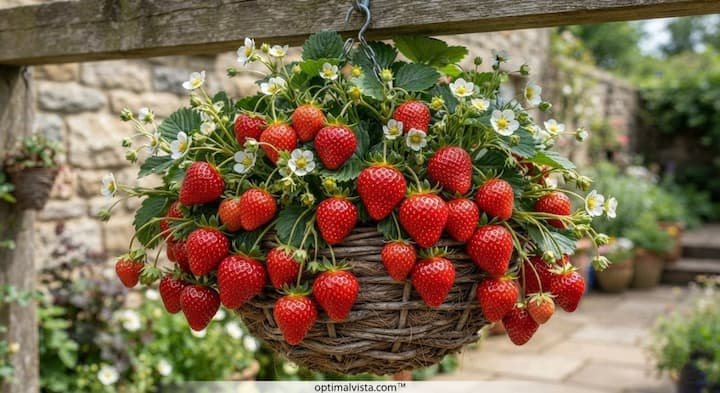
It usually comes down to a few choices made before the first plant goes in. Growing strawberries in hanging baskets keeps fruit clean, saves backyard space, and keeps most slugs out of the picture.
Short answer: yes, it works great when you pick a day-neutral or everbearing type, use a 12 to 14 inch basket, and keep the soil evenly damp. I go through every step in order below, from choosing the basket and hook to feeding, picking, and storing it over winter.
Can Strawberries Really Live in a Basket?
The plants spill over the edge with green leaves, small white flowers, and red berries.
Six things decide the result: a large basket, well-drained compost-rich soil, an everbearing or day-neutral variety, regular runner removal, steady moisture, and 6 to 8 hours of sun.
Why Growing Strawberries in Hanging Baskets Works
Lifting the plants off the ground fixes most of the usual strawberry headaches. If you are a community gardener with a tiny plot, it also gives you a second layer of growing space.
Here is what you get:
- Clean fruit that dangles instead of sitting in dirt.
- Fast drainage, so root rot is rarer, and the soil warms faster in spring.
- Better airflow, so leaves dry quicker.
- Fewer slugs and weevils up high.
- Easy picking without bending.
- Baskets you can move indoors on freezing or scorching days.
- Good results in a small backyard, even with bad native soil, and filling a basket costs far less than a raised bed.
There are trade-offs too:
- Strawberry hanging baskets dry out faster than ground beds.
- Feeding has to happen more often because water washes nutrients out.
- A full basket is heavy, so the hook matters.
Pick the Right Type for Hanging Basket Strawberries
Day-neutral plants flower no matter the day length, so they keep fruiting while temperatures stay between 40°F and 85°F.
| Type | Fruiting | Runners | First-year fruit |
|---|---|---|---|
| Day-neutral | All season, may pause in extreme heat | Many | Yes, about 10 weeks after planting |
| Everbearing | 2 to 3 flushes a year | Fewer | Light, best in year two |
| Alpine | Spring through fall, small berries | Little to none | Yes |
| June-bearing | One crop over 2 to 3 weeks | Lots | One short crop |
Skip June-bearing here, since the runners tangle with nowhere to go. Day-neutral plants make more runners and need extra drainage, while everbearing plants slow down in peak summer heat. This breakdown of June-bearing types against everbearing ones covers the details.
Best Varieties to Try
I like Albion and Seascape because they fruit fast, taste great, and spill nicely over the edge. Other day-neutral picks are Tristar and Diamante.
Everbearing options include Quinault (handles heat), Ozark Beauty (USDA Zones 4, 5, 6, 7 and 8), Ostara, Mara des Bois, Loran, Elan, Temptation, Fort Laramie, and Delizz (USDA Zones 3, 4, 5, 6, 7 and 8).
For alpine, try Alexandria, Mignonette, Ruegen, or Yellow Wonder, which are fragrant, pest-resistant, and packed with flavor. Summer Breeze Deep Rose adds pink color in USDA Zones 5, 6, 7 and 8.
Quick way to choose:
- Fruit all summer: day-neutral.
- Less pruning: everbearing or alpine.
- Shade and top flavor: alpine.
- Pretty flowers: Summer Breeze Deep Rose.
Basket Size, Material and Drainage
Hanging planter strawberries dry out faster than anything in the ground, so go big: 12 to 16 inches wide, 8 to 10 inches deep (roots only reach about 6 inches), and room for 1 to 2 gallons of soil.
In my experience, a 14 inch basket forgives mistakes that a 10 inch one never will. Wire frames with coir liners drain well but dry fast, UV-stabilized plastic holds moisture, some with built-in water reservoirs, and resin looks like terracotta but weighs far less.
Dark colors warm the soil sooner in early spring, and a wide rim keeps soil from spilling. Every basket needs several drainage holes.
For extra moisture, add a second liner cut from an old compost bag that would otherwise go in the trash, with five or six cuts from the edge toward the center so extra water still escapes.
Hooks, Weight and Hanging Height
A watered basket can weigh about 10 pounds, so use chains or wires rated for 15 to 20 pounds and screw the hook into a stud or solid beam, never plain drywall. Heavy-duty hooks, brackets, or a shepherd hook all work.
- Hang baskets at 4 to 6 feet for easy watering and picking.
- Keep them out of walkways.
- Measure how low the basket hangs once the chain is up.
Soil Mix That Works
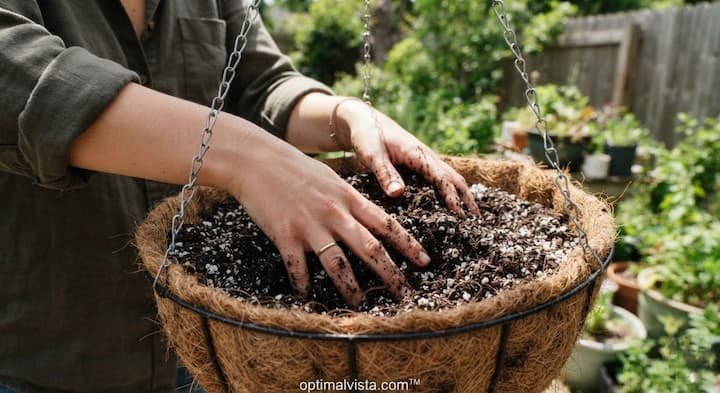
Skip garden soil, since it compacts in a basket, and skip blueberry mixes, which run too acidic. A lightweight mix of 3 parts potting mix (peat or coco coir based), 1 part aged compost, and 1 part perlite or pumice works well.
Another version uses 2 parts compost, 2 parts coco coir, and 1 part perlite. Aim for a pH around 5.5 to 6.5, and see this guide to best strawberry soil for more. Fill the basket halfway to three-quarters before planting, and replace the soil every year, since old mix carries disease.
- Mix in slow-release organic fertilizer such as a 4-6-6 blend, which lasts 8 to 12 weeks, so add a second dose later in warm climates.
- Add worm castings at 10 to 15% of the mix.
- Use limestone only if the pH tests below 5.3
- Put pebbles at the bottom for drainage.
Plugs, Bare-Root Crowns or Seeds
Strawberries are not usually started from seed, so almost nobody should try to grow strawberries in a hanging basket that way. Buy plants instead.
Plugs are pre-rooted, come in four or six packs, cost more, and take off fastest, so beginners do best with them. Bare-root crowns look dead but are just dormant, cost less in bulk, and need careful planting depth.
Best Time to Plant
Plant in early spring once nights stay above 40°F. Day-neutral types work in USDA Zones 4, 5, 6, 7 and 8, with southern gardeners starting earlier.
A basket has a perk here: if frost near 32°F is forecast, carry it into a garage or greenhouse. For a full calendar, see this guide on spring planting.
Planting Depth and Spacing
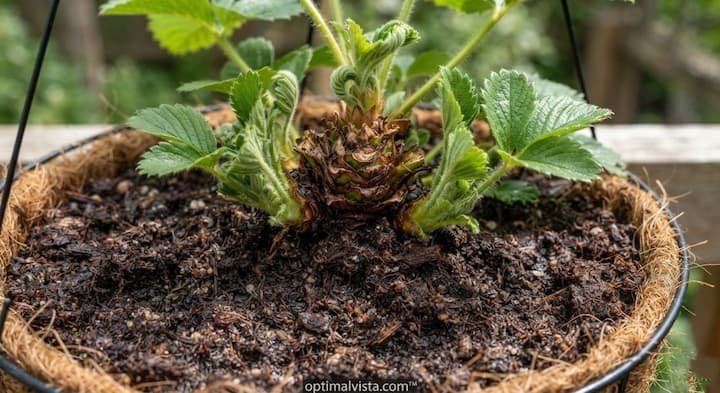
The crown is the thick brown nub where leaves meet roots. Bury it and it rots, leave roots showing and they dry out. Dig a hole about one and a half times the size of the plug or crown, and set the crown about halfway above the soil with all roots covered.
Crowding invites powdery mildew, so resist adding one more plant.
- Plant 3 in a 12 inch basket and up to 4 in a 14 inch one, allowing 6 to 10 inches each.
- Set them around the edge, angled outward so berries spill over.
- Water until it runs out the bottom, then top up any settled soil.
- Pinch off blossoms for the first 4 weeks on day-neutral plants to build roots.
Sunlight and Location
Hanging basket strawberries want 6 to 8 hours of direct sun, and morning light is best. In the Northern Hemisphere, a south-facing porch or deck is the sweet spot. Too little light shows up as pale leaves and few flowers.
- Hang baskets on the outer edge of the porch, not the shady inner part.
- Where summers top 90°F, give light shade in late afternoon, since flowering stalls above 85°F.
- Alpine types are fine with 4 to 6 hours of partial shade.
- Block strong wind, and avoid white walls, concrete, and metal siding that bounce heat.
How Much Water They Need
I think the finger test beats any schedule. Push a finger 1 to 2 inches into the soil. If it is dry, water at the base until it runs out the bottom for about 30 seconds.
Most weeks, every few days is enough, but hot weather can mean daily or twice daily watering. Baskets under a porch roof get no rain, so check them even in wet weather.
See this guide to watering strawberries for more:
- Yellow leaves usually mean too much water, and crispy leaves mean too little.
- A hose wand reaches high baskets, and drip lines suit more than 3 or 4 baskets.
- Reservoirs, double liners, mulch, and bigger baskets all cut watering.
Mulch Your Basket
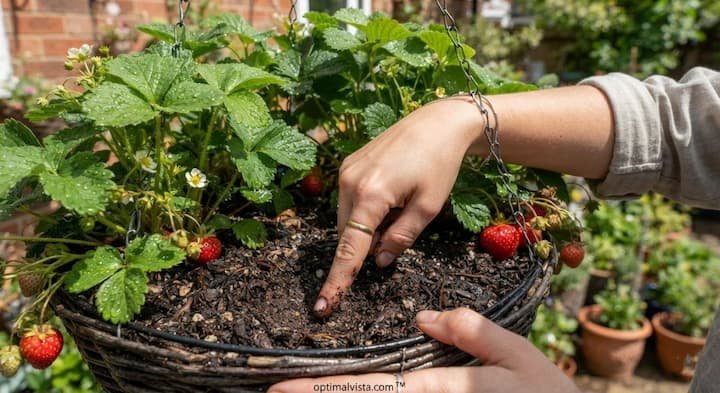
A 1 to 2 inch layer of straw makes a big difference. Baskets hold little soil, so they heat and cool fast, and straw cushions those swings. Keep a 1 inch gap around each crown so it can breathe. Mulch also keeps berries clean and helps plants overwinter.
Feeding Schedule for Strawberry Hanging Baskets
Nutrients wash out with every watering, so feeding matters. Some growers feed weekly with a light dose and others every 2 weeks. For product picks, see the best strawberry fertilizer.
- At planting: slow-release or all-purpose organic food, plus diluted kelp or fish emulsion.
- At first flowers: switch to a liquid tomato feed with ratios like 5-10-10 or 3-4-6, mixed at half strength, then repeat every 10 to 14 days until picking ends.
- Always water first, since fertilizer on dry soil burns roots.
- Stop 2 weeks before the first fall frost.
Avoid quick-release nitrogen, which gives lots of leaves, few flowers, and sometimes scorched plants. Liquid feeds work faster than granular ones but need more frequent use. Alternate synthetic and organic feeds, and add calcium and magnesium if you water with rainwater.
Runner Control and Pruning
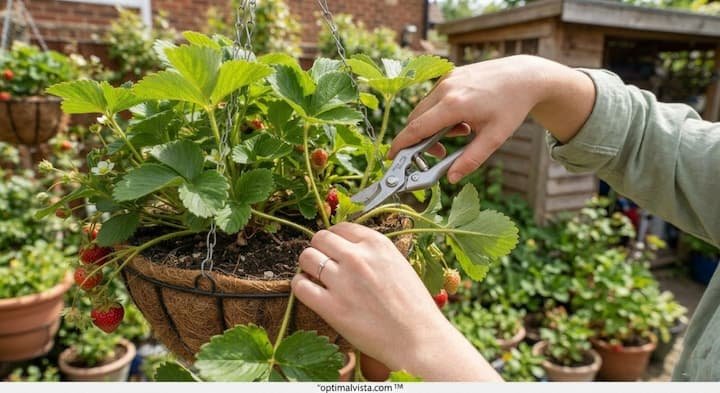
Runners are long, leafless stems with a baby plant at the tip, and in a basket they steal energy from fruit. Snip them at the base with clean,
pruners and check weekly in summer. Alpine types make almost none, but divide their clumps each year if you overwinter them. Also remove dead leaves to improve airflow. My pruners hang on a hook beside the basket, so the weekly check takes about 5 minutes.
- For free plants, let 1 or 2 runners root in small pots after the main harvest in late summer, then cut them free, as shown in this guide on strawberries from runners
- Young plants: cut runners with sharp, clean pruners.
- Older plants: just snap them off by hand.
- Spot them early, since runners vine away on extra-long stems instead of cascading down.
- Day-neutral types send out more runners than everbearing ones, so check them more often.
Pollination and Companion Flowers
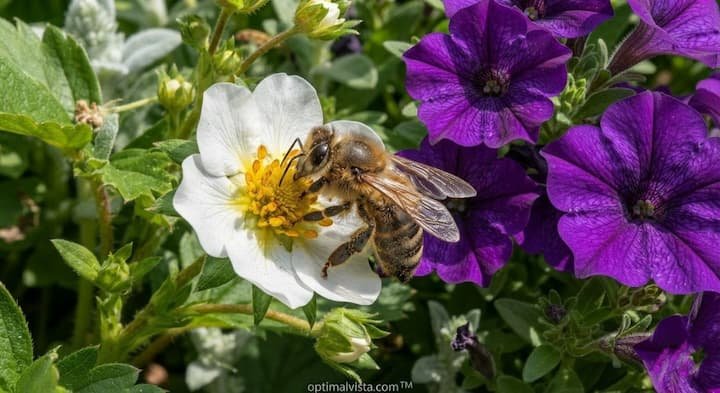
Every flower must be pollinated to become a full berry, and one berry is built from up to 200 tiny fruits called achenes. Research shows each flower needs roughly 16 to 25 bee visits to fully develop (ScienceDirect study).
These strawberry companion plants bring bees in. Honeybees and bumblebees rarely sting, but keep baskets away from doorways.
- Hang alyssum, lantana, calibrachoa, lobelia, or purple-blue petunias nearby.
- Large shrubs like bee balm, coneflower, milkweed, and goldenrod also work.
- With no bees around, brush each flower softly by hand.
Common Pests and Diseases
Baskets dodge many problems, but not all. Here is what to watch for:
- Aphids and spider mites: wash off with water, then use insecticidal soap.
- Vine weevils, slugs, and snails: rare up high, but check the rim and treat notched leaf edges early.
- Birds: net the basket as berries color up, using these bird protection tips.
- Powdery mildew and gray mold: space plants and water at the base.
- Crown and root rot: caused by deep planting and poor drainage.
Quick Fixes for Common Problems
Even a well-planted basket acts up sometimes. Most problems trace back to sun, water, or feed, and the signs can look alike. Check the leaves, soil, and flowers before changing anything.
The table below pairs each problem with its likely cause and a quick fix, so you can match what you see and act right away.
| Problem | Likely cause | Fix |
|---|---|---|
| No fruit | Too little sun, heat above 85°F, too much nitrogen | Move to 6 to 8 hours of sun, shade late afternoon |
| Small, sour berries | Crowding, uneven water, low feed | Thin to 3 plants, water steadily, feed from first flowers |
| Yellow leaves | Overwatering | Let the top inch dry, check drainage |
| Crispy leaves | Underwatering or heat | Water deeper, add mulch |
| Afternoon wilting | Heat and fast drying | Give a midday drink, add light shade |
| Misshapen berries | Weak pollination | Add bee flowers, pollinate by hand |
| Lots of leaves, few flowers | Too much nitrogen | Switch to tomato feed |
Still stuck with fruit that tastes off? Read about small sour strawberries.
Harvesting Ripe Berries
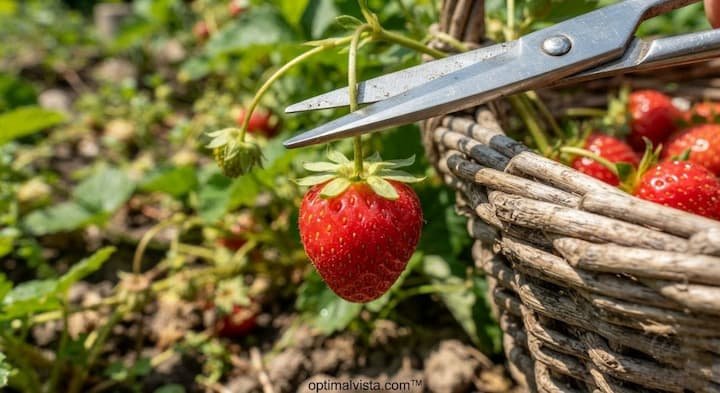
Pick only fully red berries, because strawberries do not ripen after picking. Go out in the cool morning, check every day or two at peak, and snip the stem just above the berry with scissors.
Day-neutral plants often give first berries about 10 weeks after planting. For timing details, see how to harvest strawberries.
- Expect a handful or two at a time, not a bucket.
- Keep unwashed berries in the fridge and eat them within a few days.
- Freeze extras whole on a tray.
Overwintering and Reusing Your Basket
Strawberries are perennials, so you do not have to toss the basket in the trash after fall. Leave it hanging until the leaves brown, then move it to a garage or shed that stays just above 32°F.
Check the soil monthly and water lightly. They are perennial in USDA Zones 4, 5, 6, 7 and 8, and plants live around 6 years but slow down after 3. Containers frost sooner than the ground, so watch fall nights, and second-year plants fruit earlier and heavier.
- Trim dead leaves and cover the basket with a thick layer of straw.
- Bring it back out after the last spring frost, feed it, and wait for leaves in late spring.
- Or start fresh each year with day-neutral plants, which fruit the first year.
Heat, Balcony and Frost Situations
In hot climates, give afternoon shade, add extra mulch, water twice a day, and favor heat-tolerant Albion or Quinault. In a heat wave, move baskets into shade and water at midday.
On a balcony with low light, you can still grow strawberries in a hanging basket using alpine types and a grow light. Bring baskets in or cover them when 32°F or lower is forecast. For a budget start, one plastic basket, potting mix, three plugs, and a bottle of tomato feed is plenty.
Common Mistakes to Avoid
I made the crowding mistake in my first summer, with five plants in one basket, and the berries came out small. Here are the slips to skip:
- Choosing June-bearing plants.
- Using a basket under 12 inches or one with no drainage holes.
- Burying the crown.
- Letting runners run wild.
- Feeding quick-release nitrogen.
- Hanging the basket in shade or wetting the leaves.
- Trusting a weak hook, since hanging planter strawberries can weigh about 10 pounds after watering.
Final Thoughts:
Growing strawberries in hanging baskets is mostly about setup. Choose a big basket, a day-neutral or everbearing type, loose soil, and a sunny spot, then water steadily and snip runners. Do that and you will be picking sweet berries by the front door for months. Start with one basket this spring and add more once you see how easy it is.