Why does one gardener swear Epsom salt for pepper plants doubled their harvest while the next says it did nothing at all?
Both can be telling the truth. It comes down to one mineral, one soil number, and a few dosing details most guides skip. Here’s how to figure out which kind of gardener you are before that bag ever leaves the shed.
What Epsom Salt Actually Is and Isn’t
Epsom salt is hydrated magnesium sulfate, and it has nothing in common with table salt.
By weight it’s about 10% magnesium and 13% sulfur, secondary nutrients in the same group as calcium.
The name comes from the English town of Epsom, where it was first found. Drugstore and garden center bags hold the same stuff, which is why magnesium sulfate for peppers costs only a few bucks.
What Magnesium and Sulfur Do Inside a Pepper Plant
Magnesium sits at the center of every chlorophyll molecule, so a plant that’s short on it can’t make enough green pigment to run photosynthesis.
Peppers show magnesium trouble faster than beans or lettuce do.
That’s why Epsom salt on pepper plants can look like magic in one backyard and do nothing in the next.
- Magnesium: builds chlorophyll, helps roots take in phosphorus and nitrogen, and moves to new growth when supplies run low.
- Sulfur: builds proteins and enzymes, adds flavor in hot peppers.
Does Epsom Salt for Peppers Really Work? What the Research Says
Short answer: only when the soil is low in magnesium. NDSU Extension points out that Epsom salt has no calcium at all, and that extra magnesium in the soil competes with calcium for uptake into the plant, which can make blossom end rot worse.
So any trial showing bigger peppers was most likely run in low-magnesium soil.
Small home-garden tests, like the one often credited to the National Gardening Association, can’t tell you what each soil started with, and I think that’s the honest way to read the hype.
Signs Your Pepper Plants Are Short on Magnesium
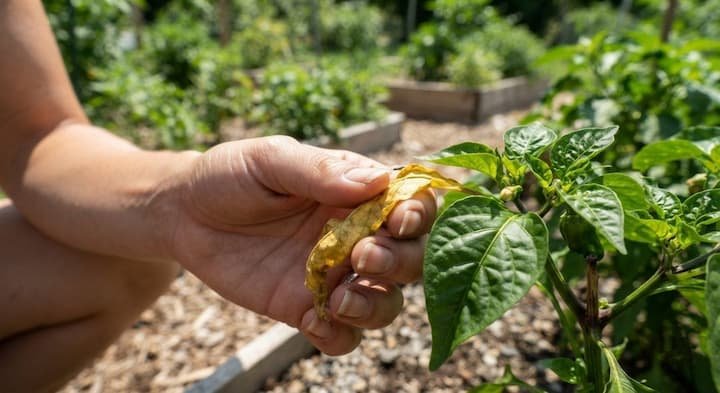
Magnesium moves around inside the plant, so the oldest leaves at the bottom show trouble first:
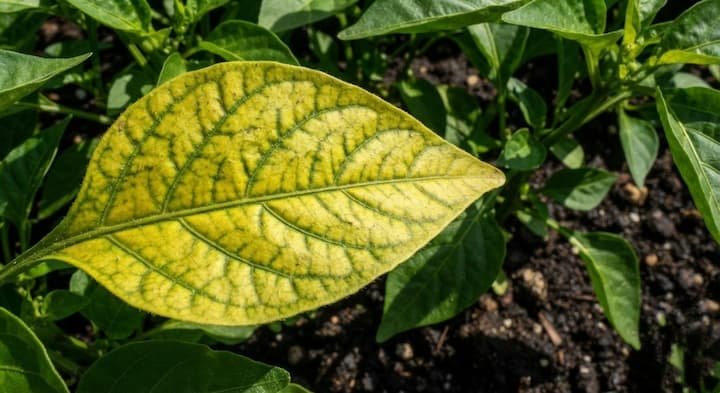
- Yellow tissue between the veins while the veins stay green.
- Lower leaves first, top growth still fine.
- Leaf edges rolling upward in hot weather or heavy fruiting (more on curling pepper leaves).
- Lower leaves dropping early, leaving bare stems.
- Pale color, stunted growth and few blossoms by midsummer.
- Small, curly leaves, especially in pots.
- Smaller fruit and slow ripening late in the season.
The veins stay green because chlorophyll in vein tissue outlasts the cells around it, and the plant pulls magnesium from old leaves to feed new growth.
Is It Magnesium? Lookalike Problems That Fool Gardeners
Yellow leaves have a dozen causes. Throwing Epsom salt on peppers that really have a watering problem just adds salt to a wet mess.
| Problem | What you see | Where it starts |
|---|---|---|
| Magnesium shortage | Yellow between green veins | Older, lower leaves |
| Nitrogen shortage | Whole leaf yellows evenly | Lower leaves, then upward |
| Iron shortage | Yellow between veins | Newest top leaves |
| Overwatering | Limp, soft, yellow leaves and wet soil | Lower leaves |
| Phosphorus shortage | Purple tint on stems and leaf undersides | Stems and undersides |
| Potassium shortage or salt burn | Brown, scorched leaf edges | Edges all over the plant |
| Root rot | Stunted growth, wilting, soft stem base | Wet soil, stem base |
| Spider mites | Fine speckling and tiny webs | Leaf undersides |
| Sunscald | Bleached patches | Sun-facing side only |
| pH lockout | Looks like a magnesium shortage, but sprays do nothing | Lower leaves |
Old leaves first points to magnesium, and new leaves first points to iron or soil pH. If the soil stays soggy, fix your watering pepper plants routine first.
How to Test Your Soil Before You Add Anything
A soil test is the only way to know your real numbers. Your county Cooperative Extension office usually runs one for about $15 to $30, and the report lists magnesium, calcium, potassium and pH.
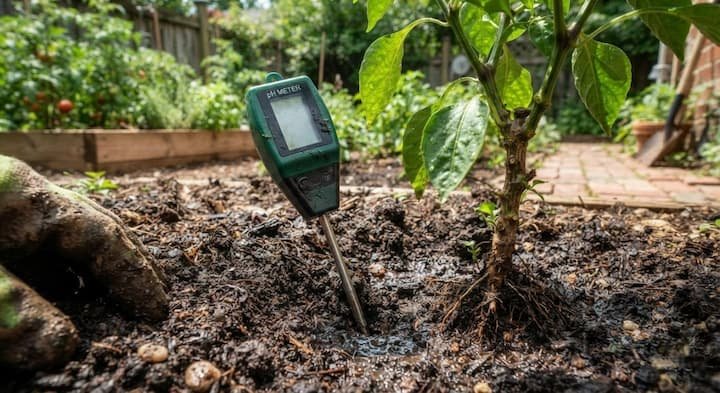
Labs rate magnesium low, medium or high, so go by your report. Magnesium that’s high next to calcium is a reason to skip Epsom salt, since 3 to 5 parts calcium to 1 part magnesium is a common target. Peppers want a pH between 6.0 and 6.8, so aim for that in any pepper soil mix.
Also check your fertilizer for peppers, because many balanced mixes already list magnesium.
No lab nearby? I like a side-by-side trial because it costs nothing. Treat one of two matching plants using the amounts in the table below, leave the other alone, and compare the color of new growth after 4 weeks, not the old leaves.
Here’s the whole decision in order:
- Spot symptoms, rule out lookalikes.
- Test magnesium and pH.
- Apply only if magnesium is low.
- Wait 2 weeks, judge new growth.
- No change? Recheck pH.
When to Skip Epsom Salt Entirely
Sometimes the best move is leaving the bag alone. Acidic soil needs dolomite lime instead, and soil above pH 7.0 locks up iron, manganese and zinc.
Skip Epsom salt when:
- Your test shows enough magnesium, or you haven’t tested at all.
- Blossom end rot is active.
- Soil pH is below 6.0, which needs fixing first, or above 7.0, as in many Southwest and Great Plains yards, where magnesium is usually plenty.
- Your fertilizer label already lists magnesium.
- Your clay or compost-rich bed already grows healthy plants.
How to Use Epsom Salt for Pepper Plants
Four methods work. A foliar spray is the fastest, drenches and side-dressing are slower, and the planting hole is for prevention.
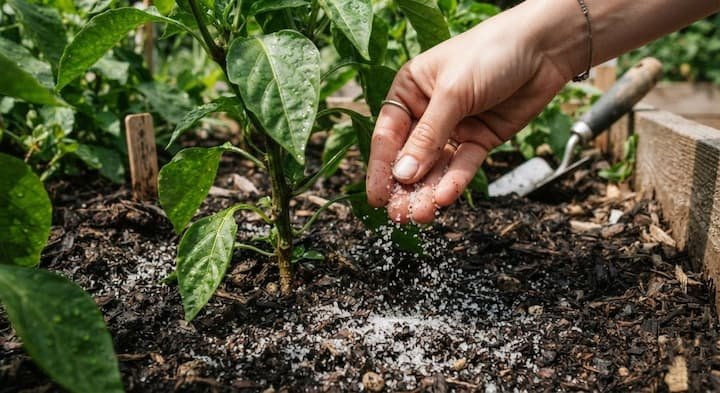
- Planting hole: mix 1 tbsp into the bottom of each hole under a thin layer of soil, never in a pile, so roots don’t touch the salt. In pots, mix it into the potting mix before planting.
- Foliar spray: 1 tbsp per gallon, absorbed through the leaves so root competition doesn’t matter (recipe next).
- Soil drench: 1 tbsp per gallon, poured on pre-watered soil (dry soil concentrates salt at the roots) until it drains from a pot’s bottom.
- Side-dressing: 1 tbsp per foot of plant height, scratched into the top inch of soil and watered in, starting once new leaves appear.
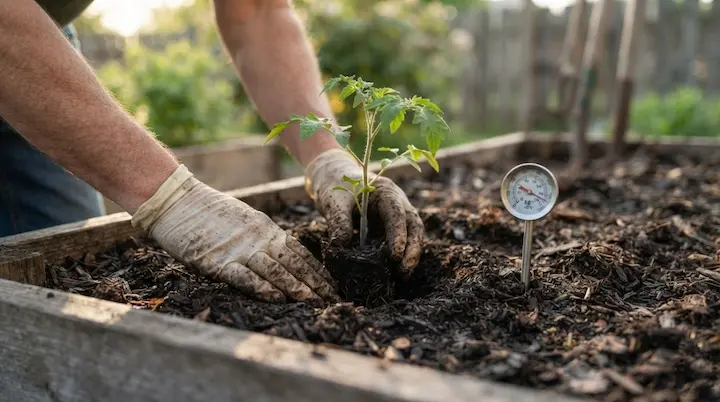
Soil temperature matters. Roots take up little magnesium when the ground is under 55°F, so a drench on a cold transplant mostly goes to waste. Check when to plant first.
Foliar Spray Recipe: Dose, Timing and the Soap Mistake
Here’s the spray I use: 1 tbsp Epsom salt in 1 gallon of room-temperature water, fully dissolved. Skip the dish soap. It doesn’t help leaves absorb magnesium, and it can burn them.
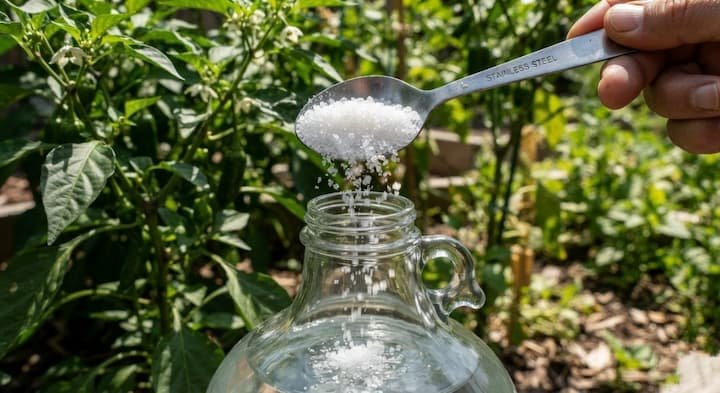
Recipes calling for 2 tbsp per gallon are double strength, and that’s a quick way to scorch leaves in summer. Some gardeners quit foliar sprays after burning leaves, usually from strength or midday sun. If that’s you, use a drench.
You can also spray ½ tbsp per gallon every week, for the same total magnesium in smaller doses.
- Spray early morning or late afternoon, never in midday sun.
- Skip it when the temperature hits 85°F or higher.
- Repeat every 2 weeks while symptoms show, then stop once new growth stays green.
- Rain within 2 to 3 hours washes it off, so pick a dry day.
Nothing shows for the first 3 days. By days 7 to 14, new leaves come in greener, and by weeks 2 to 4 flowers and fruit pick up. That’s with a spray, while drenches take 2 to 4 weeks and a planting-hole dose 3 to 6 weeks.
Old yellow leaves rarely recover, so judge by new growth. Clip badly damaged leaves with clean pruners (see how to prune pepper plants).
Soil Drench, Side-Dress and Planting-Hole Amounts
The right amount depends on the plant’s stage and pot size, so here it is in one place. Seedlings get a tiny dose, transplants get one dose at planting, and established plants get a spray, drench or side-dress on a schedule.
| Stage or setup | Amount | How often |
|---|---|---|
| Seedlings with true leaves (only if yellowing) | ¼ tsp per gallon, light drench | Every 2 to 3 weeks |
| Transplant hole | 1 tbsp per hole | Once |
| Foliar spray | 1 tbsp per gallon | Every 2 weeks, max 3 sprays |
| Soil drench, beds and in-ground | 1 tbsp per gallon | Every 4 to 6 weeks |
| 5-gallon pot | ½ tbsp in ½ gallon of water | Every 4 to 6 weeks |
| 10-gallon pot | 1 tbsp in 1 gallon of water | Every 4 to 6 weeks |
| Side-dress | 1 tbsp per foot of plant height | Monthly at most |
| Active fruiting | Foliar spray only if symptoms persist | Stop once new growth is green |
Weekly soil applications are too much, since salt builds up faster than plants use it. This is a fix, not a routine.
Season Timeline by USDA Zone
In USDA Zones 4 and 5, transplanting usually lands in late May or early June. USDA Zones 6, 7 and 8 get going from late April through mid-May.
In Zones 9 and 10 you can plant in March, and the wind-down comes in fall instead of late summer. In frost-free pockets peppers live as perennials, so repeat the schedule yearly.
Here’s the season cheat sheet:
- Transplant: after your last frost, soil above 55°F; add the hole amount only in sandy, acidic or pot setups.
- Weeks 4 to 8: watch the lower leaves and start sprays if yellowing shows.
- First bloom: one spray at the first flowers and another 10 days later, if your soil is low.
- Heavy fruiting: spray only if symptoms continue, since calcium matters most now.
- 6 weeks before frost: stop everything and let fruit ripen before the first fall freeze at 32°F.
Containers vs Raised Beds vs In-Ground and Different Pepper Types
Containers lose magnesium fastest, because every watering pushes nutrients out the drainage holes, and peat or coco coir mixes start out low. Raised beds drain faster than native soil, so they sit in the middle (see raised bed spacing for the layout).
In my own raised bed, heavy on compost, the leaves stay green without any help. In the ground, test first, since extra magnesium is hard to flush out of a backyard bed.
Sandy southeastern, acidic Pacific Northwest and weathered soils run low most often, while clay with compost rarely does. If you’re a community gardener on a shared plot, ask the coordinator whether anyone tested the soil.
- Bell peppers: heavy fruit loads, more prone to blossom end rot, so spray only when yellowing is clear. Pot growers, see bell peppers in pots.
- Jalapeños, cayennes and serranos: handle swings better, and the first-bloom spray fits them well. See jalapenos in pots.
- Superhots like Carolina Reaper: long 120 to 150 day seasons drain pots, so spray lightly every 2 to 3 weeks.
- Indoor plants: if you overwinter pepper plants, use ½ tbsp per gallon every 2 to 3 weeks and refresh the mix yearly, since old mix is the real culprit.
Why Epsom Salt Sometimes Does Nothing
Sometimes the magnesium is there and the plant can’t reach it:
- Soil pH below 5.5 or above 7.5 locks magnesium up.
- Cold soil under 55°F slows roots.
- Too much potassium crowds magnesium out.
- Salt buildup in pots shuts down nutrient uptake.
- Waterlogged or fertilizer-burned roots can’t take up much of anything.
- Hard tap water and compost-heavy beds often carry enough magnesium already.
- Epsom salt for peppers can’t fix a nitrogen, iron or watering problem.
If new growth stays yellow after 2 or 3 sprays, test pH before adding more. In a pot, flush with 2 to 3 times the pot volume in plain water, wait a week, then try again.
Scrape any white crust off the soil surface and send it to the trash. Salt buildup also dries out roots, so flush pots now and then with plain water.
Myths About Epsom Salt on Peppers: Slugs, Seeds and Taste
- Slug control: no solid evidence it works, and salt piles hurt soil.
- Germination: seed-starting mix already feeds seedlings, and salt on seeds dries them out. I’ve never needed it before true leaves.
- Taste and heat: heat comes mostly from the variety and growing stress, not sulfur.
- Pests and disease: it’s not a cure-all, so keep scouting for aphids.
- Soil pH: Epsom salt is close to neutral and doesn’t move pH.
- “You can’t overuse it”: in pots, salts pile up fast and block calcium.
Overusing Epsom Salt on Pepper Plants and Blossom End Rot
Blossom end rot shows up as a dark, sunken patch on the bottom of the fruit. It’s a calcium delivery problem, usually tied to uneven watering.
Epsom salt has no calcium, and extra magnesium competes with it at the roots, so adding it while rot is active makes things worse. Even out your watering and keep pH between 6.0 and 6.8, and add calcium only if a soil test calls for it.
Signs you’ve overdone it:
- Blossom end rot that wasn’t there before
- Crusty white salt on the soil and stunted growth
- Scorched leaf edges after midday sprays
- Very dark leaves, slow growth and wilting in wet soil
To fix it, follow these steps:
- Stop all Epsom salt right away.
- Flush a pot with 2 to 3 times its volume in plain water and let it drain fully.
- In the ground, water deeply a few times over a week.
- Skip extra feeding for 4 to 6 weeks and judge by new growth.
Epsom salt won’t revive a dying plant unless low magnesium is the cause, so rule out root rot and cold damage first.
Flowers dropping? That’s usually heat, with days over 90°F or nights over 75°F, not magnesium. Keep the bag away from kids and pets, and keep overspray off beans, which don’t need extra magnesium.
Magnesium Sulfate for Peppers vs Cal-Mag, Dolomite and Compost
- Epsom salt: fast, cheap, no pH change, no calcium. It wins when a test shows low magnesium and fine calcium.
- Cal-Mag: supplies both and suits pots and soft water. It already has magnesium, so use one or the other. It costs more, about $15 to $30 a bottle.
- Dolomite lime: raises low pH while adding calcium and magnesium, so skip it in neutral soil.
- Sul-Po-Mag: adds potassium and sulfur too, for soils low in all three.
- Compost and worm castings: slow and gentle, good for building soil, not for a quick fix.
Epsom salt mixes fine with fish emulsion if you dissolve each one separately first, but it never replaces a complete fertilizer. Buy plain, unscented Epsom salt that’s pure magnesium sulfate, with no dyes or oils.
A 4-pound bag runs a few bucks and covers a backyard patch for several seasons, and I’d skip any fancy “plant formula” markup. Keep the bag dry and sealed.
It’s fine for most home organic gardens, but certified growers should check with their certifier.
Should You Use It? The Bottom Line
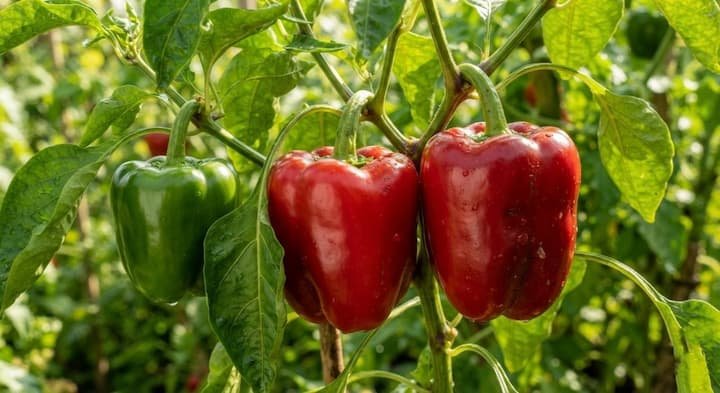
Epsom salt for pepper plants works like a repair tool, not a routine. Check the lower leaves, test your soil, and spray only when the signs and the numbers agree. When they do, a few bucks of magnesium sulfate gives you greener growth and better fruit. When they don’t, leave the bag in the shed and fix the watering or pH instead.