Yellow leaves showing up overnight can send you straight to Google I’ve panicked over the same thing in my own living room.
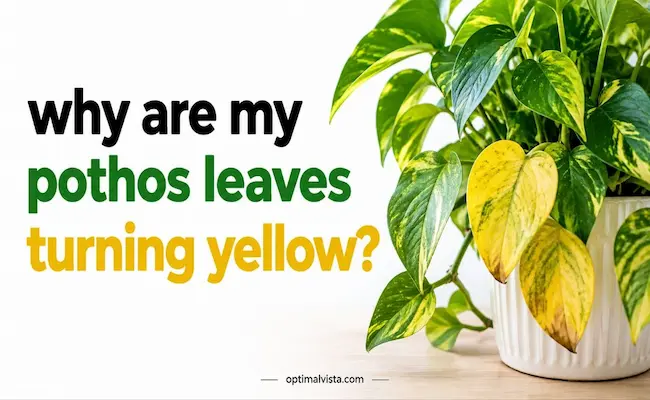
The truth is, why are my pothos leaves turning yellow has more than one answer, and the fix depends entirely on the cause. Let’s break down each one.
First, Check Your Pothos Variety
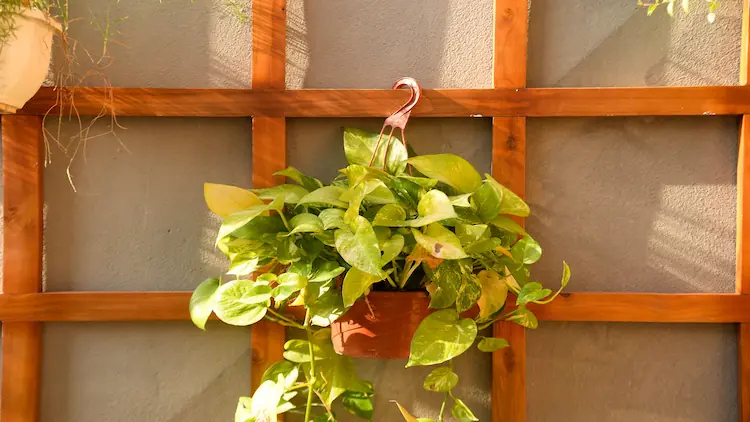
Before assuming something’s wrong, check which pothos you own. Some varieties come with pothos yellow leaves built into their natural color, not as a warning sign.
- Golden Pothos: yellow marbling on dark green is just its genetics.
- Neon Pothos: the whole leaf is naturally chartreuse-yellow.
- Marble Queen: creamy white and pale-yellow patches are normal.
If new growth comes in solid pale yellow with no green at all, that points to a light problem, covered below.
What’s Actually Happening Inside a Yellowing Leaf
A yellow leaf isn’t a disease itself it’s a symptom. Every leaf holds chlorophyll, the pigment that captures light and gives pothos its green color. Under stress, the plant breaks chlorophyll down faster than it can rebuild it, and the yellow pigment underneath shows through.
The pattern tells you more than the color:
- Solid, uniform yellow usually water or light.
- Yellow with green veins (interveinal) usually a nutrient issue.
- Blotchy or stippled yellow usually pests or disease.
Keep this pattern in mind as you go through the causes below.
Quick Diagnosis Table
| What You See | Likely Cause | First Step |
|---|---|---|
| Soft, mushy leaves; wet soil | Overwatering / root rot | Check roots, let soil dry |
| Crispy edges; bone-dry soil | Underwatering | Water deeply with 1 gallon |
| Bleached patches facing window | Sun scorch | Move back 2–3 feet |
| Slow yellowing; tiny new leaves | Low light | Move closer to a window |
| Only bottom 1–2 leaves yellow | Natural aging | No action needed |
| New leaf yellow, veins green | Iron deficiency | Add a micronutrient feed |
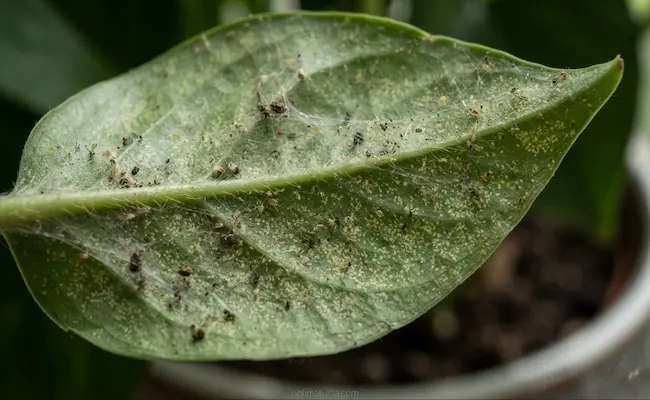
| Mottled spots, fine webbing | Pests | Check leaf undersides |
| Yellow edges, white soil crust | Salt buildup | Flush the pot with water |
Why Are My Pothos Leaves Turning Yellow? The Big Three
If you’ve been searching pothos plant turning yellow, check these three first they cause most cases.
- Overwatering: The number one cause I run into. Pothos roots need oxygen as much as water. Once soil stays soggy, oxygen exchange stops and roots suffocate within a day or two, showing up as soft, yellowing leaves (Extension’s plant database).
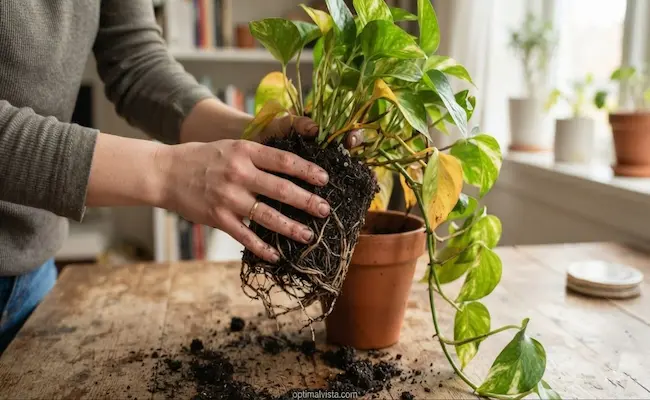
- Root rot: The serious end of overwatering. Roots turn black, mushy, and often smell sour. If less than a third of the root ball is affected, trim the rot and repot; if worse, see the rescue plan below.
- Underwatering: Leaves droop first, then yellow with crispy brown tips. Soil pulls away from the pot sides and feels light. Water thoroughly until it runs from the drainage holes roughly half a gallon for a 6-inch pot.
Light, Temperature and Water Quality Problems
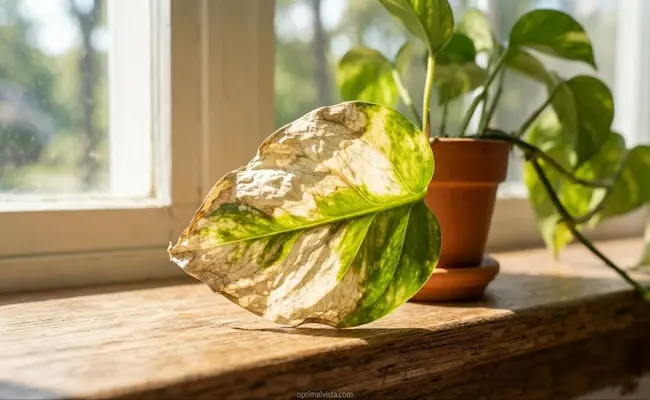
- Too much direct sun: Bleached yellow or white patches on sun-facing leaves. Move the pot 2–3 feet back or add a sheer curtain.
- Too little light: Slow yellowing plus small new leaves, usually when the pot sits more than 8 feet from any window. A grow light for 10–12 hours a day helps.
- Temperature swings: Pothos prefer 65°F to 85°F. Drafts below 50°F can turn leaf edges yellow and black.
- Water quality: Chlorine and softening salts build up over time. I let tap water sit uncovered for 24–48 hours before using it it’s made a real difference for my own plants.
Nutrients, Salt Buildup and Toxicity
Yellowing pothos leaves often trace back to the soil, not the watering schedule.
- Nitrogen deficiency: older, bottom leaves yellow first while new growth stays green.
- Iron deficiency (chlorosis): new leaves yellow, veins stay green; a pattern documented by University of Wisconsin–Madison Extension.
- Magnesium deficiency: yellowing starts at the leaf center and spreads outward.
- Salt buildup: white, crusty film on soil; flush with water equal to the pot’s volume, two or three times.
- Manganese toxicity: less common; yellow spotting followed by leaf drop, usually from micronutrient-heavy fertilizer.
Pests Behind Pothos Leaves Turning Yellow
Sap-sucking insects drain chlorophyll unevenly, so damage looks patchy rather than solid yellow.
- Spider mites: fine webbing near leaf joints.
- Mealybugs: white, cottony clumps in leaf axils.
- Scale: small brown bumps along stems.
- Thrips: silvery streaks alongside yellow patches.
Isolate the plant, wipe leaves with rubbing alcohol, then follow up with neem oil or insecticidal soap every 7–10 days for three rounds.
Pot Size, Soil and Transplant Shock
A rootbound plant roots circling the pot or escaping the drainage holes can’t pull up water efficiently, causing yellowing and stalled growth. Repot into a container 2 inches wider and loosen the roots first.
Pot material matters too. Glazed or plastic pots with no drainage holes trap water; a well-draining mix with added perlite fixes this. I cover the full soil and pot setup in my pothos plant care guide.
Recently repotted? That’s transplant shock repot in spring or summer, water well before and after, and expect 1–3 weeks of recovery.
Disease: Bacterial Leaf Spot and Bacterial Wilt
Bacterial leaf spot shows up as water-soaked lesions ringed with yellow halos, usually in high humidity. Remove affected leaves with clean pruners and avoid wetting the foliage. Bacterial wilt is rarer and mostly affects commercially propagated cuttings, not home-grown plants.
Natural Aging vs. an Actual Problem
One or two bottom leaves yellowing occasionally is normal the plant retires old growth to fund new leaves. If only the lowest leaves are affected and everything else looks healthy, there’s nothing to fix.
Step-by-Step: How I Diagnose Yellowing Pothos Leaves
- Push a finger 3 inches into the soil to check moisture.
- Slide the plant out and inspect the roots.
- Note the yellowing pattern uniform, patchy, or veined.
- Check which leaves are affected, old or new.
- Flip leaves and look for pests.
- Check distance from windows, vents, or doors.
- Recall your last fertilizing date.
Pruning, the One-Third Rule, and Regrowth
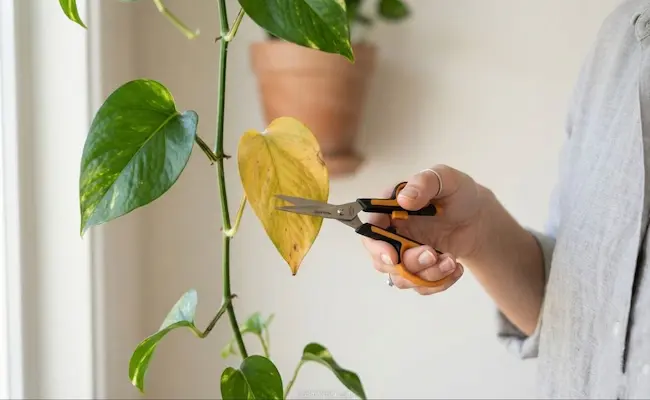
Never remove more than one-third of a pothos’s leaves at once it needs enough foliage left to keep producing energy. Use clean pruners, cut at the leaf base, and toss diseased leaves in the trash rather than the compost pile.
A yellow leaf won’t turn green again chlorophyll breakdown is one-way. Fix the cause and new growth should come in green within two to four weeks.
Rescue Plan for a Badly Damaged Plant
If more than half the leaves are yellow or mushy and the stem base has gone black, don’t give up. Cut healthy stem sections from above the damage and propagate them in water or moist soil; new roots typically form within 2–4 weeks.
If you own a Marble Queen, I’ve laid out the exact steps in how to propagate Marble Queen pothos.
Seasonal Watering Schedule
Watering needs shift with the seasons, and this is where most people go wrong.
| Season | Watering Frequency | Notes |
|---|---|---|
| Spring / Summer | Every 7–10 days | Water when top 1–2 inches feel dry |
| Fall | Every 10–14 days | Growth slows as daylight shortens |
| Winter | Every 2–3 weeks | About 1 cup for a 6-inch pot |
I’ve written a more detailed breakdown of cold-season adjustments in my pothos winter care guide.
Keeping Your Pothos Healthy Long-Term
- Water only when the top 1–2 inches of soil are dry.
- Feed a balanced fertilizer monthly in spring and summer; skip fall and winter or go organic with worm castings as fertilizer.
- Repot every 1–2 years into a pot 2 inches wider.
- Wipe dust off leaves monthly so they can photosynthesize properly.
- Keep the plant away from cold drafts and vents below 50°F.
- Community gardeners growing zucchini and eggplant in the backyard have likely seen this same soggy-soil yellowing on seedlings houseplants react the same way.
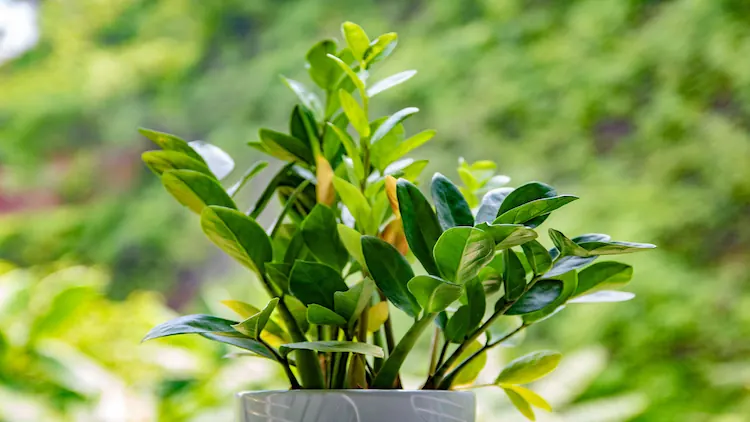
Pothos is a favorite centerpiece for shelves and windowsills because it’s forgiving, but not invincible. If you also keep a ZZ plant, don’t assume the same cause I cover that separately in why is my ZZ plant leaves turning yellow, since it stores water in its roots differently.
The same goes outdoors: why marigold leaves turn yellow usually comes down to soil pH, not light a reminder that yellowing rarely means the same thing across plants.
Most of us across USDA Zones 4 through 8 grow pothos indoors year-round anyway, so this has nothing to do with your outdoor climate zone it’s about what’s happening inside the pot.
Final Thoughts:
At the end of the day, why are my pothos leaves turning yellow almost always comes down to water, light, or time either too much, too little, or the plant doing what it naturally does. Walk through the causes above, match your symptoms, and adjust one thing at a time. Give it two to four weeks, and you’ll see healthy new growth pushing through.