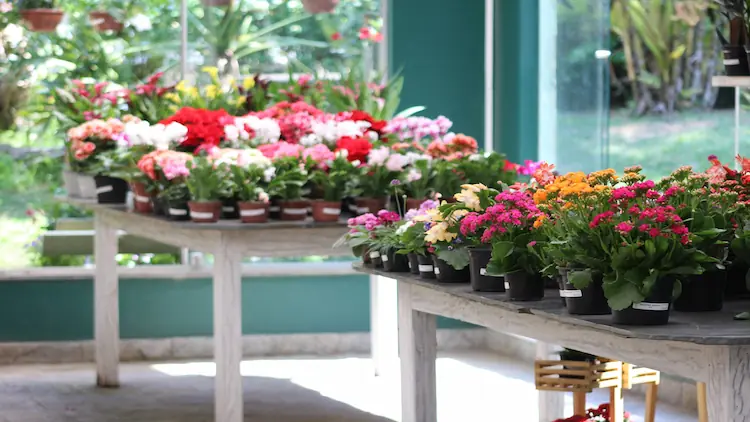
Cats walk right past the pricey plant on the shelf and go straight for the cheap one hanging by the window. Spider plants get chewed more than almost any other houseplant, and plenty of owners panic when they spot a bitten leaf.
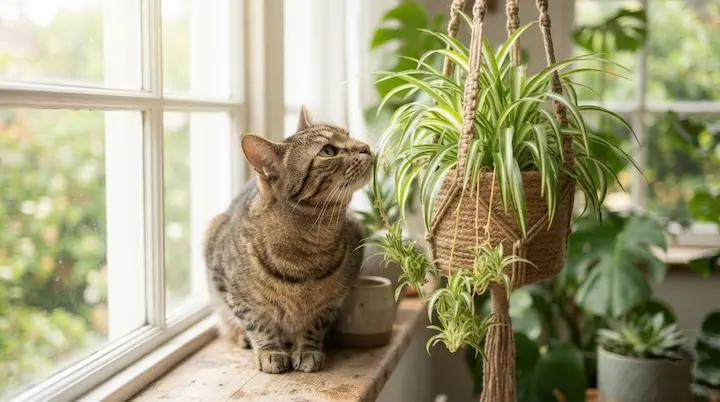
So, are spider plants toxic to cats, or is the worry overblown? The answer is simpler than most articles make it sound, but a few details matter. Here is what is proven, what is not, and what to do at home.
So, Are Spider Plants Toxic to Cats? What the Experts Say
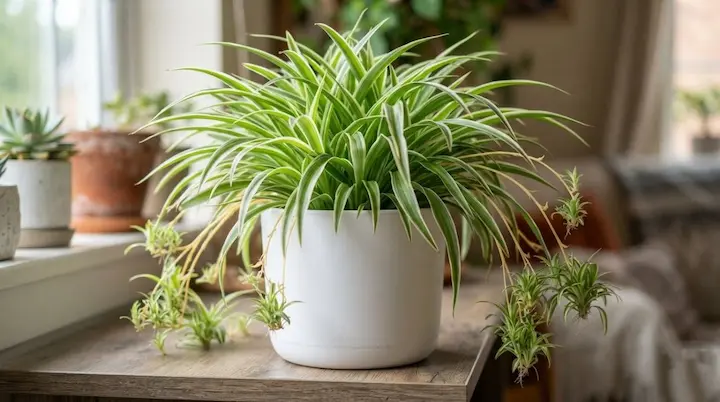
The ASPCA lists the spider plant (Chlorophytum comosum, also called spider ivy or ribbon plant) as non-toxic to cats, dogs, and horses. The Pet Poison Helpline and the National Capital Poison Center agree, and vets call it fine for homes with cats.
Fact check: Both the ASPCA plant database and the NC State Extension Plant Toolbox list this species (family Asparagaceae) as non-toxic to cats.
Non-toxic still isn’t stomach-proof. That makes spider plants safe for cats in the poisoning sense, but cats digest plant fiber badly, so a big chew session, like too much backyard grass, can cause vomiting or loose stool. That is irritation, not poison.
Why Cats Go Crazy for Spider Plants
The usual explanations:
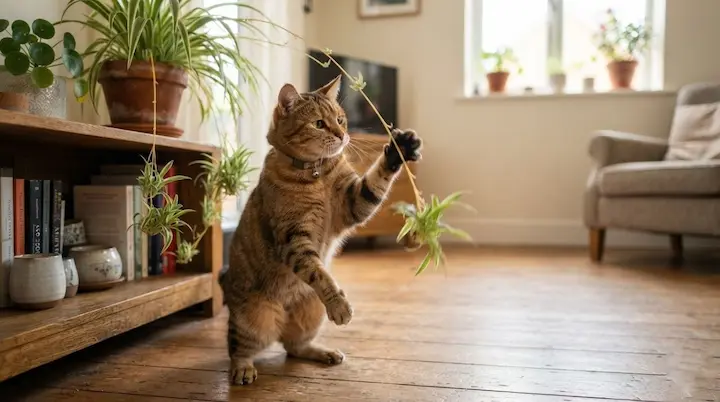
- Movement: Swaying leaves look like prey.
- Texture: Grass-like leaves suit the grass-chewing instinct, which may ease hairballs or an upset stomach.
- Scent: Faint to us, maybe stronger to a cat.
- Boredom and teething: Kittens and indoor cats chew whatever is in reach.
- Parasite instinct: Some vets link plant chewing to clearing parasites.
Some sites say spider plants work like catnip, and owners report playful, “drunk” behavior. I think that claim is shaky, since I couldn’t find a study behind it, so treat it as a theory.
What to Expect From a Cat Eating Spider Plant Leaves
Most cats that nibble a leaf or two are fine, and any signs are usually mild:
- Drooling or gagging.
- Vomiting, sometimes with plant bits.
- Loose stool or diarrhea.
- Lower appetite for 12 to 24 hours.
- Mild tiredness or a spacey, playful mood.
Signs usually start within 2 to 6 hours and fade within a day. Two cats can react differently to the same plant, depending on amount, chewing versus swallowing, an empty stomach, age, a sensitive gut, and daily habit.
No one has published a safe-amount number, so doubt any site that names an exact count of leaves. A cat also can’t live on this plant, since it has no real nutrition.
Watch at Home or Call the Vet?
A cat eating spider plant leaves once in a while is not an emergency. Here is where the line sits:
| What you see | What to do |
|---|---|
| One leaf missing or a few bites, cat acts normal | Watch at home |
| Vomited once, then alert, eating, and drinking, with no blood; signs gone within 24 hours | Watch at home |
| Vomiting more than 2 to 3 times in 24 hours | Call your vet |
| Diarrhea or any signs lasting over 24 hours | Call your vet |
| Refuses water, dry gums, sunken eyes, or blood in vomit or stool | Call your vet now |
| Any symptoms in a kitten under 6 months | Call your vet |
| Weak, collapsed, hunched and still, or crying when you touch the belly | Emergency clinic |
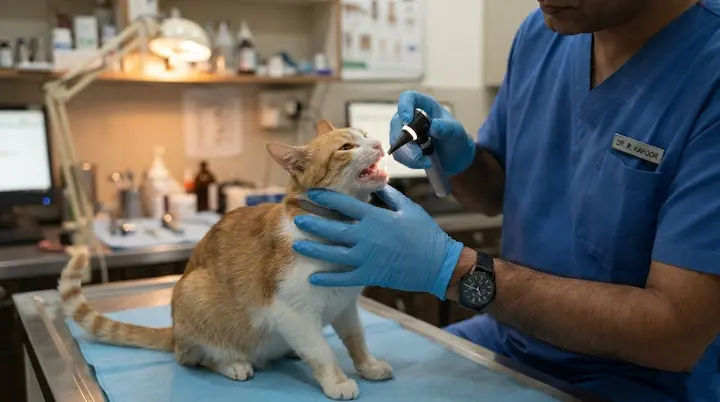
At the clinic, expect an exam and sometimes fluids or anti-nausea medicine. Ask for a cost estimate first. If you’re unsure it was a spider plant, treat it as a possible toxic look-alike and call right away.
What to Do Right Away
- Move the plant out of reach.
- Wipe leaf bits from your cat’s mouth if it lets you.
- Put out fresh water and watch your cat for 24 hours.
Stay calm, since spider plants aren’t poisonous. Don’t make your cat vomit unless a vet says so, and skip milk, oils, and human medicine. Tell the vet the amount eaten, the time, your cat’s age and weight, current signs, and any fertilizer, spray, or leaf shine on the plant.
The Bigger Risk: What Is Sprayed on the Plant
Most “spider plant poisoning” stories I read trace back to something added to the pot, not the leaves:
- Fertilizer: Granules or liquid, some with bug killer.
- Pest sprays and fungicide: Harmful if eaten.
- Leaf shine: Often oils or petroleum.
- Bone meal and blood meal: Smell great to cats, upset the stomach.
- Rocks, marbles, moss: Choking and blockage risks.
Assume anything added to the pot is riskier than the plant. Use pet-safe products, or skip treatments.
Is It Really a Spider Plant?
A real spider plant has narrow arching leaves 6 to 16 inches long and ½ to 1 inch wide, in green or green with white stripes, growing in a clump from the center. Long stems carry baby plantlets, small white flowers appear now and then, and the roots are thick.
Three look-alikes to watch:
- Dracaena (corn plant, dragon tree): Striped leaves, but toxic. It causes vomiting, drooling, and dilated pupils.
- Lucky bamboo: Toxic to cats.
- Fire Flash: An orange-stemmed relative with unclear safety.
Not sure? Snap a photo and show your vet or use a plant ID app.
Spider Plants vs. Truly Toxic Houseplants
Here is how it compares:
| Plant | Risk to cats | What can happen |
|---|---|---|
| Spider plant | Non-toxic (ASPCA) | Mild stomach upset possible |
| True lilies | Very toxic | Kidney failure, sometimes fatal |
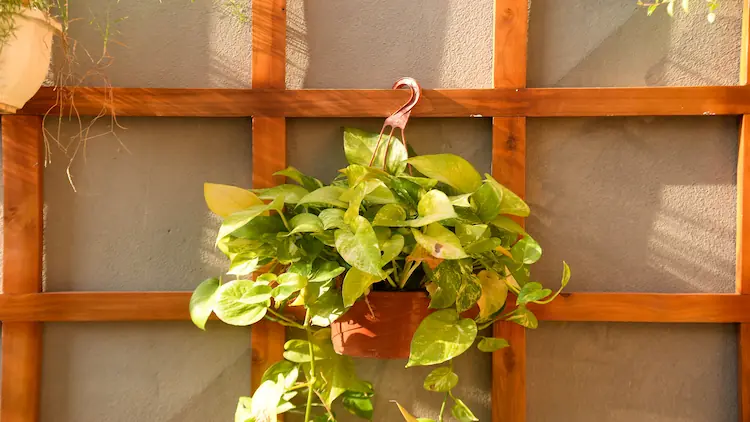
| Pothos | Toxic | Mouth pain, drooling, vomiting |
| Sago palm | Very toxic | Liver failure, seizures, can be fatal |
| Dieffenbachia | Toxic | Mouth pain, swelling, drooling |
| Aloe vera | Toxic | Vomiting, diarrhea, tremors |
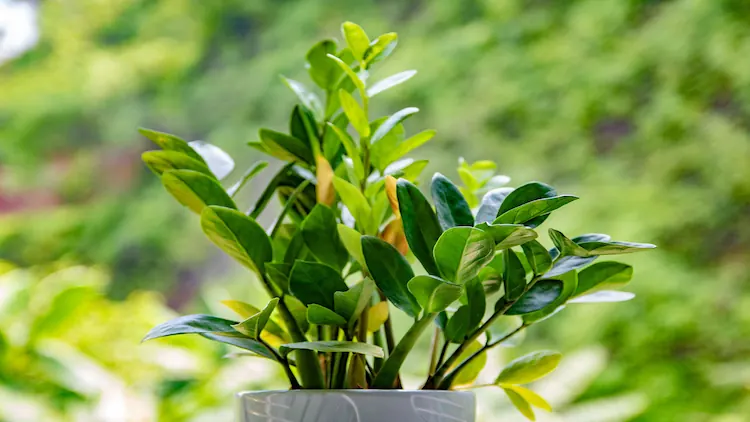
Lilies need a special warning. True lilies (Lilium) and daylilies (Hemerocallis) can cause kidney failure, so even a nibble means an emergency call. For the others, see pothos and cats, snake plant safety, and ZZ plant safety.
How to Keep Cats Away From Spider Plants
Block access, since sprays and rules rarely stop a determined cat.
What works:
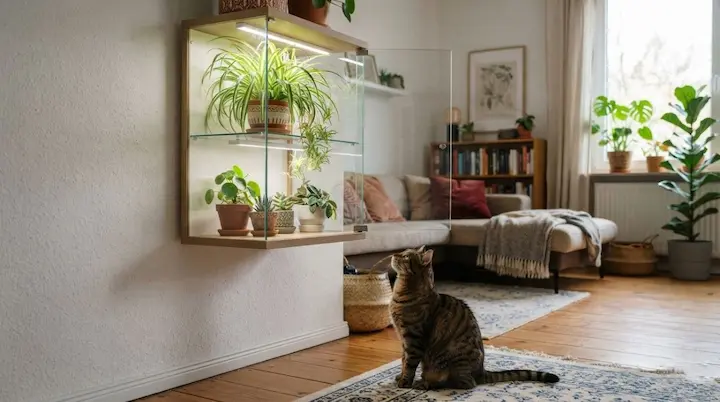
- Physical barriers: The most reliable way to keep cats away from spider plants is a closed room or a glass-door plant cabinet.
- Truly out-of-reach spots: Wall planters, if your cat truly can’t reach them.
- Pruning: Trim trailing leaves so nothing dangles.
- Removal: Move the plant out if nothing else works.
Most cats clear 5 to 6 feet, and furniture adds height, so hanging baskets fail unless the ceiling is high and nothing sits nearby. Bitter sprays, citrus peels, and training usually fail too, and sprays need constant re-spraying.
A cat that showed interest once will keep trying, so give the urge somewhere to go: a puzzle feeder, a climbing tree, and 10 minutes of wand-toy play a day.
Cat-Safe Houseplants and Chew Alternatives
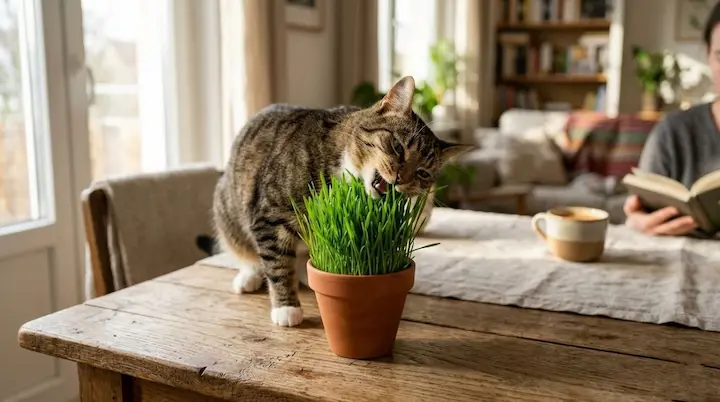
If your cat wants greens, hand it its own. I like cat grass most because it costs little and cats go for it right away.
- Cat grass (wheat, oat, or barley): Made for chewing, helps with hairballs, easy to grow indoors.
- Catnip: Safe to chew, grown fresh or bought dried, and roughly two out of three cats react.
- Catmint: Milder, with pretty flowers.
- Boston fern and bamboo palm: Safe, with a similar look.
Cat-safe houseplants like these work too, but treat any greens as a snack. To grow cat grass, scatter seed thickly in a 6-inch pot, cover with about ¼ inch of potting mix, and keep it damp. Sprouts show in about a week, and blades are ready at 3 to 4 inches. I keep two pots going and swap them every two weeks.
When Chewing Turns Into a Habit
One leaf now and then is normal. A cat that hits the same plant daily may be bored, stressed, or short on fiber, and pica or a stomach problem can also be behind it. Call your vet if vomiting follows most sessions, your cat chews fabric or plastic, or you see weight loss or appetite and stool changes.
Special Cases: Kittens, Seniors, and Other Pets
- Kittens: Teething and weak digestion raise the risk. Call about any symptoms under 6 months. In kitten homes, skip spider plants and offer cat grass.
- Seniors and cats with kidney or stomach conditions: Vomiting or diarrhea can dehydrate them faster, so call sooner.
- Multi-cat homes: You can’t watch every cat, so barriers beat supervision.
- Dogs and other pets: The ASPCA lists dogs and horses as safe too. For rabbits or birds, check its list.
- People and kids: The ASPCA list covers animals only. If a toddler chews any houseplant, call Poison Control at 1-800-222-1222.
Protecting the Plant, Too
In my experience, the plant takes more damage than the cat does. Any community gardener will tell you a chewed spider plant bounces back, though several cats can add up. Prune damaged leaves with clean pruners, divide an overgrown clump when roots fill the pot (a 1-gallon pot fits a large plant), and shelve the baby plantlets out of reach, since cats favor the dangling ones.
In USDA Zones 4, 5, 6, 7 and 8, spider plants can’t stay in the backyard through winter. Every Fall I bring mine inside before nights dip toward 40°F, well ahead of a 32°F frost. For the indoor routine, see spider plant winter care, the winter watering schedule, and yellow leaf causes.
Myths vs. Facts
- Myth: They poison cats. Fact: They’re non-toxic; the risk is stomach upset.
- Myth: They get cats high. Fact: Unproven.
- Myth: Safe means unlimited. Fact: Even with spider plants safe for cats, large amounts upset a stomach.
- Myth: Sprays and baskets stop chewing. Fact: Barriers work better.
- Myth: A sick cat blames the plant. Fact: Fertilizer and sprays are often the cause.
Emergency Contacts
- ASPCA Animal Poison Control: (888) 426-4435 (fee may apply)
- Pet Poison Helpline: (855) 764-7661 (fee applies)
- Outside the US: Call your local emergency vet or animal poison service.
- Emergency clinic now: Trouble breathing, seizures, collapse, or an unknown plant.
This article is general information, not a vet diagnosis.
Sources: ASPCA, NC State Extension, National Capital Poison Center.
Final Thoughts:
So, are spider plants toxic to cats? No. The ASPCA lists them as non-toxic, and the worst outcome is usually a short stomach upset. The real risks are big chewing sessions, kittens, and whatever fertilizer or spray sits on the plant. If your cat ignores it, keep it. If your cat keeps going after it, move the plant, offer cat grass instead, use pet-safe plant products, and call a vet when symptoms drag past a day. Your cat’s behavior matters as much as the plant’s safety rating.