Ever notice how your spider plant cruises all summer, then suddenly starts sulking once you turn the heat on?
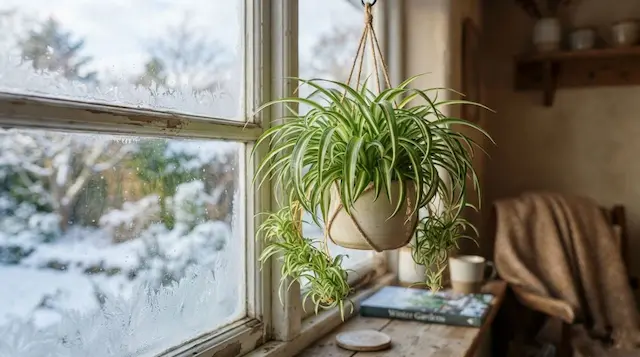
I get messages about this every year once the furnace kicks in. The truth is, spider plant winter care isn’t complicated once you understand what’s happening inside your home you’re just working against drier air, weaker light, and a plant that’s biologically trying to slow down.
Here’s what I’ve learned after six years of keeping mine alive through brutal Midwest winters.
Why Your Spider Plant Slows Down in Fall and Winter
Shorter days aren’t just annoying for you they cut straight into your plant’s ability to photosynthesize. Once daylight drops, most houseplants enter a resting state called quiescence, where growth slows way down so the plant can conserve energy.
Researchers at the University of Vermont Extension have documented this exact pattern in common houseplants, and spider plants are no exception (source). This is normal. Your plant isn’t dying, it’s just budgeting its energy differently, and your routine needs to shift with it.
Worth knowing too: NASA’s Clean Air Study found spider plants remove roughly 560 micrograms of formaldehyde per hour from indoor air (source), which is one more reason it’s worth keeping yours alive through a stuffy, closed-up winter.
Light Needs for a Spider Plant This Season
This is the piece most guides skim past, and honestly it matters as much as watering. Weaker winter sun means your plant needs a better spot, not just less water.
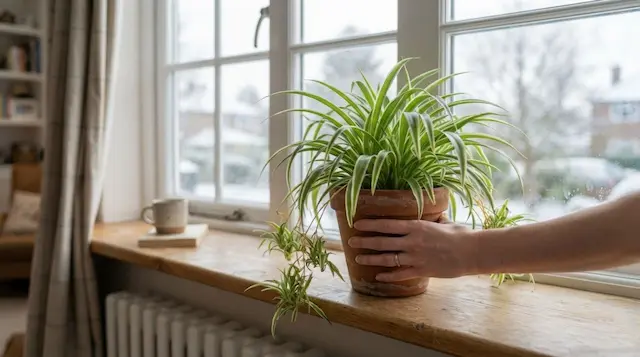
- Move it to an east- or north-facing window for steady, bright indirect light south-facing works too, but keep the plant a foot or more back so midday sun doesn’t scorch the leaves.
- Rotate the pot a quarter turn every week so every side gets a shot at the light and the plant doesn’t grow lopsided.
- If your home is naturally dim, add a basic grow light on a timer for 8 to 10 hours a day.
- Wipe leaves with a damp cloth once a month dust blocks light absorption, and it’s a bigger deal in winter when light is already scarce.
Common Winter Problems in Spider Plants
| What You’re Seeing | Likely Cause | What To Do |
|---|---|---|
| Soil stays wet for a week+ | Slower growth, less water uptake | Water less often, check soil 2 inches deep |
| Brown, crispy tips | Dry heat or mineral buildup | Raise humidity, switch to distilled water |
| Droopy leaves near a window | Cold draft or frozen glass contact | Move plant 12 inches away from the pane |
| No new pups all winter | Normal seasonal pause | Don’t force it, wait for spring |
| Yellowing lower leaves | Overwatering in low light | Let soil dry fully between waterings |
Watering Tips for Spider Plant Winter Care
This is where I see people mess up the most. You cannot water on the same weekly schedule you used in July the soil just isn’t drying out that fast anymore.
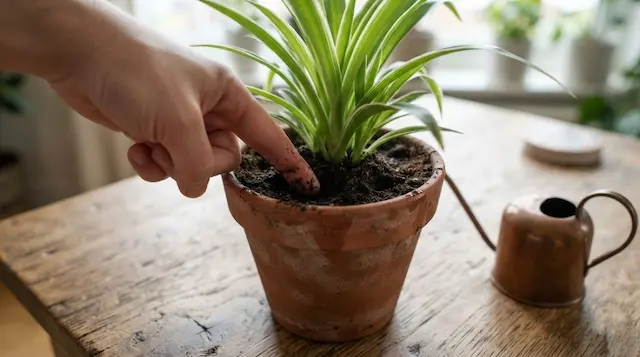
- Stick your finger, or a moisture meter, 2 inches into the soil before you water at all.
- Water thoroughly until it drains from the bottom, then dump the saucer don’t let the pot sit in standing water.
- For a standard 6-inch pot, that’s usually about 1 cup of water; for an 8-inch or larger pot, closer to a half-gallon.
- Switch to distilled or rainwater if you’re seeing brown tips tap water chlorine and fluoride build up fast when the plant isn’t using much water.
- One exception to every “wait until spring” rule in this guide: if roots are mushy and smell sour from overwatering, repot into fresh, dry soil immediately, regardless of season.
I like to keep a cheap moisture meter stuck in each pot from November through March. It’s saved me from more than one overwatering disaster.
Temperature and Drafts: The Real Danger Zone
Spider plants can technically survive down to 35°F for short stretches, but they show real stress well before that.
- Keep indoor temperature between 60°F and 75°F for steady growth.
- Never let leaves touch a cold windowpane that contact point damages even if the room itself is warm.
- Keep the plant at least a foot away from radiators, heating vents, and drafty doors.
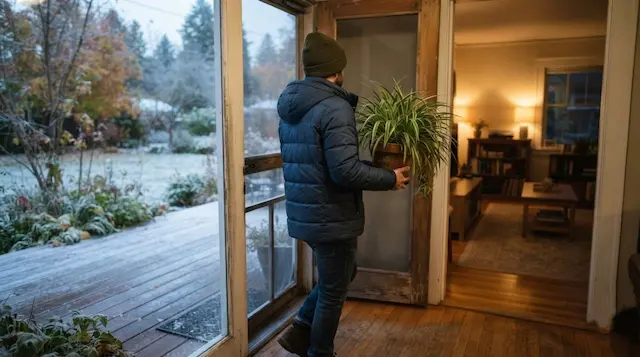
- If you garden in USDA Zones 4, 5, 6, or 7 and your plant spent the summer outside, bring it in well before your area’s first Fall frost the same rule you’d follow hauling in your zucchini and eggplant beds before a cold snap.
Humidity: The One Thing Most People Get Wrong
One thing that trips people up about caring for spider plants during winter is humidity, not watering. Here’s my honest take after years of doing this: misting doesn’t actually do much. It evaporates in minutes and barely nudges the room’s humidity level.
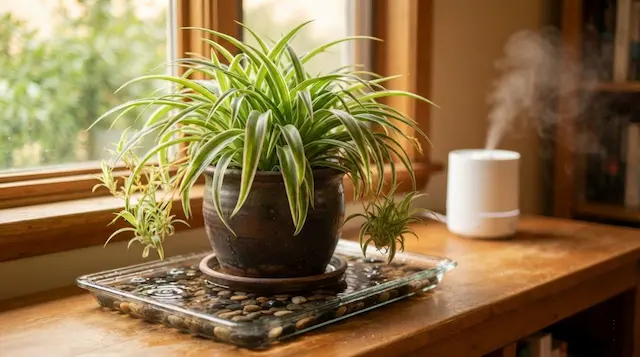
- Aim for roughly 40-50% humidity a small hygrometer from the hardware store tells you exactly where you stand.
- Set the pot on a pebble tray with water below the top of the pebbles so roots never sit wet.
- Run a small humidifier nearby if your house drops below 30% once the furnace kicks on.
- Group it with a few other houseplants, including a pothos winter care setup, a peace lily winter care routine, or a snake plant winter care corner clustered plants create their own small humidity pocket, and if you’re already running a tray for phalaenopsis orchid winter care, your spider plant can share it.
Should You Fertilize in Winter?
Short answer: no, or close to it. Your plant isn’t actively growing, so pushing fertilizer at it from November through February just builds up salts in the soil and can burn the roots. Resume feeding at quarter-strength once you spot new growth in spring, and not before.
Watch for the signs you’ve already overdone it a white, crusty film on the soil surface, or brown, scorched-looking tips even though the soil feels moist.
If you catch it, flush the pot with plain water several times until it runs freely out the drainage holes; that washes the extra salts out of the root zone before real damage sets in.
If you’re already composting kitchen scraps, this stretch is a good time to build up your pile instead check out how to make compost at home if you want your spring feeding to come from your own yard rather than a bottle.
Winter Pests to Watch For
Dry indoor heat is basically a welcome mat for spider mites and mealybugs. A few winter spider plant care habits I never skip while rotating pots for even light exposure:
- Check the undersides of leaves for fine webbing or sticky residue.
- Wipe leaves down with a damp cloth monthly, which doubles as the light-boosting dusting mentioned earlier.
- Isolate the plant immediately if you spot anything, so it doesn’t spread to your other houseplants.
Skip the Pruners and Repotting Mostly
Winter is not the time for major work leave routine repotting for spring, when roots actually have the energy to recover from disturbed soil. This is basically the same idea behind a zz plant winter care routine, which also just asks to be left alone until longer days return.
The one exception: grab a clean pair of pruners and snip off any fully brown or mushy leaves, since dead material sitting on the soil surface invites fungus and pests.
Toss those clippings in the trash or garbage rather than your compost bin if you suspect disease. This same wait-for-spring logic is the reasoning behind timing when to cut back perennials before winter instead of doing it too early.
Bringing Outdoor Spider Plants In Before Frost
If your spider plant spent the summer as a backyard accent, plenty of community gardener folks like using them for color along a shady border, don’t wait until a frost warning to bring it in. Unlike sunflower winter care, which is really just clearing spent stalks from the yard once the season ends, a spider plant is one you actually get to bring indoors and keep growing.
Inspect the leaves and soil closely for hitchhiking bugs before it comes anywhere near your other plants, hose it down outside to knock off any pests or debris, and let it acclimate somewhere in between, like a covered porch, for about a week before moving it to its permanent indoor spot.
Sudden temperature or light swings shock the plant more than the cold itself does.
What About the Baby Spiders Pups?
I get a lot of questions about this one. It’s completely normal for pup production to pause entirely during winter, so don’t force it by fertilizing or fussing over the mother plant.
In my experience, pups show up reliably again once daylight lengthens in spring, and rushing the process usually just stresses an already resting plant.
Getting Ready for Spring
Keeping spider plants during the winter months healthy really just sets you up for a strong spring bounce-back.
Once you notice new leaf growth or the soil drying out noticeably faster, that’s your cue to gradually increase watering frequency and start resuming light fertilizing.
This is also a good window to finally repot if the roots look crowded, and a healthy spider plant can easily become a nice color accent as a center favor on a spring windowsill display once it bounces back.
Final Thoughts:
At the end of the day, spider plant winter care really just comes down to doing less less water, less feeding, less fussing while paying closer attention to light, drafts, and humidity. I think that’s the part most people get backwards; they try harder instead of adjusting. Get those basics right and your plant will bounce right back the moment spring light returns.