
Ever wonder why the tomatoes at your neighbor’s fence turn red weeks before yours?
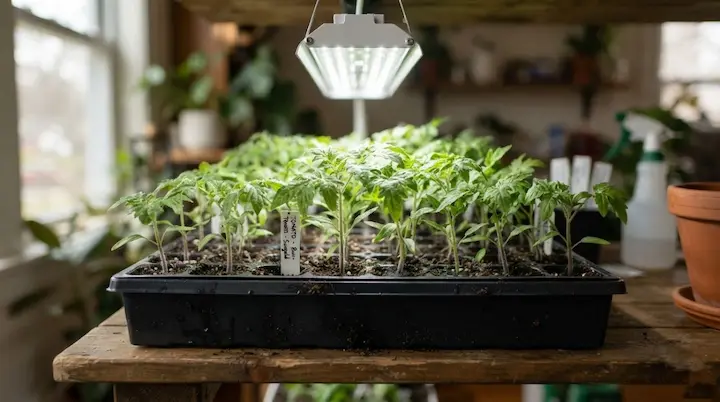
Most of the time, it’s not luck or fancy soil. It’s a head start made on a windowsill months earlier. Here’s how to start tomato seeds indoors so your plants are stocky, healthy, and ready for the backyard the moment the weather cooperates. Nothing complicated, just good timing and a few cheap supplies.
Growing Tomatoes From Seed Beats Buying Transplants
A six-pack at the garden center runs a few bucks and usually gives you one or two varieties. A packet of seeds costs about the same and gives you dozens of plants in whatever variety you want.
Tomatoes also take 60 to 100 days to reach harvest, so in colder yards a head start decides whether the fruit ripens before fall frost. Growing tomatoes from seed puts you in charge of all of it.
When to Sow Tomato Seeds in Your Zone
Everything runs backward from your average last frost date. Look it up by zip code on a frost-date tool or ask your local extension office, then count back 6 to 8 weeks.
Say your last frost is May 10: you’d sow between March 15 and March 29. That rule holds across USDA Zones 4, 5, 6, 7 and 8, with small tweaks for the type of tomato. Your zone gives a rough idea, but your local last frost date is the better guide. Sow too early and you get tall, root-bound plants; sow too late and they’re too small when it’s time to move out.
You’ll see some guides say 4 to 6 weeks and others say 6 to 8. I think the gap comes from plant type and light setup, so use the type as your guide:
- Cherry tomatoes: 4 to 5 weeks before planting out.
- Determinate (bush) types: about 6 weeks.
- Indeterminate (vining) types: a full 8 weeks.
- Not sure? 6 to 8 weeks before last frost is when to sow tomato seeds for most varieties.
Plants are ready to go outside once the soil hits 60°F, nights stay above 50°F, and frost is behind you. Waiting about a week past the last frost date is safer. Here’s a rough calendar by region:
| Region | USDA Zones | Usual last frost | Sow indoors |
|---|---|---|---|
| Northern states | 3 and 4 | Late May to early June | Early to mid April |
| Midwest and Northeast | 5 and 6 | Late April to mid May | Early March to early April |
| Mid-Atlantic and upper South | 7 and 8 | Late March to mid April | Late January to early March |
| Pacific Northwest | 8 and 9 | Mid April, but cool springs | Mid March to early April |
| Gulf Coast and Florida | 9 and 10 | January to February | Late November to December |
Running late? Don’t crowd the tray to catch up. Pick fast cherry types and grab a few garden center transplants to fill gaps. In Zones 9 and 10, a second sowing in midsummer sets you up for a fall garden crop.
Picking Tomato Seeds That Fit Your Yard
Determinate tomatoes stay 2 to 3 feet tall and ripen close together, which suits containers and canning. Indeterminate plants keep growing and fruiting until frost, so they need cages or a trellis.
Then think about use: cherry and grape types for snacking, beefsteak for slicing, and Roma or paste types like ‘Amish Paste’ for sauce. I favor heirlooms such as ‘Pineapple’ for flavor, but hybrids often bring better disease resistance and steadier yields.
Check days to maturity on the packet and lean toward 60 to 70 days if your summers are short. Cherry types are the easiest for beginners, and for containers stick with bush types or compact cherries like ‘Tumbling Tom’. Feeling adventurous? Try a blue or black variety.
Got an old packet in the drawer? Lay 10 seeds on a damp paper towel, slip it into a zip bag, and keep it warm. If 7 or more sprout within 7 to 10 days, you’re good. If fewer than 5 do, sow extra seeds.
Indoor Tomato Seed Starting Supplies You Actually Need
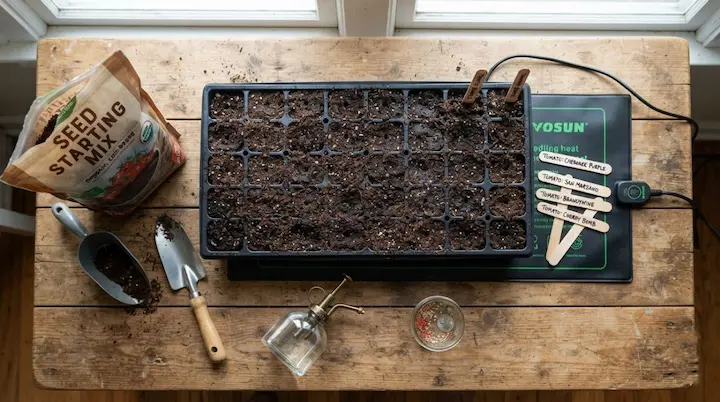
Indoor tomato seed starting works fine on a small budget. Grab cell trays or small pots about 2 to 3 inches wide and at least 2 to 3 inches deep, with drainage holes. Washed yogurt cups and takeout trays work too, so keep them out of the trash and poke holes in the bottom. Use a seed starting mix, not backyard dirt, since garden soil packs down and can carry disease.
Making your own is easy: 2 parts coco coir or peat moss, 1 part perlite, and 1 part vermiculite, by volume. A heat mat, humidity dome, plant labels, spray bottle, small fan, and a balanced liquid fertilizer round out the list. For light, the budget route is a cheap 4-foot shop light hung on chains, which beats any windowsill.
The ideal route is an LED rated 5000K to 6500K on a plug-in timer. Either one works, and popsicle sticks make fine labels. The lights and the heat mat are the only real purchases; everything else costs very little.
How to Start Tomato Seeds Indoors, Step by Step
- Wet the mix first, since dry mix soaks unevenly, until it feels like a wrung-out sponge. Then fill your containers loosely without pressing down.
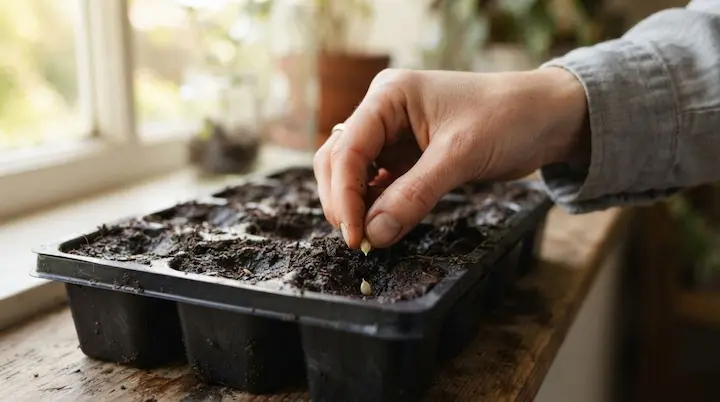
- Drop in 2 seeds per cell about 1/4 inch deep and cover lightly. I always label variety and date right away, because tiny seedlings all look alike. Optional: roll damp seeds in mycorrhizal fungi powder first for extra root growth.
- Water gently by misting, or set the tray in a shallow pan and let it soak from the bottom. Pouring from above washes seeds out of place.
- Cover with a dome or plastic wrap and keep the tray warm, 70°F to 80°F. A heat mat helps, but never go past 95°F.
- Check daily. Sprouts usually show in 5 to 10 days.
- When sprouts break through, pull the cover and heat mat so damping-off doesn’t get a foothold. Move the tray under lights in a cooler spot around 65°F to 72°F, and snip the weaker seedling in each cell at soil level with small pruners or scissors. Pulling it out can rip up the roots of its neighbor.
One number worth knowing: Michigan State University Extension says to keep soil between 75°F and 80°F until germination, and notes that tomato seeds sprout better in the dark (MSU Extension).
Caring for Seedlings Until Transplant Day
Once the sprouts are up, tomato seedlings indoors need strong light, moving air, and a light hand with the watering can.
- Light: 12 to 16 hours a day, with bulbs 2 to 3 inches above the leaves. Raise the lights as plants grow, and check the height every couple of days. In my experience, a window in late winter isn’t enough, and plants stretch and flop.
- Temperature: after germination, room temperature around 65°F to 72°F is right. Slightly cooler nights, near 60°F, keep plants short and stocky.
- Water: overwatering kills more seedlings than anything else. Water only when the surface feels slightly dry. I’ve lost a whole tray to soggy mix.
- Airflow: run a small fan on low for a few hours a day, or brush your hand across the tops. Keep it gentle, so leaves barely move, and skip strong wind that dries them out. Stems come out thicker.
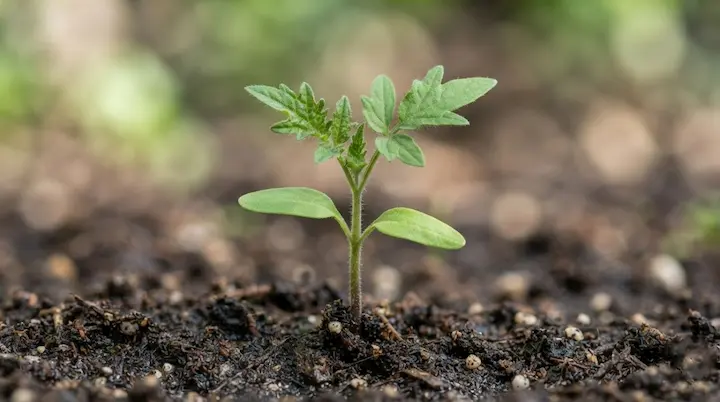
- Leaves: the first two smooth, oval leaves are cotyledons, the seed leaves. The jagged ones that follow are true leaves, and healthy ones are a deep green color.
- Feeding: tomato seedlings indoors run out of food fast, since seed mix has almost none. Once true leaves appear, give a balanced tomato fertilizer at 1/4 strength every 7 to 10 days, then step it up slowly.
- Potting up: when the second set of true leaves shows, move each plant into a 3 to 4 inch pot. Bury the stem up to the first leaves every time, since roots form along the buried part.
Hardening Off Before They Go Outside
- Begin 7 to 10 days before planting out, when seedlings are about 6 to 8 inches tall with several true leaves.
- Nights should stay above 50°F with no frost in the forecast.
- Days 1 and 2: 1 to 3 hours of bright shade, out of the wind.
- Days 3 and 4: 3 to 5 hours with gentle morning sun.
- Days 5 and 6: most of the day in a light breeze, then back inside at night.
- Day 7 onward: they can stay out overnight if it holds above 50°F.
- Pots dry out faster outside, so check moisture often.
- Haul them in if leaves look bleached or the wind picks up.
- In a very windy climate, a cold frame or plastic sheeting gives extra cover.
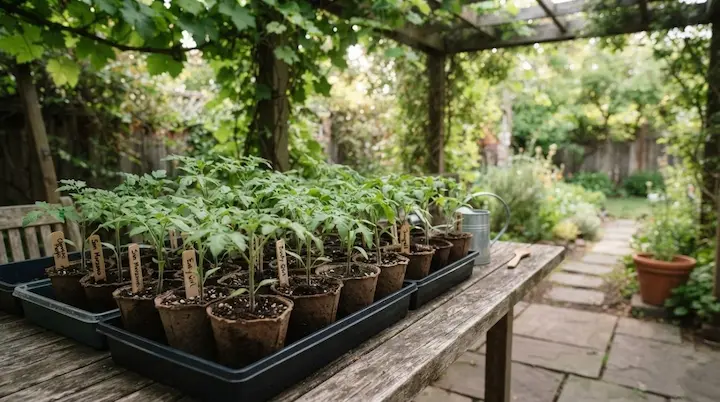
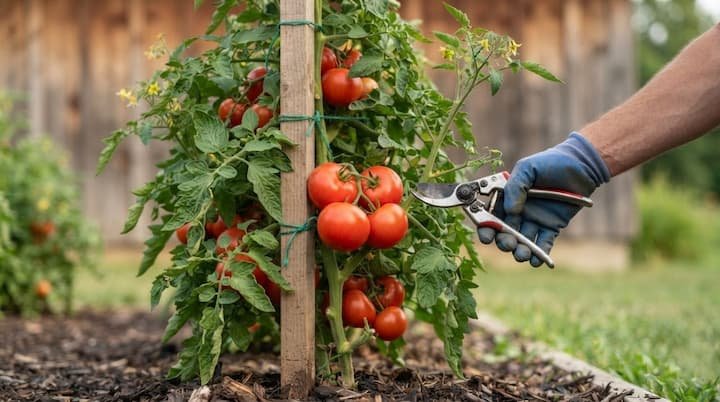
Once your seedlings are in the ground and about 1 to 2 feet tall, start pruning tomato plants to keep them healthy and full of fruit.
Transplanting Into the Backyard
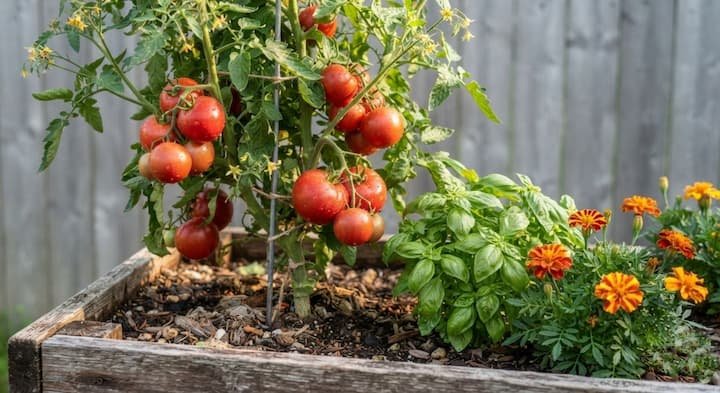
Pick a spot with 6 to 8 hours of sun. Work in some good compost and aim for soil pH around 6.0 to 6.8. The same goes for raised garden beds. If you’re a community gardener on a shared plot, check the stake and cage rules first.
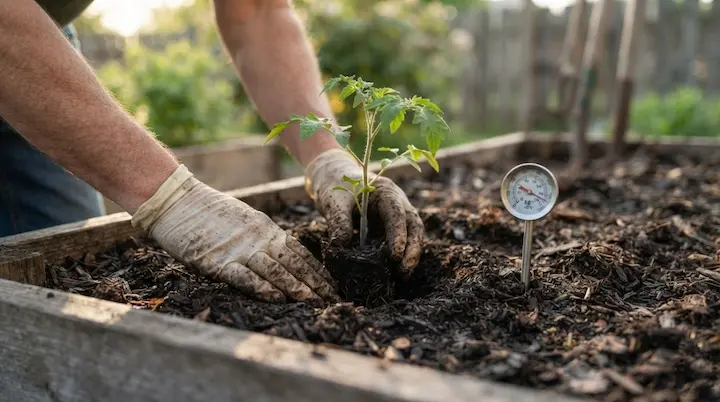
Plant on a cloudy day or in the evening to soften transplant shock. Set each plant deep, burying the stem up to the first leaves, or lay a leggy one sideways in a trench so roots form along it. Space plants 24 inches apart, put in the stake or cage right away before the roots spread, and give each plant about 1 gallon of water.
Crushed eggshells are harmless, but blossom-end rot mostly comes from uneven watering, so keep moisture steady. If the forecast dips toward 45°F, cover plants overnight with row cover or an upside-down 5-gallon bucket.
Common Problems and Quick Fixes
| Problem | Likely cause | Fix |
|---|---|---|
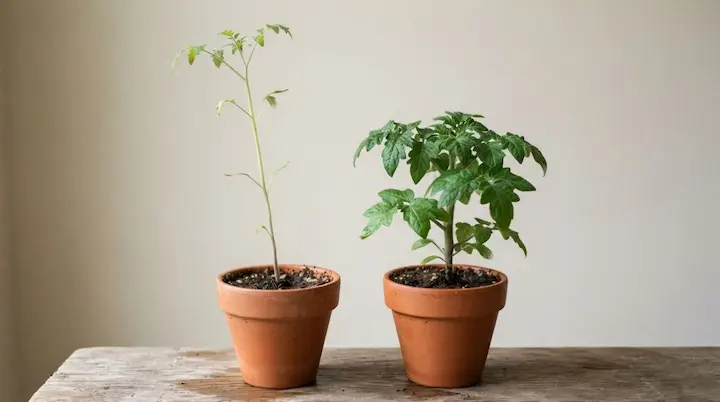
| Tall, thin stems | Weak light | Lower lights to 2 to 3 inches, run 12 to 16 hours, bury stems when repotting |
| Seedlings collapse at soil line | Damping-off from cool, soggy mix | Remove cover after sprouting, water from the bottom, run a fan, use fresh mix |
| White mold on soil | Damp, stagnant air | Scrape off the top layer, add a fan, let the top inch dry |
| Seeds won’t sprout | Cold mix, old seed, too deep | Use a heat mat at 70°F to 80°F, test old seed, keep depth at 1/4 inch |
| Yellow leaves | Too much water or hungry plants | Let the surface dry, start 1/4-strength feeding |
| Purple leaf color | Cold roots | Warm the room above 65°F |
| Slow growth | Cold, small pot, or dim light | Warm up, pot up, add light |
| Root-bound plants | Left in tiny cells too long | Pot up early, sow later next year |
Mistakes I See Every Spring
- Sowing too early, then fighting giant plants in a tiny space.
- Using backyard soil instead of seed mix.
- Hanging lights too far above the leaves.
- Skipping hardening off.
- Planting out on the last frost date without checking nighttime lows.
- Watering hard from above or keeping the mix soggy.
- Skipping labels when you grow several varieties.
Seed to Garden Timeline
Week 0 is sowing day. By week 1 sprouts appear and the cover comes off. Around weeks 2 to 3, true leaves show up and it’s time to pot up. Weeks 4 to 6 are for raising lights and feeding every 7 to 10 days. Weeks 6 to 7 are hardening off, and week 8 is planting out.
Peppers and eggplant follow the same steps, though they usually want a bit more lead time.
Final Thoughts:
Now you know how to start tomato seeds indoors, from picking the sowing date to hardening off and planting out. Pay attention to timing, keep the light close, and hold back on the watering can. Do that, and you’ll be picking tomatoes while friends are still waiting on their first blossoms. Grab a packet this weekend, check your frost date, and get a tray going. Then line up good compost and tomato fertilizer for planting day.
Pingback: Best Fertilizer for Tomatoes: 6 Proven Picks for Big Yields
Pingback: Growing Tomatoes in Pots: 7 Easy Wins for Big Harvests