
Ever noticed that the leafiest tomato plant in the yard is often the one with the fewest tomatoes?
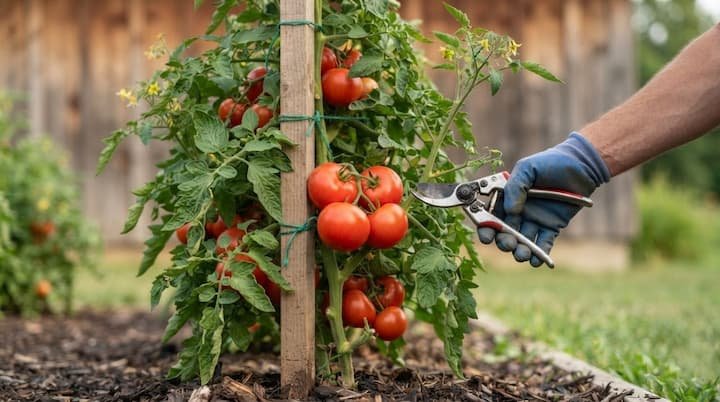
All that green feels like a good sign, but it can hide disease, shade the fruit, and drain the plant’s energy. A few small cuts fix that fast. Once you know how to prune tomato plants, the whole plant starts working for fruit instead of extra leaves.
Why Pruning Tomato Plants Pays Off (and When to Skip It)
A tomato plant has one pool of energy, and every extra stem, sucker, and leaf pulls from it. Cut the right ones and more sugar and water go to the fruit already on the vine. You also open up the center of the plant, so air moves through and leaves dry faster after rain or watering. That matters because wet leaves are where fungal disease gets started.
I think the biggest reason people skip it is that cutting a healthy plant feels wrong. It isn’t, as long as you cut with a plan.
Pruning does come with a trade-off. An Oregon State University report found that heavy pruning and staking of Early Girl tomatoes gave earlier ripening and larger fruit, but a lower yield per plant. The payoff is biggest in short seasons and humid, disease-prone summers, and smaller in long, dry ones.
So go light, or skip it, in these cases:
- Your plant is a determinate (bush) type, because it sets fruit on side shoots.
- You want the most total pounds and have plenty of room between plants.
- Temps are near 90°F, or the leaves are wet.
Know Your Tomato Type Before You Cut Anything
Check the seed packet or plant tag for the words determinate, semi-determinate, or indeterminate. A tag that says bush means determinate, and one that says vining means indeterminate.
Determinate plants stop at about 3 to 4 feet and set most of their fruit in one round. Indeterminate plants keep growing and fruiting until frost, often passing 6 feet.
| Type | Growth | Sucker removal | Leaf removal | Topping |
|---|---|---|---|---|
| Determinate (bush) | Stops at 3 to 4 feet | No, suckers carry fruit | Only leaves touching soil | No |
| Semi-determinate | Medium, 4 to 5 feet | Light, below the first flower cluster only | Lower leaves | No |
| Indeterminate (vining) | Keeps growing, 6 feet or more | Yes, regularly | Lower and diseased leaves | Yes, before frost |
- Never remove suckers on bush types, since those side shoots carry the fruit.
- On determinate plants, pinch off flowers that show up before the plant is 18 to 24 inches tall, so it builds roots and leaves first.
- Not sure what you have? Treat it like a determinate and prune lightly.
Tools and Prep Before You Trim Tomato Plants
Sharp, clean pruners make cleaner cuts, and clean cuts heal faster. I like to keep a small bucket by the garden gate with pruners, gloves, and a spray bottle of rubbing alcohol.
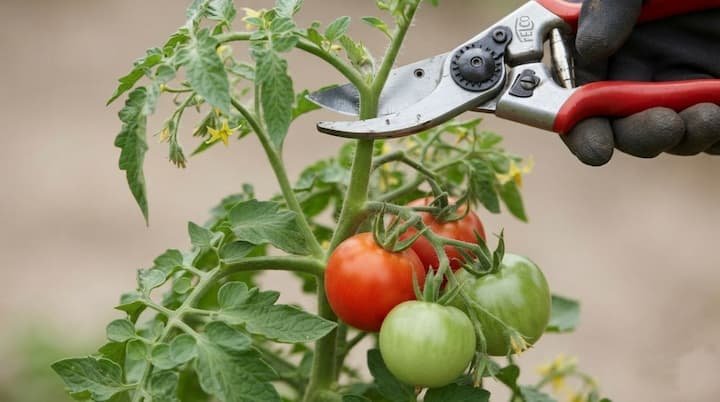
Here is the kit: your own fingers for small suckers, bypass pruners or small snips for stems thicker than a pencil, gloves (tomato foliage stains your hands dark green), isopropyl alcohol or a mix of 1 part bleach to 9 parts water to wipe blades between plants, a bucket for clippings, and stakes, cages, or a trellis already in place before you start. Skip the wipe-down and one sick plant can spread disease along the whole row.
When to Prune Tomatoes and How Often
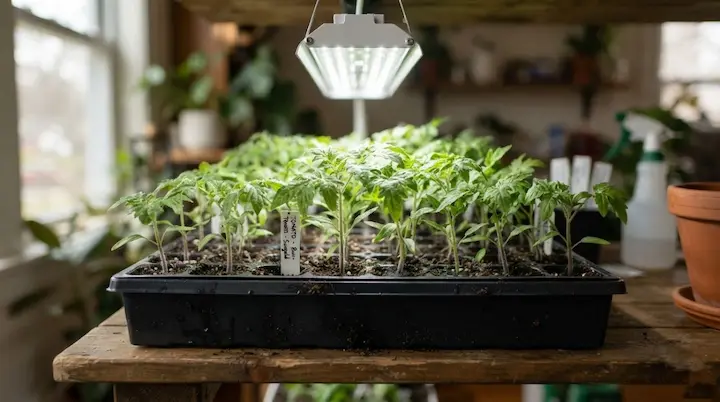
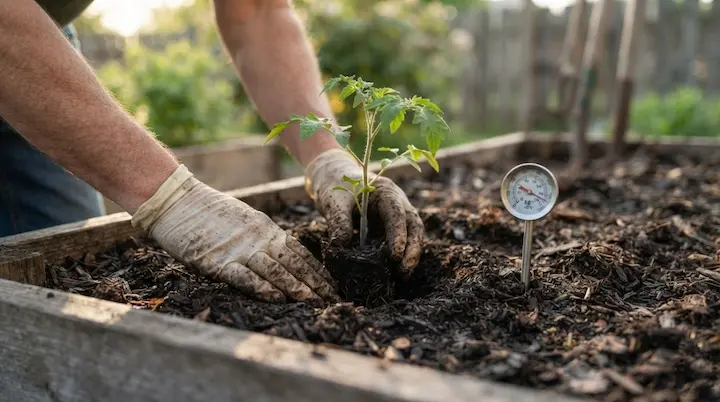
Start once the plant is 1 to 2 feet tall and has a few branches off the main stem. Before that, it needs every leaf to build roots. Your when to plant date sets the clock here, and seedlings from starting seeds indoors are usually ready for first cuts a few weeks after they go in the ground.
- Rule for when to prune tomatoes: early morning, leaves dry, no rain in the forecast.
- Check the plant every 7 to 10 days, because suckers grow fast.
- Go light when it reaches 90°F or more.
- Water at soil level with a soaker hose or drip line, so soil doesn’t splash onto fresh cuts.
My experience is that a 10-minute walk through the patch every Sunday beats one big cleanup every month.
Find the Parts of the Plant First
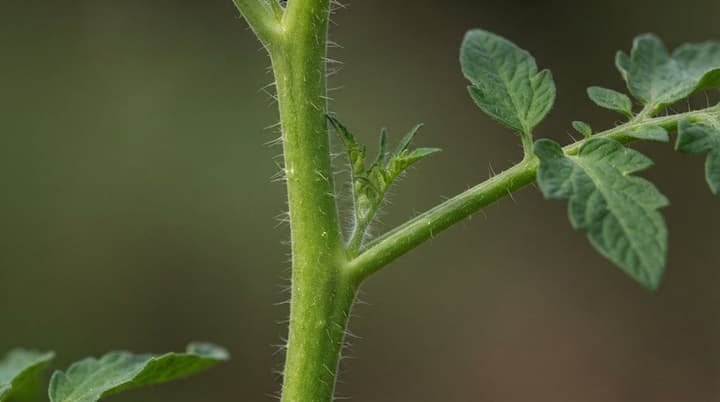
Look at where a branch meets the main stem. A leaf stem points straight out or slightly down and carries leaflets along its length. A sucker sprouts from the V just above that leaf and points up at roughly a 45-degree angle. Together, the main stem, leaf, and sucker form a rough K shape.
Left alone, a sucker grows its own leaves, branches, and even flower clusters. Leave the leaf stems unless they are damaged or diseased, and tie the main stem to your support. The flower cluster, called a truss, is a group of buds, yellow flowers, or small green tomatoes, and it is your landmark for the cuts below.
How to Prune Tomato Plants: Removing Suckers Step by Step
- Start at the bottom and check every V between the main stem and a leaf stem.
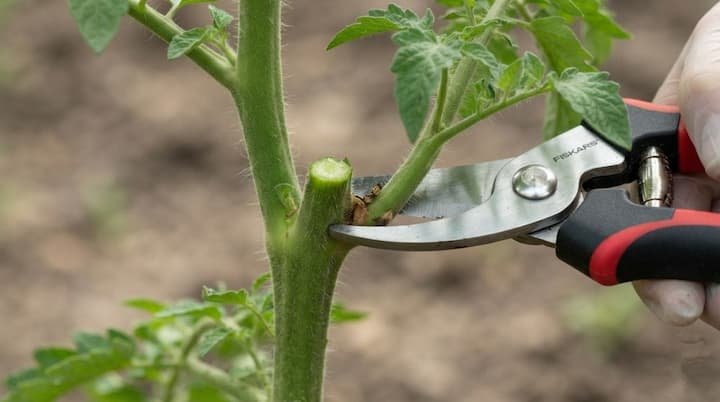
- Judge the size. If it is under 2 inches and pencil thin, pinch it off between your thumb and finger. If it is bigger, use pruners so you don’t tear the stem.
- Cut close to the main stem without nicking it, and leave no long stub behind.
- Work on a dry morning, and wipe the blades first if any plant showed spots.
- Repeat every 7 to 10 days, since new suckers show up all season.
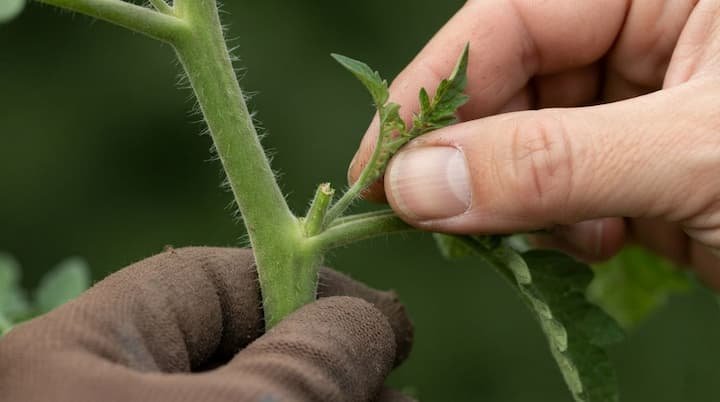
Suckers below the first flower cluster are the easiest call, because they sit low, stay shaded, and live close to wet soil. Above the first cluster, suckers can carry their own flowers and fruit, so removing them trades some tomatoes for airflow and bigger fruit.
Take your time up there. A sucker that has already gotten thick is better handled with the next trick than yanked off.
The Missouri Pruning Trick for Bigger Suckers
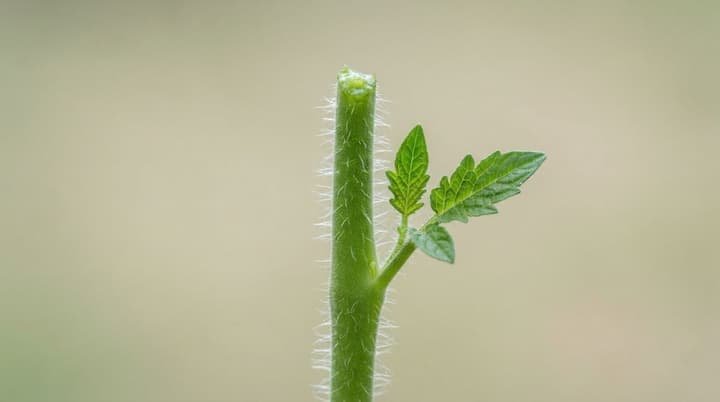
Missouri pruning means you pinch off only the tip of the sucker and keep its first one or two leaves. Those leaves keep making food and shade the wound from sun. The sucker stops growing out, so you don’t get a new branch. The stub can sprout again, so go back and redo it now and then.
It suits thick suckers below the first flower cluster, where a full cut leaves a big wound, and it helps in sunny yards because the extra leaves shade bare stem.
Pick a Stem System: One, Two, or Three Stems
Many gardeners grow indeterminate tomatoes on one to three main stems. Pruning tomato plants down to one stem gives the earliest fruit, but more stems mean more tomatoes later in the season. Short seasons favor fewer stems, and long seasons favor more.
I usually run two stems: the main stem plus the strongest sucker under the first flower cluster, which gives the plant a Y shape.
| System | What you do | Best for | Trade-off |
|---|---|---|---|
| One stem | Remove every sucker | Short seasons in USDA Zones 4 and 5, wet summers, small yards | Needs a tall, sturdy stake |
| Two stems | Keep the main stem and one sucker | Most backyard gardens | A bit more weight to support |
| Three stems | Keep the main stem and two suckers | Long seasons in Zones 7 and 8 | Needs very strong support and more upkeep |
| Unpruned | Cut nothing | Lots of room, low effort | Crowded plants, slower ripening, more disease risk |
Leaf Pruning: What to Take and What to Leave
Leaves are the plant’s solar panels, so take the right ones. Healthy leaves in the middle and top of the plant feed the fruit and shade it from sunscald.
Take these:
- Any leaf touching the soil, since splashing soil carries early blight spores.
- The lowest leaves, up to the first flower cluster or roughly the bottom 12 inches of stem, so you get a clear zone where soil splash can’t reach.
- Yellow or brown leaves that no longer make food.
- Leaves with spots.
Leave these:
- Healthy green leaves in the middle and upper plant.
- Leaves that shade ripening fruit.
Never take more than one-third of the leaves in a single week, and go lighter when in doubt. I bag diseased leaves and put them in the trash. Healthy clippings can go in a home compost, and a pile that stays hot, like with hot composting, breaks them down faster.
Topping Your Plants Before the First Frost
Topping means cutting the growing tip of the main stem so the plant stops making new growth and puts its energy into the fruit it already has. Do it about 4 to 6 weeks before your first expected fall frost, when temps drop to 32°F.
Cut just above the second leaf past the highest fruit cluster you want to ripen. In a short season this can buy fruit an extra 1 to 2 weeks of ripening before frost. Then pinch off new flowers and tiny green fruit that won’t have time to ripen.
Frost dates vary across USDA Zones 4, 5, 6, 7 and 8, so treat these as a rough guide and check your local date:
- Zones 4 and 5: mid to late August.
- Zone 6: early September.
- Zones 7 and 8: late September to early October.
In mild areas like USDA Zones 9 and 10, frost may never arrive, so the end of the season is your call. Pick the date you want the plant finished and top it 4 to 6 weeks earlier.
Special Cases: Pots, Roma, Greenhouse, and Humid Weather
- Containers: use at least a 5-gallon pot, and 10 gallons for big vining types. You can trim tomato plants in pots the same way, but stick to one or two stems because the root space is small.
- Cherry tomatoes: these vines are vigorous and forgiving, so two or three stems work fine.
- Roma and other paste types: most are determinate, so leave the suckers and just clear leaves touching the soil.
- Heirlooms: many are indeterminate with big, heavy fruit, so give them a stout stake and stick to one or two stems.
- Greenhouse or high tunnel: train plants up a string and top them at the roof. If you heat a greenhouse through winter, your topping date follows your own schedule, not frost.
- Hot, humid weather: airflow matters most here, so clear the lowest leaves and prune on dry mornings. Keep enough leaf cover over the fruit, because bare tomatoes scald in strong sun.
Aftercare: Water, Feed, and Support
A freshly pruned plant needs a little backup. Keep water at the base, keep leaves dry, and tie new growth to its support. Feed on schedule with a good tomato fertilizer, and for a gentle top-up, worm castings work well mixed into the top inch of soil.
Water about 1 to 2 inches per week, rain included. Mulch with straw or shredded leaves to stop soil splash and hold moisture, tie the main stem to its stake every 8 to 12 inches with soft ties, and look over the cuts and leaves for new spots, removing any sick leaf right away.
Here is a weekly checklist worth printing:
- Pinch new suckers (indeterminate types only).
- Clear leaves touching the soil.
- Remove yellow, brown, or spotted leaves.
- Check ties and support.
- Water at the base and look for spots.
Common Mistakes to Avoid
I made the first mistake on this list my second summer, stripping the suckers off a row of bush tomatoes, and the harvest came in thin.
- Cutting suckers off determinate plants.
- Treating tomato pruning as a one-time job.
- Pruning wet plants or working in the hottest part of the day.
- Taking more than a third of the leaves in one week.
- Skipping the alcohol wipe on your pruners.
- Ripping big suckers off by hand and tearing the main stem.
- Leaving long stubs on the main stem, which can die back and let disease in.
- Removing so many leaves that fruit sits bare in the sun.
Bonus: Turn Suckers Into Free Plants
The suckers you cut don’t have to go in the garbage. A healthy 4 to 6 inch sucker roots easily, which gets you a free fall crop in warm zones or a plant to hand off to a neighbor or a community gardener.
- Cut a healthy sucker 4 to 6 inches long.
- Strip the lower leaves and keep the top few.
- Stand it in a glass of water on a bright windowsill and change the water every couple of days.
- Pot it up when roots reach 1 to 2 inches, usually in 1 to 2 weeks.
- If you root in soil, keep the mix just damp, since soggy mix invites soil gnats.
Final Thoughts:
Learning how to prune tomato plants comes down to a few steady habits: know your type, cut on dry mornings, pinch suckers early, clear the lowest leaves, and top the plant before 32°F frost. Start small this weekend with one plant in your backyard. Check it every week, and the plants will do the rest.

Pingback: Tomatoes Blossom End Rot: 7 Proven Fixes for Better Results
Pingback: How to Hand Pollinate Tomatoes: Easy Proven Steps Today