
Same seeds, same sun, same watering, yet one backyard bed gives bowls of tomatoes while the next gives tall green plants and almost no fruit.
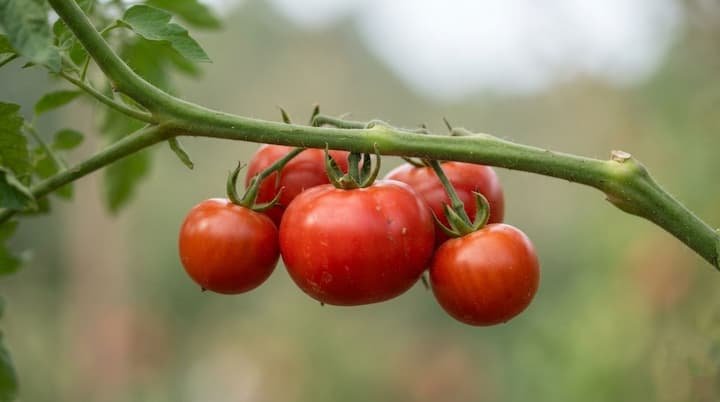
Feeding is usually the gap. Picking the best fertilizer for tomatoes depends on soil, stage, and pot or bed, and most bags skip all three. Soil testing comes first. This guide sorts it out in plain terms, so the next bag in the cart actually fits.
Quick Look at Popular Fertilizer Picks
The table below lines up the best tomato fertilizer choices found at most garden centers. NPK numbers shift a little between bag sizes, so check the label.
| Product | Type | Organic | NPK | Best For | Cost Per Feeding |
|---|---|---|---|---|---|
| Dr. Earth Home Grown | Granular | Yes | 4-6-3 | Pots, beds, native soil | Low |
| Espoma Tomato-tone | Granular | Yes | 3-4-6 | Budget buyers, blossom end rot | Low |
| Burpee Organic Tomato & Vegetable | Granular | Yes | 3-6-4 | Hands-off feeding up to 3 months | Low |
| Big A | Water-soluble | Yes | 9-1.5-7 | Fast organic feed | Higher |
| Miracle-Gro LiquaFeed | Liquid | No | 9-4-9 | Hose-end convenience | Medium |
| Greenway Biotech | Water-soluble | No | 4-18-38 | Hydroponics, big beds | Lowest per gallon |
Test the Soil and Check pH First
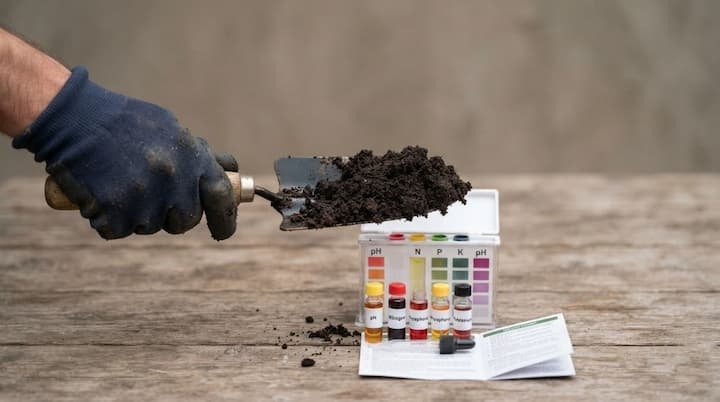
A state extension office test usually runs $15 to $20 and lists nutrient levels plus amendment advice. Tomatoes do best at a pH of about 6.2 to 6.8. Outside that range, nutrients get locked up.
- Take samples from 4 to 6 spots, about 6 inches deep.
- Test in early spring or Fall so amendments have time to work.
- Retest every 2 to 3 years.
- Heavy clay or sandy ground needs a better tomato soil mix first.
What Tomato Plants Actually Need
Tomatoes are heavy feeders. Labels list N-P-K in that order. A 4-6-4 bag is 4% nitrogen, 6% phosphorus and 4% potassium.
- Nitrogen (N): leaves and stems.
- Phosphorus (P): roots, flowers and fruit set.
- Potassium (K): strong stems, plant health and fruit quality.
Secondary nutrients are calcium, magnesium and sulfur, with tiny amounts of iron, manganese, zinc, copper and boron on top. Any tomato plant food with calcium and magnesium on the label covers most of that second group.
Picking the Best Fertilizer for Tomatoes by Growth Stage
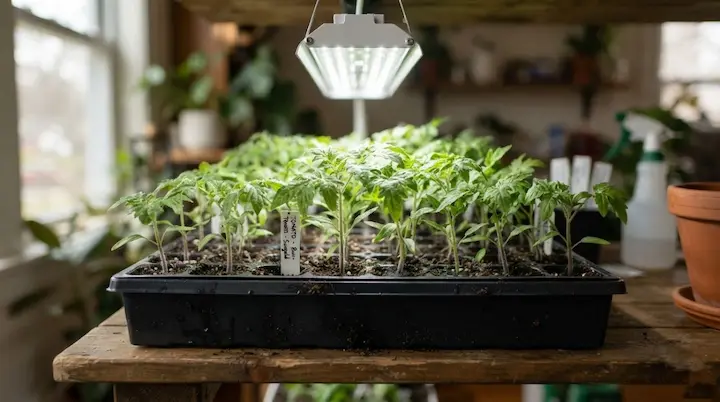
- Seedlings: half-strength balanced liquid until plants reach 6 to 8 inches tall (see starting seeds indoors).
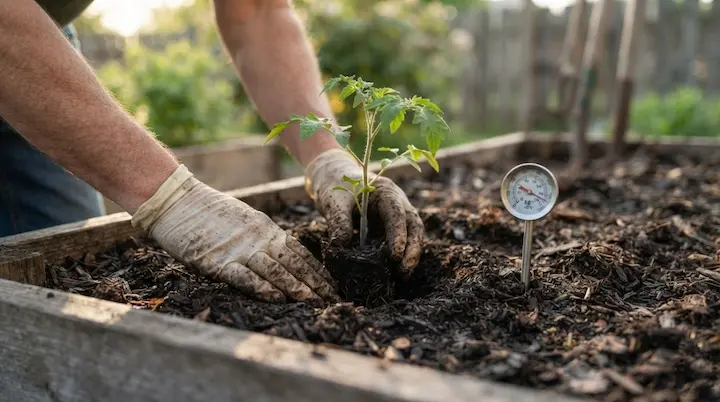
- Transplant and vegetative growth: balanced feed with a slow-release granule mixed in at planting, something near 4-6-3. A 10-10-10 bag works once at half rate.
- Flowering: nitrogen drops and phosphorus rises, for example 3-6-4, with calcium added for fruit set.
- Fruiting: lowest nitrogen and highest potassium, like 3-4-6, or 4-18-38 in a water-soluble mix.
- Late season: ease off.
Fertilizer Types: Granular, Liquid, Water-Soluble and More
Choose a fertilizer for tomato plants by how fast it works and how often there is time to apply it.
- Granular: slow-release, stores for years, needs only 2 or 3 applications. Quick-release types give a short burst, while coated, polymer-coated and sulfur-coated versions feed slower and longer. I like granular for the base feed.
- Liquid: a concentrate mixed with water, available to roots right away, reapplied every 1 to 2 weeks. A quick boost for weak or stunted plants on top of a granule base.
- Water-soluble powder: dissolves fully, works in drip lines, foliar sprays and hydroponics, and is cheap per gallon. It spreads evenly, so burn risk is lower and dosing is precise.
- Complete (balanced): all three major nutrients in one bag, which keeps the schedule simple and supports branches, flowers and disease resistance.
- Specialized tomato blends: more phosphorus and potassium, with calcium and trace minerals added.
Organic or synthetic is the next call. An organic fertilizer for tomatoes works slower because soil microbes have to break it down.
- Organic: lower NPK numbers, more micronutrients, gentler on roots, better soil structure, and safer for spiders and paper wasps that eat aphids.
- Synthetic: fast action and tight control, best for rescuing stalled plants.
- Mixed approach: organic base at planting, then a liquid top-up during peak fruiting.
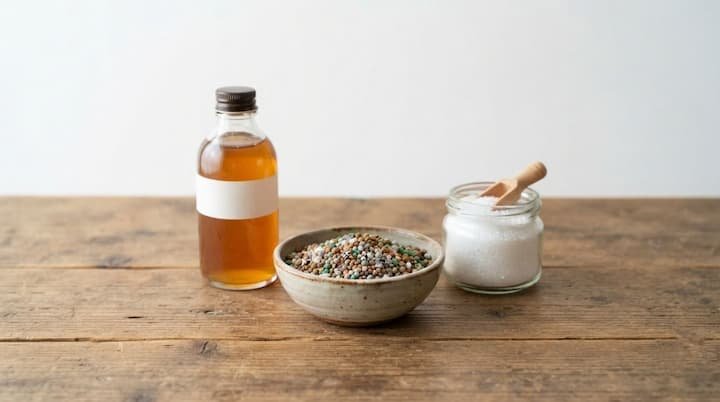
Organic Fertilizer for Tomatoes, Ingredient by Ingredient
- Compost: holds water and adds calcium, manganese and sulfur. Work it in before planting.
- Aged manure: cow, horse or chicken. Fresh manure burns roots, so use it only after it has aged 6 months or more. Balanced NPK plus trace minerals. Work in before planting.
- Bone meal: high phosphorus for roots and flowers. Mix in at planting.
- Blood meal: very high nitrogen for fast leafy growth. Easy to overdo, so use it early in the season when leaves look pale.
- Fish emulsion: liquid and one of the few fast organic options. Rich in nitrogen, calcium and phosphorus, applied about every 2 weeks when growth stalls. It smells.
- Kelp or seaweed: minerals that help with heat stress and tougher fruit skin. Mix in at planting or spray in hot spells.
- Green manure: clover, buckwheat, alfalfa or winter wheat, tilled under in the Fall before planting, which also improves soil structure.
- Rock phosphate: slow, steady phosphorus for early roots and flower set. Mix in before planting, since it releases slowly.
Top Picks: Best Tomato Fertilizer by Type
- Dr. Earth (granular, organic, 4-6-3): OMRI-listed and non-GMO, works in pots and beds. Harder to spread than a liquid.
- Espoma Tomato-tone (granular, organic, 3-4-6): about 5% calcium to help against blossom end rot, plus soil microbes. Timing directions are a bit confusing. In my experience it is the easiest budget buy.
- Burpee Organic (granular, 3-6-4): feeds up to 3 months, with a second top-dress 8 to 12 weeks later. Slower than liquid, with easy per-square-foot rates.
- Big A (water-soluble, organic, 9-1.5-7): dissolves fast, but needs weekly feeding.
- Miracle-Gro LiquaFeed (liquid, 9-4-9): one cartridge covers up to 400 square feet, applied every 2 weeks. Feeder sold separately, not organic.
- Greenway Biotech (water-soluble, 4-18-38): a 5 lb bag makes 1,000 gallons, and it works for hydroponics. The label covers foliar or dry side-dress use. Not organic.
Brands vary by region, so match the NPK numbers and type at a local garden center rather than chasing one brand.
Feeding Schedule: When and How Much
Timing starts with when to plant. USDA Zones 4, 5, 6, 7 and 8 all follow the same order of stages, only the calendar dates move.
- At transplant: soil above 60°F and nights above 50°F. Mix granules into the planting area or give half-strength liquid.
- 2 to 3 weeks later: a light balanced feed.
- First flowers: switch to lower nitrogen and higher phosphorus and potassium.
- Fruiting: granules every 8 to 12 weeks, liquid every 2 to 3 weeks.
- Last feed: about 4 weeks before the first Fall frost at 32°F.
I start the first feed about two weeks after transplanting. In Zones 4, 5 and 6 the season is short, so fruiting feeds begin early and stop around late August. In Zones 7 and 8 feeding can run into September. Always follow the label rate for granules, and with liquids, half strength is safer than full while plants are young.
How to Apply It the Right Way
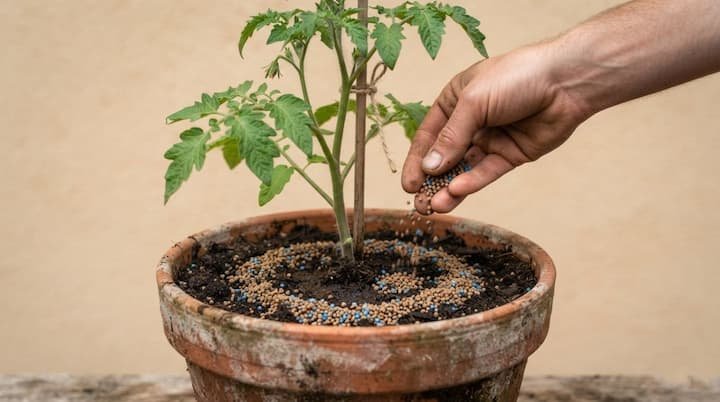
- Granules: scratch into the top 2 inches of soil in a ring about 6 inches from the stem, then water in.
- Liquid: soak the soil around the base with a watering can or hose-end sprayer, not the leaves, and do it in the morning.
- Foliar spray: half strength or weaker, early in the cool of the day.
Water dry beds first, since dry soil plus fertilizer burns roots fast. Planting depth also decides where roots sit, so check planting depth before placing granules.
Containers, Raised Beds and In-Ground Rows
Penn State Extension notes that potting mix usually carries only about two weeks of fertilizer before plants need feeding.
- Containers: use at least a 5-gallon pot per plant, then feed weekly after the first 2 weeks.
- Raised beds: compost on top plus a slow-release granule. Beds drain fast, so feed a little more often.
- In-ground rows: let the soil test decide. Clay holds nutrients longer than sand.
- Community gardener plots: often rich in compost, so test first.
Determinate vs Indeterminate Feeding
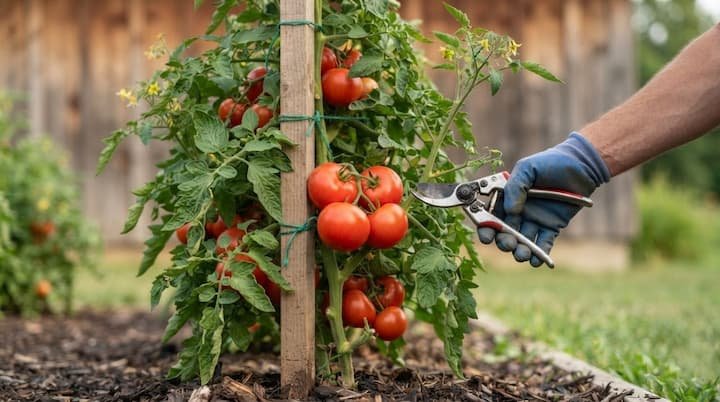
Bush types (determinate) set most fruit in one window. Feed heavier early, then taper after fruit set. Vining types (indeterminate) keep growing and fruiting until frost, so they need steady feeding. Sturdy tomato cages and regular pruning tomato plants with clean pruners suit vines.
- Cherry types: lighter feeding is usually enough.
- Large beefsteaks: extra phosphorus and potassium once fruit starts sizing up.
Reading the Leaves: Deficiency Chart
| Symptom | Likely Cause | Fix |
|---|---|---|
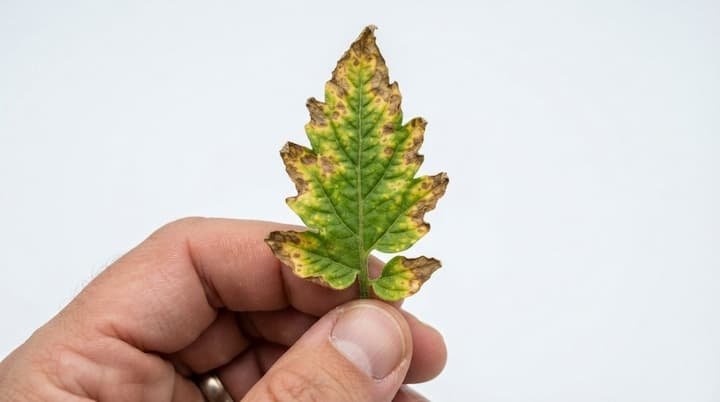
| Pale, yellow lower leaves | Low nitrogen | Fish emulsion or a balanced liquid |
| Purple tint on leaves and stems | Low phosphorus, often cold soil | Bone meal, or wait for warmer soil |
| Yellow new leaves | Low iron or high pH | Chelated iron, check pH |
| Yellow or gold spots on young leaves | Low manganese | Micronutrient foliar spray |
| Brittle leaves, orange or bronze color | Low zinc | Zinc supplement |
| Small, curled leaves | Low boron | Light dose of a micronutrient blend |
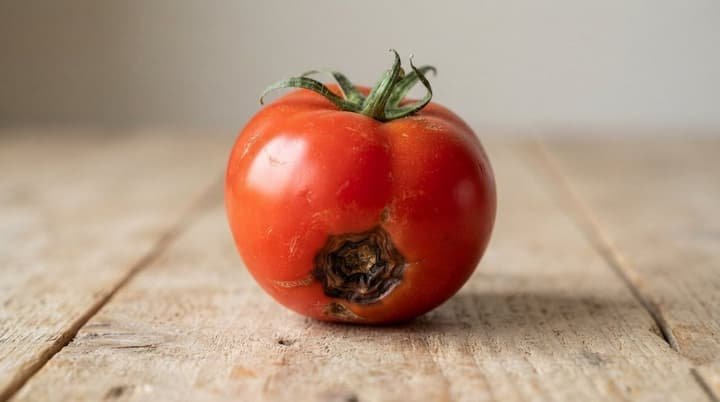
| Dark, sunken spot on fruit bottom | Calcium not reaching fruit | Even watering plus gypsum |
| Yellow or scorched edges on older leaves | Low potassium | Higher-potassium feed like 3-4-6, or kelp |
| Yellow between veins on older leaves | Low magnesium | Epsom salt, only if a test shows low magnesium |
| New leaves stay unrolled, leaf tips die | Low copper | Micronutrient blend with copper |
| Brown, burnt leaf edges right after feeding | Fertilizer burn | Flush with water, see the next section |
Blossom end rot often has plenty of calcium in the soil behind it. Iowa State Extension ties it to swings between dry and soaked ground and says tomatoes need about 1 to 1.5 inches of water per week in the growing season. Mulch keeps that moisture steady. More in common tomato problems.
Too Much Fertilizer: Signs and Recovery
I burned two plants in my first summer by adding extra, and the leaf edges went brown within days.
- Thick, dark green leaves with few flowers.
- White crust of salt on the soil surface.
- Scorched leaf edges.
- Wilting even though the soil is wet.
Recovery steps:
- Stop feeding for 2 to 3 weeks.
- Flush with water, several gallons for a large pot.
- Trim burnt leaves with clean pruners.
- Restart later at half rate.
Natural Minerals and Amendments
- Calcium: gypsum adds it without changing pH. Lime adds it too but raises pH, so use it only when pH tests low.
- Eggshells: crush fine, they break down slowly.
- Magnesium: Epsom salt only helps when a test shows low magnesium.
- Sulfur: usually fine in compost-rich soil.
- Iron: most useful early, in the vegetative stage.
Used coffee grounds give a mild nitrogen bump and work best added through compost.
DIY Homemade Mix
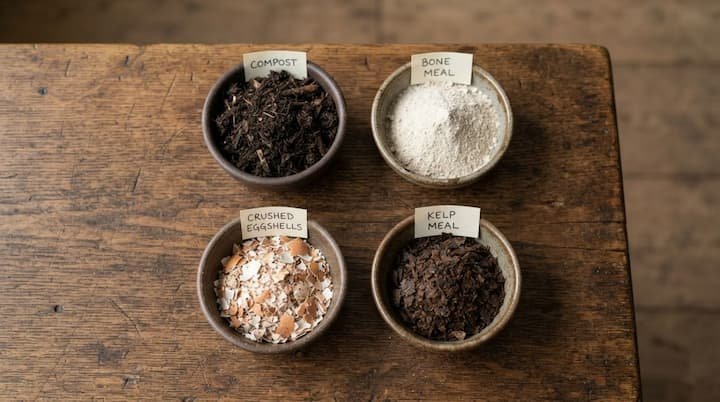
In my experience, compost alone covers a lot, and a few add-ins fill the gaps. Work 2 to 3 inches of homemade compost into the top 6 inches of soil.
- Bone meal, about a half cup per plant, for phosphorus.
- Kelp meal for minerals and stress tolerance.
- Small amounts of blood meal when leaves look pale.
- A light dusting of wood ash only if the soil is acidic.
- Crushed eggshells and composted coffee grounds.
- Pet or human hair, which some gardeners add to keep pests away.
Mix everything evenly, spread it on beds, native soil or pots at planting, and side-dress once more at first flowers. Test the soil first, since the right ratio depends on what the ground already holds.
Mistakes That Waste Fertilizer
- Feeding a high-nitrogen blend once flowers show.
- Fertilizing dry soil.
- Piling granules against the stem.
- Skipping the soil test.
- Using a general fertilizer for tomato plants with no calcium or magnesium listed.
- Spreading fresh manure.
- Feeding right before heavy rain.
I think the biggest one is adding more whenever leaves look pale, since cold soil or overwatering can cause that too.
Runoff, Pets and Safe Storage
Extra fertilizer washes into waterways and feeds algae blooms that starve aquatic life. Skip feeding before heavy rain and stay within label rates, organic or not. Organic and slow-release types leach less.
- Bone meal and blood meal attract dogs and raccoons, so work them well into the soil.
- Store bags in sealed bins, dry and off the floor.
- Wear gloves, keep liquid off ripe fruit, and rinse tomatoes before eating.
- Empty bags go in the garbage, not the compost.
Cost Per Season
- Granular tomato plant food needs just 2 or 3 applications, so cost per feeding stays low.
- Liquid every 2 to 3 weeks means 5 to 8 feedings by Fall, and weekly organic mixes like Big A cost more.
- Water-soluble powder is cheapest per gallon, and one 5 lb bag can make 1,000 gallons.
- Compost costs the least in the long run.
- Cost per plant: divide the bag price by the feedings on the label, then by the number of plants fed.
- Best value for a small backyard: one slow-release granule at planting plus occasional liquid.
Final Thoughts:
The best fertilizer for tomatoes is the one that matches the soil test, the growth stage, and the way the plants are grown. Start with a balanced base feed, shift to lower nitrogen at flowering, and stop before the Fall frost. Keep notes each season and adjust. For the bigger picture, see this guide to growing tomatoes.
Pingback: How to Ripen Green Tomatoes: Easy Proven Ways That Work