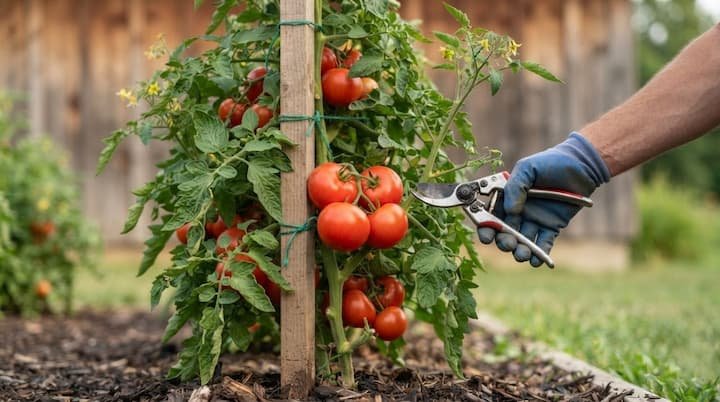
Ever wonder why two pepper plants, same variety, same sun, same watering can, end up looking like they belong to different gardens?
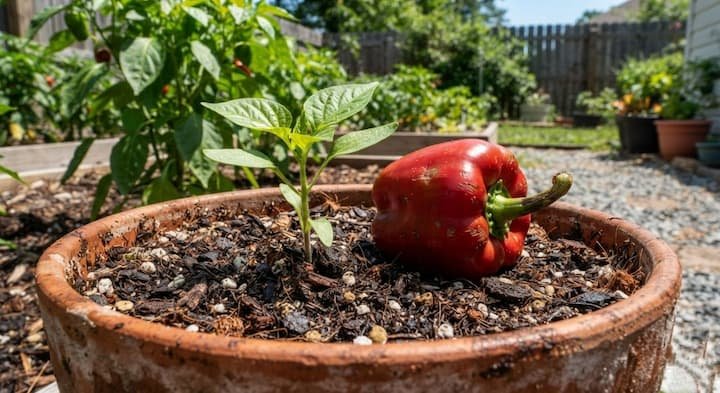
Nine times out of ten it comes down to what’s under the roots. Peppers are picky about soil in a way tomatoes just aren’t, and one wrong bag can stall a whole season.
So here’s the short version: the best soil mix for peppers is loose, drains fast, holds a little moisture, and sits at a pH of 6.0 to 6.8. Below, I’ll break down what that looks like for pots, beds, and your yard, plus the mixes I’d actually build, with real ratios.
What Makes the Best Soil Mix for Peppers Work
Peppers ask for five things from the ground, and missing one shows up fast in the plant:
- Fast drainage so roots never sit in water.
- Air pockets around the roots.
- Steady moisture that never gets soggy.
- A slightly acidic pH of 6.0 to 6.8
- Balanced food, not a nitrogen overload.
Tomatoes forgive denser dirt and lettuce shrugs off wet roots, and carrots just want loose, stone-free soil. Peppers don’t. Root rot from soggy soil is the top reason healthy transplants collapse in early summer.
Quick Pick: Which Mix Fits Your Setup
Not sure where to start? Match your setup in this table, then read the section that fits.
| Setup | Go-to mix |
|---|---|
| Pots (5+ gallons) | 60% potting mix, 20% compost, 20% perlite |
| Raised bed | Equal parts compost, coco coir, vermiculite |
| In-ground, clay yard | 4-6 inches compost plus 20-25% perlite |
| In-ground, sandy yard | 30% compost plus 10% vermiculite |
| Seedlings | Sterile seed-starting mix |
| Hot and super-hot types | Leaner mix: 55% topsoil, 25% perlite, 15% compost, 5% greensand |
| Bell peppers | Compost-rich, fast-draining, light on nitrogen |
Check Your Soil Texture and Drainage First
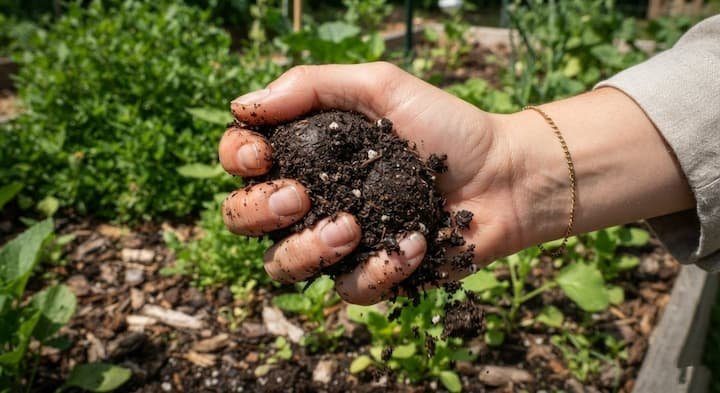
Spend ten minutes on tests before buying anything. Squeeze a handful of moist soil: it should hold its shape, then crumble when poked. Slick and stuck together means clay. Falls apart at once means too sandy. Healthy soil usually has a dark color and a crumbly feel.
For a jar test, fill a quart jar one-third with soil, top it with water, shake, and let it settle for a day. Sand drops first, silt next, clay on top, so you can see your ratio. For a drainage test, dig a hole 12 inches deep, fill it with water twice, and time the second drain.
Roughly 1 to 2 inches an hour is healthy. If water sits all day, you have a problem. And if a screwdriver won’t push 6 inches into moist soil, it’s compacted.
Aim for loam (a mix of sand, silt, and clay) with 3-5% organic matter. Most native soil only has 0.5-2%.
Soil pH for Peppers: Getting It Right
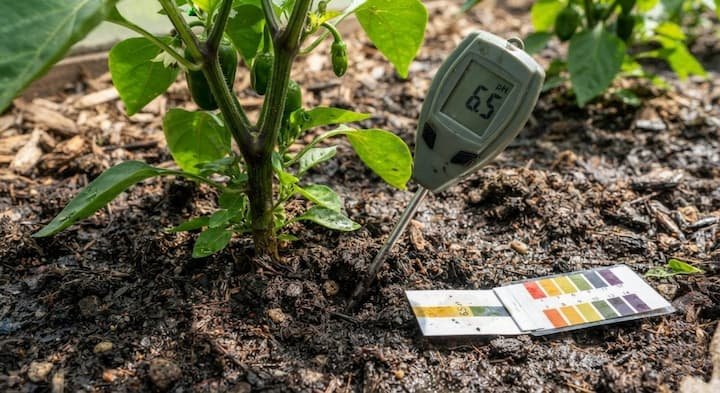
Peppers do best at a pH of 6.0 to 6.8. Penn State Extension explains that soil pH controls how available nutrients are, so a plant can starve in soil that’s full of food. Purple leaf undersides or yellow leaves with green veins often point to pH, not hunger.
Test with a meter or strips, or send a sample to your county extension lab. It usually runs $15-$20 and also reports nutrients plus a lime or sulfur rate.
Follow that rate. As a rough guide, 5 pounds of lime per 100 square feet raises pH about half a point, and 1 pound of sulfur lowers it about the same. Both take 3-6 months, so fall is the time to fix it, not the week before planting. Above 7.5, iron and manganese lock up, and below 5.5, aluminum becomes a problem. Very acidic soil may need lime over a couple of years.
For a home strip test, stir 2-3 tablespoons of soil into an equal amount of distilled water, dip the strip for 1 second, and read it after 60 seconds. Extension reports also show organic matter. Peppers survive a pH above 7 but grow poorly, so if yours is far off, raised beds or bagged mix in pots skip the fight.
Key Ingredients and What Each One Does
- Compost: feeds the soil and fixes both clay and sand. Use aged compost, at least 90 days old, since fresh can burn roots.
- Coco coir or peat moss: holds moisture without packing down. Coir rewets easily, peat adds acidity.
- Perlite: drains and aerates. Use 10-20% of the mix.
- Vermiculite: holds water and nutrients. Use 5-10%.
- Coarse sand: helps drainage in beds. Never play sand, it packs tight.
- Worm castings: 10-15% by volume (about 2 cups in a 5-gallon pot) gives roots a head start.
- Bark fines: keep raised beds from compacting over the years.
- Greensand and aged manure: potassium and slow food. Never raw manure.
Put bone meal and kelp meal in the planting hole, not across the bed, since phosphorus moves slowly.
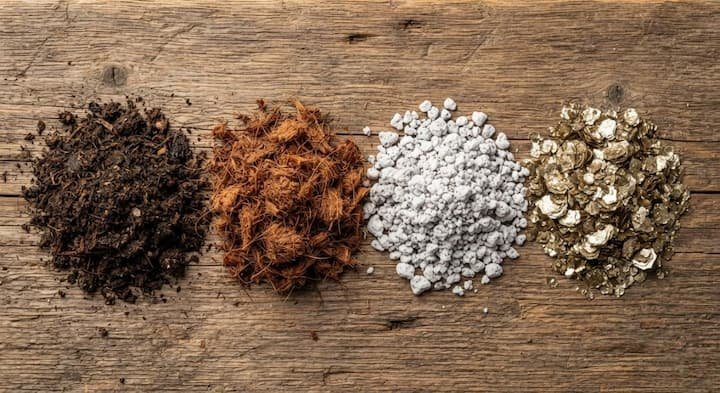
Seed-Starting Mix, Potting Mix, Potting Soil and Garden Soil
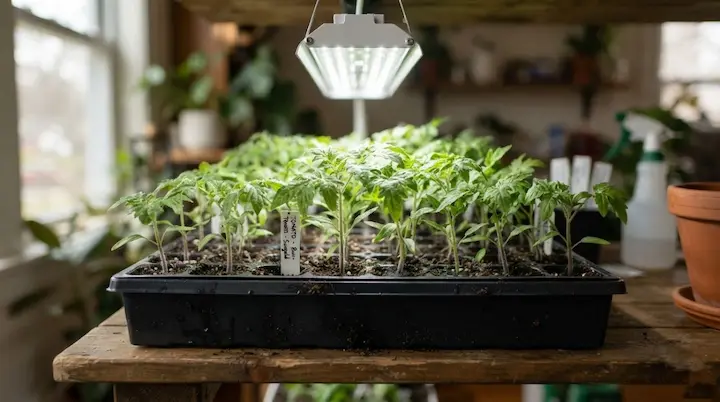
Seedlings need a light, sterile seed-starting mix. Regular potting soil is too dense and can carry fungus that causes damping-off.
Buy a bag, or blend equal parts peat or coir, fine compost, and vermiculite, then bake it at 180°F for 30 minutes (it smells). Skipping this to save money usually costs you seedlings.
Potting mix has little or no real dirt, just peat or coir, perlite, and bark. Potting soil includes garden soil, so it’s heavier. For pots, mix is the better pick. Bagged raised bed mix is usually compost-heavy, while plain topsoil packs down, so amend it.
Garden soil never goes in a pot. It turns to brick by midsummer.
Homemade Pepper Soil Mix Recipes for Containers
All of these work in a pot with drainage holes:
- 60-20-20: 60% potting mix, 20% compost or castings, 20% perlite.
- 50-25-15-10: potting mix, perlite, compost, coco coir.
- Classic: half peat or coir, a quarter compost, a quarter perlite.
- Hatch-style: equal parts topsoil, compost, and coarse sand, best in big pots or beds.
I like the 60-20-20 for beginners. If you use peat, add 1 tablespoon of garden lime per gallon to offset the acid. A homemade pepper soil mix runs about half the cost of premium bags once you’re filling ten or more pots. Pure compost only works if it’s top quality, and it gets heavy and salty fast.
Two simpler ratios work too: 2 parts potting mix, 1 part compost, 1 part perlite or sand, or equal thirds compost, coir, and perlite. Mix dry in a bucket until even. Pure compost, or a 10-part compost base with fish and bone fertilizer, works only with top-quality compost.
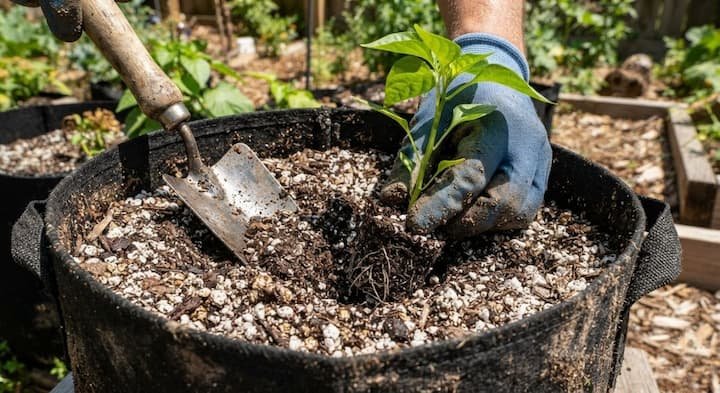
Building a Raised Bed Soil Mix
- Raised bed soil for peppers, option one: equal thirds blended compost, coco coir, and vermiculite
- Option two: 40% topsoil, 30% compost, 20% perlite, 10% aged bark fines
Raised bed soil for peppers gets pricey if you guess the volume wrong. Multiply length by width by depth in feet. A 4 x 8 foot bed filled 1 foot deep needs 32 cubic feet, which is about 1.2 cubic yards of bulk soil or roughly 16 to 21 bags.
Bulk from a landscape yard is cheaper, just ask for screened. Metal and wood sides warm the soil to 65°F weeks earlier, which helps in USDA Zones 4, 5, 6, 7 and 8. Soil settles, so top up with 1-2 inches of compost each spring. Plant spacing is covered in raised bed spacing.
Row covers add another 5-8°F on cold nights, and a 4 x 8 foot bed fits 8 to 10 plants, 12 to 18 inches apart.
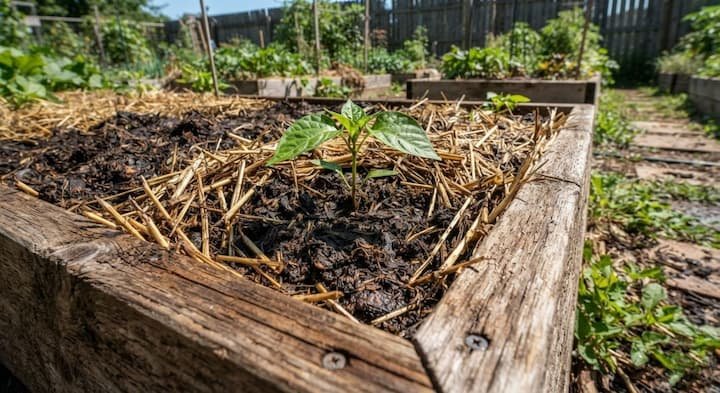
Amending Your Yard Soil In the Ground
Test first, then fix what the test says. If you’re a community gardener on a shared plot, this matters even more. Soil for pepper plants in a shared bed may carry old disease or leftover fertilizer.
For clay, work 4-6 inches of compost across the whole bed, not just the planting holes, or roots hit a clay wall and circle back. Add perlite at 20-25% by volume too.
A simple in-ground blend is 2 parts native loam, 1 part compost, 1 part aged manure, plus a cup of perlite per square foot. For sandy yards, add compost plus shredded leaves to slow the drainage. Mix everything 6 to 12 inches deep, and use a broadfork instead of a tiller to keep worm tunnels intact.
Let the bed settle 2-3 weeks before planting. A fall cover crop like crimson clover or hairy vetch, sown about 6 weeks before first frost, feeds next year’s peppers. Cut it 3-4 weeks before transplanting. Top the bed with fresh compost every season and aerate it once a year.
Best Potting Soil for Peppers From the Garden Center
Five bagged options come up a lot:
- FoxFarm Ocean Forest: rich in castings, pH around 6.3-6.8, can be strong for tiny seedlings.
- FoxFarm Happy Frog: includes mycorrhizae, good for beginners.
- Espoma Organic: mycorrhizae too, pH 6.0-7.0
- Black Gold: light and airy, but fungus gnats can show up indoors.
- Potting soil for peppers on a budget: Miracle-Gro Performance Organics, though fluff it first because it can compact.
Check the label for compost or coir plus perlite or vermiculite. Skip bags labeled topsoil or garden soil for pots. A good bag feels springy when squeezed.
Skip “moisture control” mixes, since they hold extra water peppers don’t want. If a bag is dense, stir in 1 part perlite to 3 parts mix. At about 0.67 cubic feet per 5-gallon pot, premium bags run roughly $9-$12 a plant versus $5-$6 DIY. I think bagged wins for 1-5 pots and DIY wins at 10 or more.
To fix a bag, stir in compost, then water a test pot: standing water means add perlite. Skip fertilizer-packed mixes for seedlings, and don’t overdo lime.
Soil for Pepper Plants by Variety and Pot Size
Bell peppers react badly to too much nitrogen and are prone to blossom end rot, so keep the mix compost-rich but airy and at least 12 inches deep.
Hot and super-hot types like a leaner, potassium-forward mix at pH 6.0-6.2, with the soil allowed to dry a bit between waterings during fruiting. Mild stress can raise heat. Sweet types are easygoing.
| Pepper type | Minimum pot size |
|---|---|
| Sweet peppers | 3-5 gallons |
| Bell, poblano, Hatch | 5-7 gallons |
| Hot peppers | 5-7 gallons |
| Tall types like pepperoncini | 10-15 gallons |
That’s about 0.5 cubic feet of mix for 3-5 gallon pots, 0.8 for 5-7 gallons, and 1.5 for 10-15 gallons.
Fabric and terracotta pots dry out quickly, while plastic holds moisture longer and gets hot in full sun. Bigger pots swing less between wet and dry. Check bell peppers in pots for the full container setup.
Feeding the Soil: Nutrients, Calcium and Magnesium
Compost gets plants started, fertilizer keeps them going. For the first 6-8 weeks after transplanting, a balanced 10-10-10 or fish emulsion every two weeks works.
Once flowers show, drop the nitrogen and switch to something like 5-10-10. Seedlings do fine on a balanced 5-5-5, and a potassium-heavy blend like 11-11-40 helps once fruit sets. Pick nitrate-form nitrogen over ammonium-form.
Too much nitrogen gives you a leafy bush that’s slow to set fruit. If fruit stalls on green, not turning red covers the usual causes. The pepper fertilizer guide has brand picks.
Blossom end rot is usually uneven watering, not missing calcium, and foliar calcium sprays won’t fix it. For truly low calcium, bone meal or gypsum in the planting hole helps. Yellow leaves with green veins can mean low magnesium, but test before adding Epsom salt.
Mulch, Soil Temperature and Watering
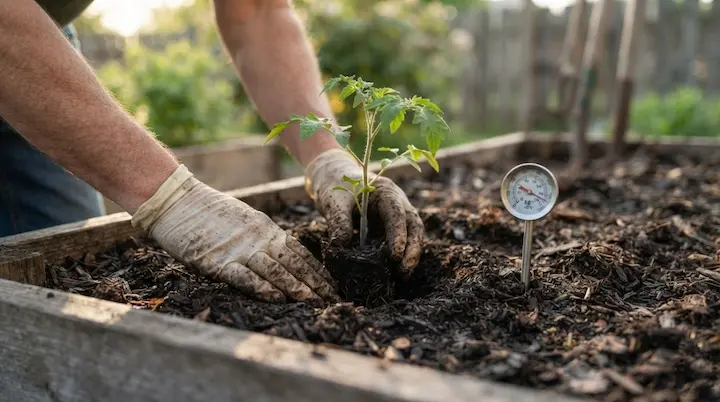
Pepper roots slow down below 65°F, so wait for warm soil before transplanting. Black plastic warms soil fastest. Straw or shredded leaves cool it in heat.
Spread 2-3 inches, and keep it a few inches off the stem so rot can’t start. In hot, dry parts of the Southwest, add extra compost and mulch. In humid areas of the Southeast, lean on perlite. Cool northern yards do best in raised beds.
Hard overhead spraying compacts the surface, so water at the base with drip or a soaker hose, and let the top inch dry between waterings. The guide to watering pepper plants covers timing.
Push a finger 1 inch down to check: dry means water, damp means wait.
Common Soil Problems and Fixes
- Yellow lower leaves, heavy pot: waterlogged soil. Let it dry and check the drainage holes.
- Stunted plant, sour smell: poor drainage. Repot in fresh mix.
- Purple leaf undersides: phosphorus locked out by cold soil or pH. Test it.
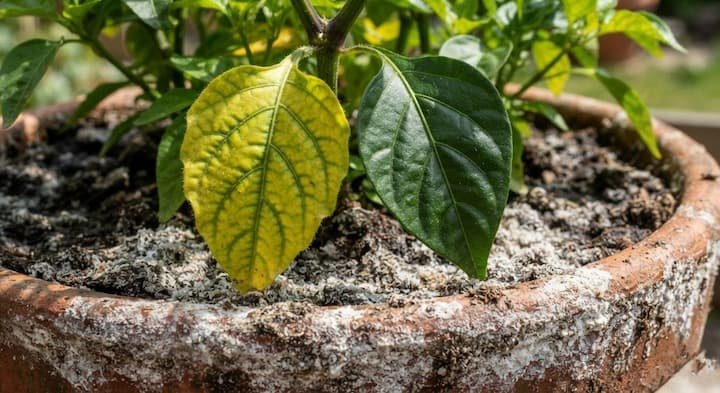
- Yellow leaves, green veins: high pH or low magnesium.
- Curling leaves: often heat or water stress, see leaves curling.
- Fungus gnats: dry the top 2 inches, add yellow sticky traps, and drench with Mosquito Bits (BTi) every 5-7 days. A gnat life cycle takes about 2.5 weeks, so act fast, and topdress pots with coarse sand.
- White crust on pots: salt buildup. Flush every 4-6 weeks until water runs freely for several minutes.
Older leaves yellowing from the bottom up mean low nitrogen, so feed fish emulsion. Brown, curled leaf edges point to low potassium, so add kelp meal. A plant that feels heavy for its pot needs fresh, dry mix.
Soil diseases like Phytophthora, Verticillium, and nematodes build up in the same bed. Rotate crops, and send diseased plants to the trash instead of the compost pile. In a hot summer, solarize an infected bed by covering moist soil with clear plastic for 4-6 weeks.
Soil Mistakes and Myths
- Garden soil or play sand in pots.
- Fresh manure, which burns roots and can carry bacteria.
- Too much lime, which locks up nutrients.
- Peat-heavy mix in a humid yard.
Two myths stick around. A gravel layer at the bottom of a pot doesn’t help drainage, since water pools above the gravel until the soil there is soaked.
In my experience it just shrinks the root zone. And adding plain sand to clay can make something close to cement, so use compost and perlite first. Crushed eggshells break down too slowly to fix blossom end rot.
Never work or walk on wet soil, since it compacts, and don’t overfeed, which burns roots.
Seasonal Soil Care, Reuse and Rotation
Spring: test and amend 2-4 weeks before transplanting. Mid-season: top-dress pots with fresh compost every 4-6 weeks, and mulch beds. Fall: pull spent plants, add a 2-inch layer of compost, and sow a cover crop.
I’ve reused potting mix from healthy plants by pulling out roots, screening it, and blending half old mix with half new mix plus fresh perlite. If plants had disease, bag the mix for the trash. For rotation, keep peppers out of any bed that grew tomatoes, peppers, eggplant, or potatoes in the last 3 years.
Overwintering potted plants? Keep the mix on the dry side, since cool roots in wet mix rot. The guide to overwintering pepper plants covers the rest. For timing, see when to plant, and for starting seeds, growing from seed.
Conclusion: Your Soil Prep Checklist
Get the soil right and most of your pepper problems never show up. Clear weeds and debris, test your pH, make sure water drains, mix in compost, and soak the bed or pots before planting. Whether you build the best soil mix for peppers yourself or buy a bag and fix it up with perlite, aim for loose, airy and slightly acidic. Every backyard is different, so adjust after a season and keep notes.