Walk into any plant shop or scroll through a home decor feed, and you’ll spot the ZZ plant everywhere that glossy, low-maintenance green centerpiece sitting on shelves in nurseries, offices, and living rooms alike.
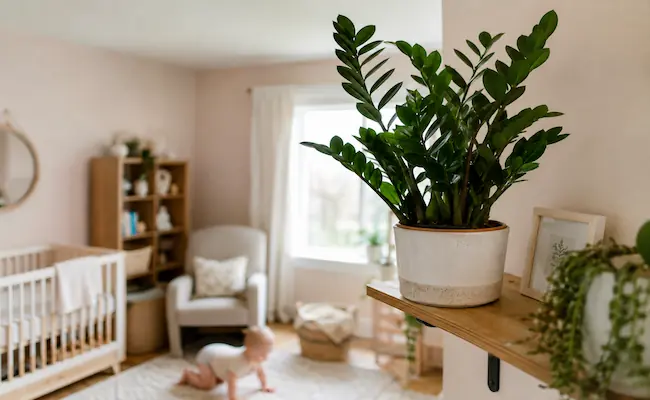
But if there’s a baby crawling around the house, you might be wondering: are zz plant toxic to babies, and should that pretty plant in the corner actually worry you? The answer isn’t as scary as some articles make it sound, but it’s not nothing either. Here’s what really happens if a baby gets hold of one.
Are ZZ Plant Toxic to Babies? The Straight Answer
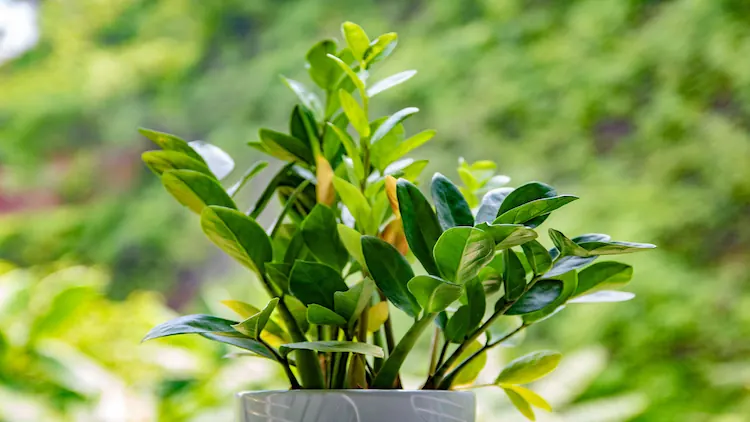
Yes, the ZZ plant (Zamioculcas zamiifolia) is toxic to babies if a piece of it ends up in their mouth. It belongs to the Araceae family, the same group as pothos and dieffenbachia, and it’s easy to see why it’s such a popular houseplant it survives on neglect, tolerates low light, and keeps its deep green color on thick, glossy stems that grow 2 to 3 feet tall.
That toughness comes from a built-in defense system. Every leaf, stem, and root holds tiny needle-shaped crystals that irritate soft tissue on contact.
This isn’t a systemic poison that spreads through the bloodstream it behaves more like a mouthful of tiny glass shards.
Painful, yes. Life-threatening, almost never. For zz plant baby safety, the real concern is contact and irritation, not chemical poisoning. Some parents search this question as is zamioculcas toxic to infants, using the plant’s scientific name it’s the same plant, and the answer doesn’t change.
What Is a ZZ Plant, Exactly
Before the risk side of things, it helps to know what you’re actually dealing with.
The ZZ plant, or Zamioculcas zamiifolia, is native to Eastern Africa and became a houseplant favorite because it barely needs you around to survive. You’ll recognize it by its thick, waxy, dark green leaflets growing in feathery pairs along upright stems, usually topping out around 2 to 3 feet indoors.
It stores water in potato-like underground rhizomes, which is why it shrugs off a missed watering or two. Nice plant for a busy household just one you need to place with a baby’s reach in mind.
Why This Houseplant Bites Back
The mechanism behind the sting has a name: raphides microscopic, needle-shaped calcium oxalate crystals stored in special cells throughout the plant. The moment a baby bites down and breaks those cells open, the crystals dig into the mucous membranes of the mouth and throat.
The ASPCA lists the ZZ plant alongside pothos, peace lily, dieffenbachia, and philodendron as one of the common insoluble calcium oxalate plants its poison control center regularly fields calls about (ASPCA). It’s a well-documented category, not internet rumor.
How Serious Can It Really Get
Here’s the good news: the pain itself works as a built-in safety brake. It hurts enough, fast enough, that most kids stop after one bite instead of swallowing a whole leaf.
Research cited by the University of Vermont notes the calcium oxalate crystals in ZZ plants are chemically related to the compounds that form kidney stones in humans, which explains the sharp, immediate reaction (HomeGuides/SFGate). There’s no official “safe dose” published anywhere, so any exposure still deserves a call to Poison Control rather than a wait-and-see approach.
Risk Changes With Your Babies Age
Not every age group faces the same risk, so it helps to know where your babies falls. A newborn who can’t move is exposed mostly through a caregiver’s hands or clothing, while a crawling baby will actually reach the pot, grab a leaf, and head straight for their mouth. Toddlers carry the highest risk, since they can bite through a stem and swallow a real piece rather than just mouthing it.
| Age Group | Main Risk | What to Watch |
|---|---|---|
| Newborn (0–6 months) | Indirect contact through a caregiver’s hands or sap residue | Skin redness after being held or fed |
| Crawling infant (6–12 months) | Touching soil or leaves, then mouthing hands | Drooling, lip swelling |
| Toddler (1–3 years) | Direct biting or chewing of leaves | Burning, crying, spitting out plant bits |
ZZ Plant Poisoning Symptoms in Babies
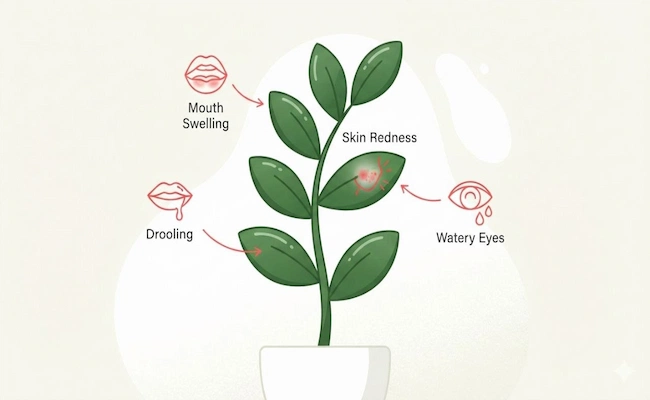
Symptoms usually show up within minutes and stay concentrated around the point of exposure. Unlike a food allergy that can spread across the whole body, this reaction tends to stay local mouth, skin, or eyes which is part of why it rarely turns into something more serious.
- Mouth and throat: burning sensation, heavy drooling, swollen lips or tongue, trouble swallowing.
- Skin: redness, itching, or a mild rash wherever the sap touched.
- Eyes: burning, tearing, or redness if a hand carrying sap rubs the eye.
- Stomach: nausea or vomiting if a larger piece was actually swallowed.
One scenario people don’t always think about: handling the plant while repotting or pruning, then breastfeeding without washing your hands first. Trace sap can transfer to the skin and cause the same irritation for the baby. It’s a small risk, but an easy one to avoid just rinse your hands before feeding time, same as after handling any plant.
When It’s an Emergency vs. When You Can Handle It at Home
Home care is usually enough when:
- There’s mild lip redness or a bit of drooling.
- The baby is upset but breathing normally.
- No swelling is spreading.
Call Poison Control right away if:
- Swelling keeps growing.
- Crying won’t settle down.
- Vomiting starts.
Get to the ER or call 911 if:
- Breathing looks labored or noisy.
- Lips or face start turning bluish.
- The throat seems to be closing up.
- The baby becomes unusually quiet or unresponsive.
What to Do the Moment It Happens
- Gently remove any leftover plant material from the mouth.
- Rinse the mouth with cool water to wash away remaining crystals.
- Offer small sips of milk or water don’t force it if the baby resists.
- Call Poison Control at 1-800-222-1222 and describe how much was likely eaten.
- Hold onto a piece of the plant so you can identify it for the doctor if needed.
None of these steps require rushing to the emergency room by default. Most cases are managed calmly at home over the phone, and Poison Control will tell you if a hospital visit is actually necessary.
What to Expect at the Doctor’s Office
If Poison Control sends you in, don’t expect anything dramatic. A doctor will typically rinse the mouth again, check for throat swelling, and offer pain relief if needed. Anti-nausea medication might come into play if vomiting is severe, but that’s not the norm. Most visits end with a short observation period, since the reaction almost always runs its course within 24 hours on its own.
How the ZZ Plant Stacks Up Against Other Toxic Houseplants
| Plant | Toxicity Level | Common Symptoms |
|---|---|---|
| ZZ Plant | Mild to moderate | Mouth/throat irritation, drooling |
| Pothos / Philodendron | Mild to moderate | Similar oral irritation, swelling |
| Dieffenbachia | Moderate to high | Throat swelling that can affect breathing |
| Peace Lily | Mild | Milder version of the same reaction |
The main takeaway: ZZ plant sits in the middle of the pack not as mild as a peace lily, but nowhere near as risky as dieffenbachia, which can genuinely interfere with breathing in severe cases.
If there’s a dog or cat in the house too, the reaction plays out a little differently it’s worth checking whether are zz plant toxic to dogs or are zz plant toxic to cats before assuming the risk is identical to a baby’s.
Common Myths About ZZ Plant Toxicity
A lot of the fear around this plant comes from a few myths worth clearing up before you decide it has to go:
- It’s deadly poisonous: It’s not. The reaction is painful and unpleasant, but fatalities from ZZ plant ingestion aren’t something you’ll find documented.
- Just touching it is dangerous: Brief contact with an intact leaf is generally fine. The sap released from a broken stem or leaf is what actually causes irritation.
- It releases toxic fumes into the air: No, it doesn’t. There’s no airborne risk the danger is only from direct contact or ingestion.
Keeping these straight helps you make a level-headed decision instead of an overly cautious one.
Baby Safe Houseplants to Swap In
If keeping a toxic plant around feels like more stress than it’s worth, plenty of good-looking alternatives won’t cause this reaction:
- Parlor Palm (Chamaedorea elegans).
- Spider Plant (Chlorophytum comosum).
- Boston Fern (Nephrolepis exaltata).
- Peperomia and Haworthia varieties.
None of these are truly harmful if a curious baby takes a nibble, though any plant material in bulk can upset a small stomach. For a broader list, check out best indoor plants for every home before your next nursery run.
Keeping Your ZZ Plant Baby-Proofed Year-Round
- Keep it on a high shelf or hanging planter, out of reach from any crawling baby
- Wear gloves when using pruners to trim it back- Wash your hands before picking up the baby after handling the plant
- Pick up fallen leaves right away and toss them in the trash/garbage, not the yard- Label the pot if a babysitter, grandparent, or community gardener friend is watching the kids and might not know it’s risky
- Keep the Poison Control number saved on the fridge or in your phone
- Sweep the plant’s base after pruning, since cut stems shed more concentrated sap than an intact leaf
None of this means the plant has to leave the house. A little placement strategy a hanging basket instead of a low side table usually solves most of the risk without giving up a plant this easy to keep alive.
The plant is forgiving on care too, so there’s no need to fuss over the soil constantly see how often to water a zz plant to keep the routine low-stress.
If it spends summer on the backyard patio in USDA Zones 9 through 11, bring it back indoors well before Fall anything under 45°F stresses the plant, and outdoor soil means more fallen leaf debris within reach of small hands. Even someone who tends their Zucchini and Eggplant beds like a seasoned community gardener might not realize a common houseplant carries this same defense mechanism.
What About the Family Dog or Cat
Pets react to the same crystals, just with different tells: drooling, pawing at the mouth, or vomiting after chewing a leaf. Most cases resolve within 24 hours, but call the vet if drooling won’t stop or your pet seems to struggle breathing.
A Quick Reference Worth Saving
Screenshot the red-flag list above, or jot the Poison Control number on an index card for the fridge. When something like this happens, you won’t want to be searching your phone.
This guide pulls from ASPCA Poison Control data and pediatric toxicology reporting, but it supports your judgment rather than replacing it. If you’re ever unsure, your pediatrician or local poison control center is always the better call than guessing.
Final Thoughts:
So, are zz plant toxic to babies? Yes, mildly, painfully, but rarely dangerously. The crystals inside cause real discomfort if chewed, yet serious complications are uncommon because the pain itself stops most kids before they swallow much. Keep it up high, rinse and call Poison Control if there’s an exposure, and watch for the red-flag signs above. With a few basic precautions, there’s no real reason to give up a plant this easy to keep alive just because there’s a baby in the house.