My neighbor called me in a bit of a panic last month because her Labrador had just torn a leaf off her ZZ plant and was drooling all over the kitchen floor.
That’s the moment most people start typing “are zz plant toxic to dogs” into their phone, and honestly, I’ve been down that same road with my own dog years ago. So let me walk you through everything I’ve learned, without the scary internet exaggeration and without the fluff.
Are ZZ Plant Toxic to Dogs? Here’s the Science
Yes, the ZZ plant (Zamioculcas zamiifolia) is toxic to dogs, but it’s not the kind of toxic that ends in tragedy. The plant is loaded with calcium oxalate crystals called raphides tiny, needle-shaped structures packed inside every leaf, stem, and root.
When a dog bites down, those crystals get released and jab into the soft tissue of the mouth and throat.
A study published through the National Institutes of Health actually looked at how these raphides work as a plant defense mechanism, and researchers found the needle-shaped crystals physically puncture cell membranes to cause irritation, as shown in this NCBI/PLOS One study on raphides. It’s a mechanical injury more than a chemical poisoning, and that distinction matters a lot for how worried you should actually be.
The ASPCA lists the ZZ plant as toxic to both dogs and cats, and their official ASPCA toxic plant database is the one I always point people toward when they’re not sure about a plant they already own.
What Does a ZZ Plant Actually Look Like?
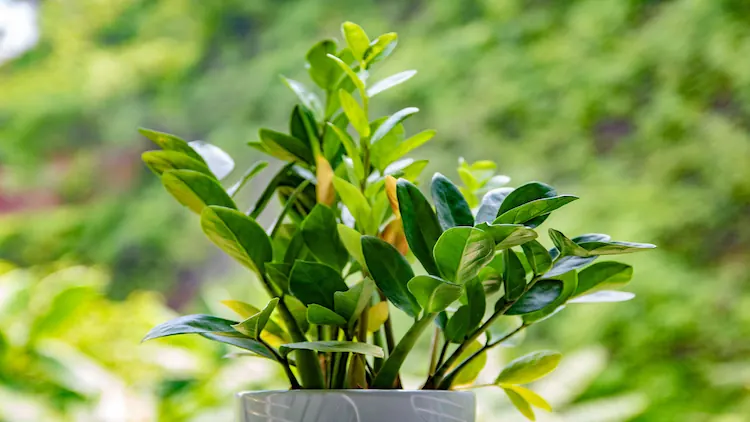
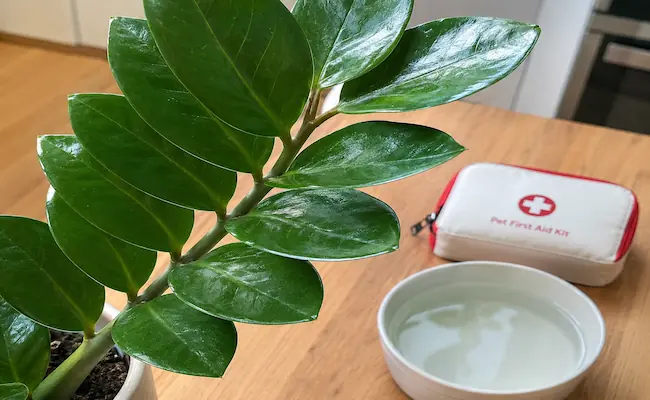
Before you panic, it’s worth double-checking your dog actually got into a ZZ plant and not something else growing in a similar pot nearby. A ZZ plant has thick, upright stems lined with glossy, oval-shaped leaflets, deep green in color, almost rubbery to the touch.
The stems grow straight up out of thick, potato-like rhizomes just under the soil line, often 1 to 2 feet tall in a regular indoor pot.
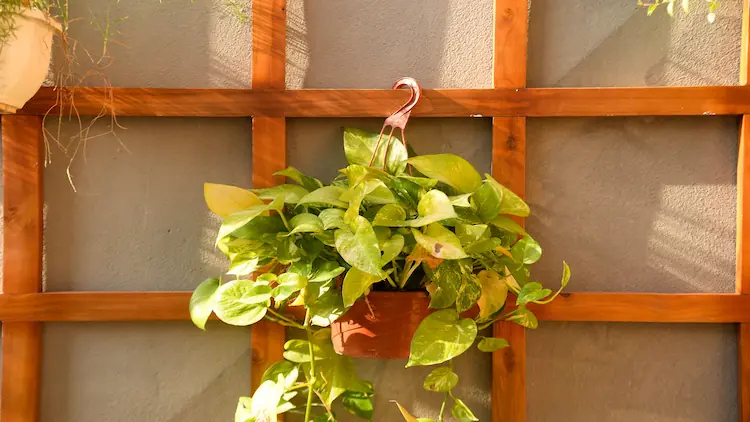
People sometimes confuse it with pothos or philodendron sitting on a nearby shelf, but neither of those has the same stiff, upright growth habit pothos vines trail down, while a ZZ plant stands straight up like a little palm frond.
If you’re not sure what your dog chewed on, save a piece of the leaf in a bag to show your vet. It makes identification a lot faster.
How Bad Is ZZ Plant Toxicity in Dogs, Really?
This is where I think most articles online get people needlessly scared. ZZ plant toxicity in dogs is considered mild to moderate, not life threatening. My dog nipped a stem years ago and was back to normal within an hour after some water and a little fussing on my part.
Here’s a simple way I break it down for people who ask me:
| Amount Chewed | Likely Reaction | What I’d Do |
|---|---|---|
| One small bite or lick | Mild drooling, maybe pawing at mouth | Rinse mouth, watch for an hour |
| A few leaves | Vomiting, more drooling, mouth pain | Call your vet for guidance |
| Large amount (small dog) | Repeated vomiting, swelling, distress | Vet visit same day |
Smaller dogs feel the effects faster because the dose is bigger relative to their body weight. A ten-pound terrier chewing a few leaves is a different situation than a seventy-pound retriever doing the same thing.
Symptoms After Your Dog Chews on a ZZ Plant
If your dog got into your plant, here’s what to keep an eye on:
- Heavy drooling or foaming at the mouth.
- Pawing at the mouth or rubbing their face on the carpet.
- Vomiting or loss of appetite.
- Diarrhea within a few hours.
- Swelling of the lips, tongue, or gums.
- Skin redness if the sap touched their paw or belly.
Most of these show up within the first thirty minutes to an hour, not days later.
Home Monitor or Vet Visit? Here’s My Rule of Thumb
I know the “call your vet immediately” advice everywhere online doesn’t actually tell you what “immediately” means. So here’s how I actually decide:
- Stay home and watch: Your dog took one bite, drooled for a few minutes, and is back to acting normal within 30 to 60 minutes.
- Call your vet for advice, same day: Vomiting happens more than once, your dog keeps pawing at their mouth well past an hour, or they’re refusing food.
- Go in right away, don’t wait: Breathing looks labored, gums look pale or bluish, there’s noticeable swelling around the mouth or throat, or a small dog ate a large amount.
This isn’t a substitute for a real vet’s judgment on your specific dog, but it’s the same rough triage I use before I even pick up the phone.
What to Do If Your Dog Ate ZZ Plant
If your dog ate zz plant material, don’t panic, but don’t ignore it either. Here’s my exact routine when this happens at my own house:
- Pull any leftover leaf or stem out of their mouth right away.
- Rinse their mouth gently with cool water from the tap.
- Offer a small amount of water or plain yogurt to help settle the irritation.
- Do not make them throw up unless a vet tells you to this can sometimes cause more harm than good.
- Watch them closely for the next couple of hours.
Keep the ASPCA Animal Poison Control number handy: (888) 426-4435. I have it saved in my phone, and honestly every dog owner should.
What If It’s Just Skin Contact, Not Eating?
Sometimes your dog doesn’t eat the plant at all they just brush against a broken leaf and get sap on their paw or fur. In that case, rinse the area with cool water and keep an eye out for redness or itching. It’s usually a much smaller deal than ingestion, and it clears up on its own within a day.
How Long Does Recovery Take?
In my experience, and based on what vets generally report, mild cases clear up within an hour or two once the chewing stops.
More significant ingestion with vomiting and diarrhea can take 24 to 48 hours to fully resolve, especially if a vet gets involved with fluids or anti-nausea medication. Dogs bounce back well from this one it’s uncomfortable, not dangerous.
ZZ Plant vs Cats: Is It the Same Risk?
I get asked this a lot, especially by people with a multi-pet house. The toxic mechanism is the same for both, but cats tend to be more curious about chewing on leaves and are smaller-bodied, so the same amount of plant material hits them harder.
| Dogs | Cats | |
|---|---|---|
| Main risk factor | Larger dogs chew more plant material at once | Smaller body size means a bigger dose per pound |
| Typical behavior | Curious nibble, then stop from pain | More likely to keep chewing or playing with leaves |
| Overall risk level | Mild to moderate | Mild to moderate, slightly higher per bite |
If you’ve got a cat too, I’d actually recommend reading my full breakdown on is a ZZ plant toxic to cats since the precautions differ a little between the two pets.
ZZ Plant Dog Safety: Keeping It Out of Reach
This is the part that actually prevents the whole problem in the first place. A few things I do at my own place:
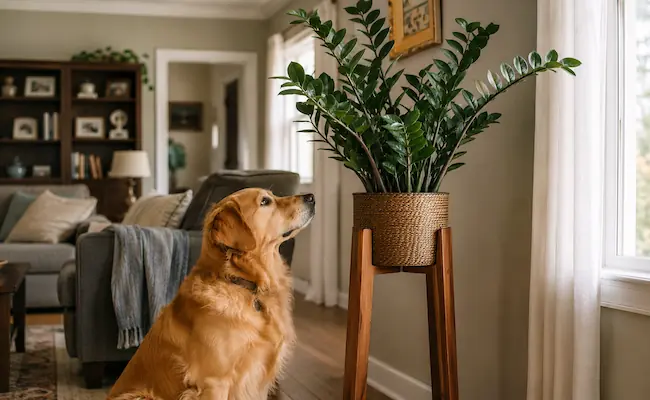
- I keep my ZZ plant up on a stand, about 3 feet off the ground, well past where my dog can reach even standing on his hind legs.
- Anytime I trim it with pruners, I toss the clippings straight in the trash, not the compost pile, since I don’t want stray leaves near my vegetable beds where I grow zucchini and eggplant every summer.
- If you’re a community gardener like me and keep a shared plot, be extra careful dogs from other yards sometimes wander through, and you don’t always know which plants they’ll sniff at.
- Come Fall, when I move mine back indoors from the porch, I make sure it’s not sitting anywhere near 32°F drafts by a door, both for the plant’s sake and so it’s not sitting at nose-level for a curious dog checking out the entryway.
- If you’re in USDA Zones 4, 5, 6, or 7, this plant can’t survive outdoors through winter anyway, so it’s coming inside regardless just plan where indoors it’ll land.
Its deep, glossy green color makes it a real centerpiece favorite on plant stands and mantels, which is honestly part of why so many people keep it despite the mild risk. I don’t think that’s a reason to get rid of it just be smart about placement. If you want more general care tips, I’ve also got a full ZZ plant care guide and a piece on how often to water a ZZ plant that covers the basics from soil to sunlight.
Dog-Safe Plants I’d Pick Instead
If you’d rather skip the risk altogether, especially with a persistent chewer at home, here are a few I’ve grown myself that are non-toxic to dogs:
- Spider plant: nearly impossible to kill, safe for pets.
- Boston fern: great in a hanging basket, needs more humidity.
- Parlor palm: similar tropical look to a ZZ plant without the risk.
- Calathea: beautiful patterned leaves, low light tolerant.
I put together a longer list in my best pet-safe indoor plants post if you want more options for your yard or backyard sunroom.
Final Thoughts:
Look, are zz plant toxic to dogs is a fair question to ask, and yes, the answer is technically Yes but in my experience, it’s one of the more forgiving houseplants out there when it comes to pet mishaps. Keep it out of paw’s reach, know the symptoms, rinse the mouth if your dog gets into it, and call your vet if things don’t settle down quickly. Most dogs, including mine, walk away from a ZZ plant incident just fine within a day.