When I brought home my first string of turtles, I thought it would be like any other hanging plant. Water it, give it some sun, and that’s it. Two weeks later half the leaves had fallen off and I had no idea what went wrong. Turns out this plant looks like a succulent but behaves like something from a rainforest floor.
So you cannot treat it like a cactus, and you cannot treat it like a fern either. That mix-up is exactly why people pick this plant thinking it is “easy” and then end up frustrated. In this article I am going to walk you through everything I had to learn the hard way when to water, what soil to use, how to propagate it, and what changes with the seasons. No complicated terms, just plain talk.
What Is String of Turtles
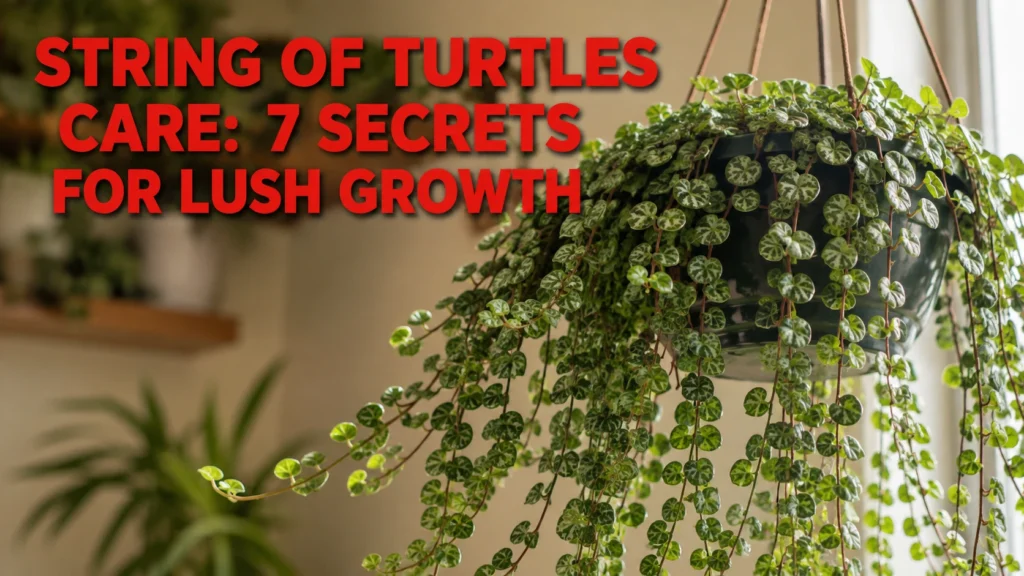
Its botanical name is Peperomia prostrata, and it comes from the rainforests of Brazil, where it grows by climbing up trees and rocks. Each tiny round leaf looks like a little turtle shell, which is exactly where the name comes from.
That pattern on the leaf is not just for looks. In the wild, this plant barely gets any light, so the top part of each leaf is see-through and works almost like a tiny lens, pulling light deeper into the leaf. When the plant gets good light, that pattern shows up sharp and clear. When light is low, the pattern fades and the leaf turns plain green. Keep this in mind, because most of the problems we will talk about later come back to this one point.
Light: What This Plant Wants Most
Bright, indirect light is non-negotiable here. A north or east facing window works best it enjoys that soft morning sun.
If you only have a south or west facing window, keep the plant 3-4 feet back from it, or hang a sheer curtain in between. Direct afternoon sun will scorch the leaves and wash out that lovely pattern until it turns a pale yellow.
Here is something people often get wrong they hang the plant from a high hook, and while the vines trail down nicely into the light, the pot itself sits way up in a dark corner. That means the base of the plant, right at the soil, never sees any light. Over time the stems near the soil weaken and rot, and eventually the whole vine just falls off. So make sure the top of the pot gets light too, not just the trailing vines.
How to tell if the light is right:
- Too much light: leaves turn pale or slightly reddish, and the pattern gets washed out.
- Too little light: new leaves come in bigger and plain dark green, the pattern disappears, and the stem stretches out with bigger gaps between leaves.
Watering: This Is Where Most Plants Die
The roots on a string of turtles are extremely thin and delicate. Too much water sitting around them and they rot almost immediately. So the rule to remember is simple when in doubt, do not water.
How to know when it actually needs water :
Gently pinch one of the older, firmer leaves near the base of the plant. If it feels hard and does not give at all, it does not need water yet. If it feels a little soft and bends slightly, that is your sign to water. This works better than a moisture meter because the pot is usually too shallow for the meter to give an accurate reading anyway.
As a rough guide, that usually works out to about every 8-12 days in warmer months, and it can stretch to 3 weeks in winter but treat that as a rough idea only. The finger test is always the real answer.
Why bottom watering matters :
If you water from the top, it gets trapped between the tightly packed leaves sitting on the soil, since the water has nowhere to drain quickly. That trapped moisture is what rots the stem at the base.
- Fill a bowl with about 2 inches of room-temperature water.
- Set the nursery pot into the water.
- Let it sit for 20-30 minutes so the soil soaks up what it needs.
- Lift it out, let it drain completely, then hang it back up.
Avoid cold water in winter it can cause the leaves to drop suddenly. Just let your water sit out overnight so it reaches room temperature before using it.
A quick way to check the roots :
If the plant looks weak and you cannot figure out why, gently pull it out of the pot and take a look. Healthy roots are white or light cream and feel fairly firm. If they are brown, black, or turn mushy in your hand, that is rot trim away the damaged roots and move the plant into fresh soil right away.
Soil and Potting
Regular potting soil is too heavy for this plant, and pure cactus mix dries out too fast. You want something in between:
- 2 parts peat moss or coco coir.
- 1 part perlite.
- 1 part fine orchid bark.
Go for a shallow pot something like an azalea pot or a bulb pan that is wider than it is deep. The reason is simple: the roots on this plant only go about 2 inches deep. If the pot is too deep, the soil at the bottom stays wet all the time because there are no roots there to soak it up, and that is exactly where fungus gnats and rot start.
Do not rush to repot. This plant does not like being disturbed. Only repot once the soil has fully broken down or the roots are coming out of every drainage hole that usually means once every 2-4 years.
Fertilizer:
This plant does not eat much. During spring and summer, feed it once a month with a balanced liquid fertilizer, diluted to half or even a quarter of the usual strength. Stop completely in winter. Strong fertilizer will burn those delicate roots, so it is always better to underfeed than overfeed here.
Temperature and Humidity
This is a tropical plant through and through, and it does not handle cold well at all.
| Factor | Ideal Range |
|---|---|
| Temperature | 65°F – 80°F (18°C – 26°C) |
| Minimum Safe Temp | Below 55°F (13°C) is risky |
| Humidity | 50% – 70% |
| Light | Bright, indirect (north/east window) |
| Watering | Only when a leaf feels soft, and always from the bottom |
Keep it away from AC vents or cold windows a cold draft will make the leaves drop fast.
Regular indoor air (around 30-40% humidity) is usually a bit too dry for it. A few simple fixes:
- Group it with other plants to build a small pocket of humidity.
- Run a small humidifier nearby.
- It also does really well inside a closed glass terrarium or jar, if you want to go that route.
Propagation: Growing a New Plant From This One
Two methods work well here.
Method 1’st – layering it right in the pot (great for a bald crown):
If the top of the plant has gone bald, take a long trailing vine, without cutting it, and loop it back over the bare soil, pinning it down with a small clip. Wherever the nodes touch the soil, they will root and thicken up the crown again.
Method 2’nd — cuttings:
- Line a clear container with slightly damp sphagnum moss or perlite.
- Snip a few healthy strands from the plant.
- Lay them flat on top of the moss — do not bury them, just let the stem touch the moss.
- Close the lid and place it in bright light.
- In 2-3 weeks, roots will start growing from each node.
I would avoid water propagation for this one the leaves rot the moment they sit in water for too long. If you really want to try it, keep only the bare stem in the water and keep the leaves well above it.
Pruning:
Trimming once or twice a year is enough. Cut just above a node with clean scissors. This pushes the plant to activate new growth points further up, which fills it out nicely. Do not throw away the cuttings they are perfect for starting a new plant.
Pests and Common Problems
Spider mites are the biggest threat here, mostly because the leaves are too small to wipe down one by one. If you notice webbing or tiny moving dots, take the plant to the sink and give it a good rinse, or dip the foliage in a mix of water and mild insecticidal soap.
Mealybugs (white, cottony spots where leaves meet the stem) and fungus gnats (small flies around the soil) are also common, and both usually point back to overwatering. Letting the soil dry out properly is the easiest way to keep both away.
A Simple Season-by-Season Guide
| Season | What To Do |
|---|---|
| Spring (Mar-May) | Start feeding it again, water a bit more regularly, repot only if truly needed |
| Summer (Jun-Aug) | Peak growing time, keep up the feeding, watch the humidity closely |
| Autumn (Sep-Nov) | Cut back on fertilizer, let it dry out for longer between waterings |
| Winter (Dec-Feb) | Stop fertilizing completely, protect from cold and drafts, and do not worry if growth slows right down |
What To Look For Before You Buy One
At the nursery, pick up the pot and give it a gentle shake. If the strands come loose easily, the roots are probably not established, or rot has already started. A full, dense crown matters more than one long trailing vine a bald crown takes years to fill back in, while a long vine can grow back in just a few months.
Use your phone flashlight to check under the leaves before buying that is usually where mealybugs like to hide.
A regular string of turtles is usually reasonably priced in a small pot, while the variegated version, with white or cream edges, tends to be much rarer and more expensive. If someone is selling a “variegated” one at a very low price, take a closer look it is often just sun-bleached leaves being sold as something special .
Final Thoughts:
String of turtles is not the plant you buy and forget about it asks for a bit of attention, especially around watering. But once you get its rhythm down water from the bottom, wait for a leaf to go soft before watering again, and keep the crown in the light instead of just the trailing vines it stops being fussy and actually grows fast. If there is one rule to hold onto through all of this, it is that keeping this plant a little too dry will always work out better than keeping it a little too wet.