
Here’s something that surprises most backyard gardeners: a tomato planted two weeks early often ripens later than one planted on time. Cold ground stalls the roots, and the late seedling simply passes it.
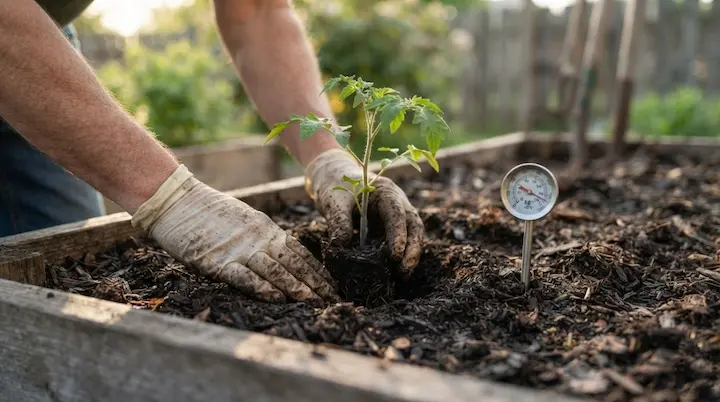
So when to plant tomatoes has less to do with the calendar and more to do with soil, nights, and frost. Whether you garden in USDA Zones 3 through 11 or in a frost-free climate, this guide shows how to read all three.
The Three Numbers That Set Your Planting Date
Three numbers drive every tomato decision: your average last frost date, your soil temperature, and your frost-free season length. The last frost date is a 50/50 average from decades of weather records, so half of all years still see frost after it. Add one to two weeks as a buffer.
- In the US, search your zip code on a frost date calculator or call your county extension office. Outside the US, check your national weather service.
- Your USDA zone shows winter lows, not frost dates. Even inside one zone, tomato planting time by zone can swing a couple of weeks.
- Low spots hold cold air and frost late, hilltops warm sooner, and a south-facing wall or paved backyard runs warmer than open ground.
- Find your first fall frost too. The gap between the two is your frost-free season.
- Frost dates drift, so recheck them every few seasons.
Soil and Air Temperature Targets for Tomatoes
Watch the soil, not the air. A sunny 70°F afternoon can sit on top of 48°F ground. Sources list a minimum anywhere from 50°F to 60°F, because tomatoes survive cold ground but don’t grow in it. Treat 50°F as survival and 60°F as the real go-ahead. Here’s how the numbers break down:
| Reading | What happens |
|---|---|
| Soil below 55°F | Roots stall, phosphorus is hard to absorb, leaves may turn purple, disease risk rises |
| Soil at 60°F, 4 inches deep | Safe to plant |
| Soil at 65°F to 70°F | Ideal |
| Days at 70°F to 80°F, nights at 60°F to 70°F | Best growth |
| Nights below 55°F or above 75°F | Blossoms drop, fruit fails to set |
| Days above 90°F, especially with hot nights | Flowers abort and pollen turns sterile |
| 32°F and below | Frost damage starts, and 28°F kills plants within hours |
Michigan State University Extension backs up the night numbers: temperatures below 55°F or above 75°F can leave tomato pollen sterile, and fruit sets best when nights hold between 60°F and 70°F (MSU Extension).
- Push a soil thermometer 4 inches deep and read it around 8 a.m. for three mornings in a row.
- No thermometer? Stick a finger 4 inches into the soil. If you can’t hold it there for a full minute, it’s too cold.
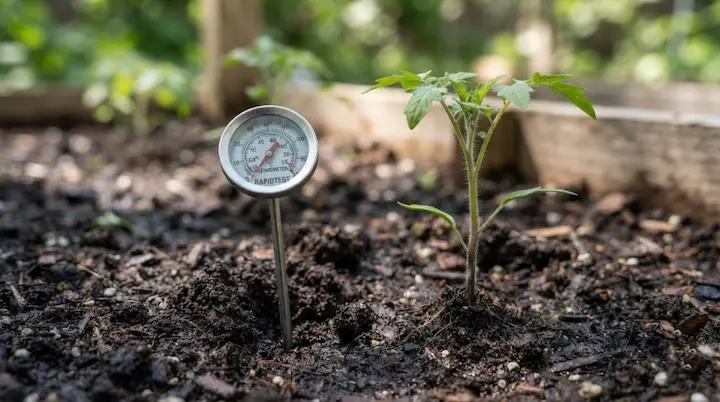
Skip the Rush: The Best Time to Plant Tomatoes Is Later Than You Think
Early plants sit in cold soil for 2 to 4 weeks while the roots do almost nothing. A seedling set out two or three weeks later in warm ground usually catches up within about 10 days. In my experience, the plants I rushed in April always looked worse by June than the ones I planted in May.
Signs it’s too early:
- Soil feels cold 4 inches down
- Nights still dip to 45°F or lower
- Frost shows up in the 10-day forecast
- Ground is soggy from spring rain
Signs it’s time:
- Soil at 60°F or higher.
- Nights above 50°F.
- No frost in the forecast.
- Seedlings hardened off.
One exception: frost cloth or water-filled protectors let experienced growers plant a few weeks early, but only with covers ready.
When to Start Tomato Seeds Indoors
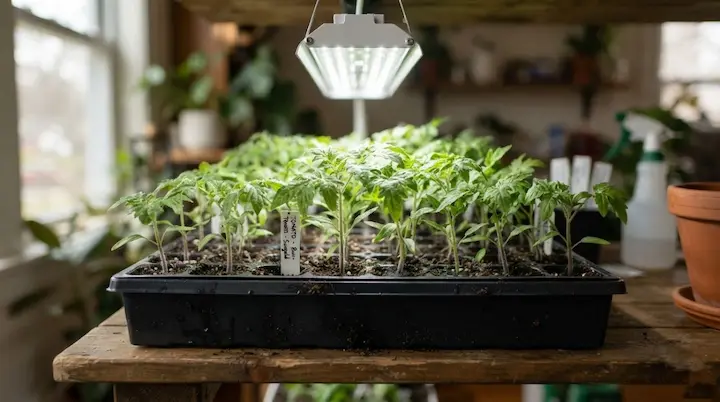
Count back 6 to 8 weeks from your last frost date. If you plan to wait two weeks after frost to set plants out, count back from that outdoor date instead. Start too early in short winter days and seedlings turn tall and floppy. I start mine about 7 weeks before my last frost date.
- Germinate at 70°F to 75°F. Sprouts show in 7 to 14 days.
- Run a grow light 14 to 16 hours a day, 4 to 5 inches above the plants.
- Use a heat mat under the trays, then pull it a few weeks in.
- Direct sowing only works after frost has passed and soil and air hold 65°F to 75°F.
- Read up on seed starting for trays and soil mix.
When to Plant Tomatoes in Your Zone: The Full Schedule
This tomato planting time by zone chart gives the usual windows. Shift each date by a week or so to match your own frost date.
| USDA Zones | Start seeds indoors | Average last frost | Start hardening off | Transplant outdoors | First harvest |
|---|---|---|---|---|---|
| 3 and 4 | Mid to late April | Mid May to mid June | Late May to early June | Early to mid June | August to early September |
| 5 | Late March to early April | Late April to mid May | Early to mid May | Mid May to early June | Late July to August |
| 6 | Early to mid March | Mid April to early May | Late April to early May | Early to mid May | Late July to August |
| 7 and 8 | Late February to March | Mid March to mid April | Early to mid April | Mid April to mid May | Late June to August |
| 9 to 11 | December to January | Little to none | Mid to late January | Late January to March, plus a fall crop in August | April to June |
For most backyard gardeners in USDA Zones 4, 5, 6, 7 and 8, when to transplant tomatoes lands one to two weeks after the last frost date. Season length changes the wiggle room:
- Short season (under 120 frost-free days): plant right at the last frost date with covers on hand, and pick 52 to 70 day varieties.
- Average season (120 to 170 days): wait one to two weeks after frost and check the 10-day forecast first.
- Long season (170+ days): wait about two weeks after frost, then plan a second crop for fall.
- Frost-free spots (Zones 10 and 11, Hawaii, tropical climates): heat is the limit, so plant in cooler months.
- Southern Hemisphere: flip the whole schedule by about six months.
A month-by-month look for Zones 5 and 6:
- January to February: order seeds and note your frost date.
- March: start seeds indoors.
- April: pot up seedlings and check soil temperature weekly.
- May: harden off, then transplant once soil hits 60°F.
- June: last plantings in cold zones. Keep frost cloth handy.
Worked example: with a May 1 last frost, start seeds around March 13 (7 weeks back), begin hardening off May 5, and transplant around May 15 if soil reads 60°F. Short-season example: with a May 20 last frost, start seeds around April 1 and transplant around June 1.
Seedling Readiness, Hardening Off and When to Transplant Tomatoes
Seedlings are ready at 6 to 10 inches tall, with a stem about as thick as a pencil, dark green leaves, and two or three sets of true leaves. The first two oval leaves are seed leaves and don’t count. Skip plants already carrying flowers or fruit. Pot up into bigger containers every two to three weeks as they grow.
Hardening off takes 7 to 10 days:
- Days 1 and 2: 2 to 3 hours in the shade.
- Days 3 and 4: 6 to 8 hours of dappled light.
- Days 5 and 6: a few hours of direct morning sun.
- Days 7 to 10: full sun, with a little less water.
- Bring them inside if leaves wilt or curl, then try again.
Buying transplants at the garden center? Pick stocky plants 6 to 10 inches tall with no flowers, and harden them off anyway. Transplant on a cloudy day or in the late afternoon.
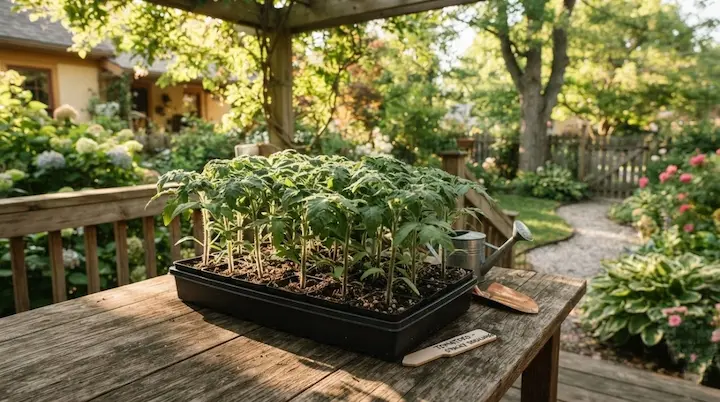
Match Your Variety to Your Planting Window
Determinate types stop at a set height and ripen in a flush, so they suit short seasons and canning. Indeterminate types keep growing and fruiting until frost. Count days to maturity from your transplant date, and finish at least two weeks before the first fall frost. See more tomato varieties here.
- Early and cold-hardy (52 to 70 days): Early Girl, Stupice, Siletz, and Sub Arctic. Best for Zones 3 to 5.
- Mid-season (70 to 80 days): the safe pick for Zones 5 to 7.
- Late (80+ days): Brandywine and most heirlooms. They need Zones 7 and up, or a greenhouse. In cool regions, skip anything over 90 days.
- Heat-tolerant: Celebrity, Heatmaster, and Sweet 100 handle hot spring planting.
- By type: cherries ripen first, beefsteaks last, and paste tomatoes ripen in one big flush.
I like Sun Gold cherries for the first ripe fruit of the year.
Is It Too Late? Simple Late-Season Math
Count the days from your planting date to your average first fall frost. Days to maturity, plus about 3 weeks of picking, plus a 2 week buffer, must fit inside that number.
Example: June 25 to an October 15 frost is 112 days, so a 65 day variety (65 + 21 + 14 = 100) works. In the South, the best time to plant tomatoes for a second round is July or August.
- Pick early varieties that ripen in 52 to 70 days.
- Stagger indeterminate plantings every two to three weeks for steady picking.
- Use cloches, cold frames, row cover, or a greenhouse to protect late fruit from fall chill.
Frost and Cold Protection That Actually Works
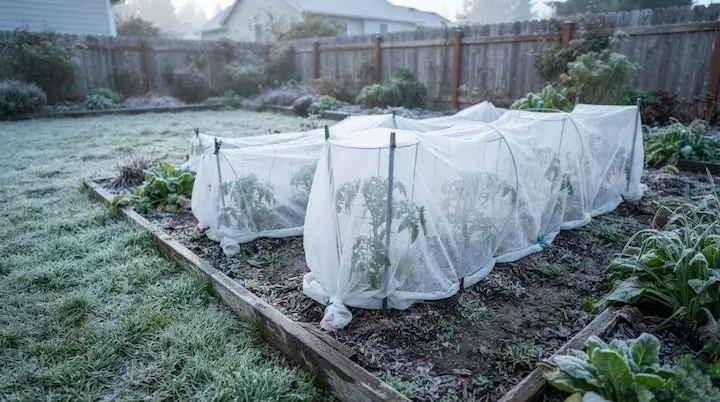
If a frost warning shows up after planting, water the soil well first, since moist soil holds heat better than dry soil. Cover plants before dusk and take covers off the next morning. I keep old bedsheets and a few 5 gallon buckets by the back door every May.
- Frost cloth adds a few degrees. Bedsheets, buckets, or an upside-down trash can work for one cold night.
- Clear plastic adds up to about 20°F but cooks plants in sun, so keep it off the leaves.
- Water-filled protectors handle nights down to about 20°F.
- Black plastic mulch warms soil by 5°F to 10°F.
- Hoop houses and high tunnels let you plant two to three weeks early.
- Potted plants can move inside on frost nights.
Frost hit anyway? Wait 3 to 5 days before pulling anything. A firm stem with new growth at the base or leaf joints means the plant is alive. A mushy stem means replant. More options are in this frost protection guide.
Heat, Humidity and Rainy-Season Planting
In Zones 9 to 11, heat sets the limit instead of frost, and many gardeners grow two crops, spring and fall. Nights above 75°F and days above 90°F drop blossoms, so skip setting plants out in midsummer.
- Give afternoon shade with light shade cloth.
- Mulch 2 to 3 inches deep to keep roots cooler.
- Water deeply, roughly 1 to 2 gallons per plant each week.
- Wait for soggy ground to drain after heavy rain before planting.
- Long humid stretches hurt pollination, so aim flowering for drier weeks.
Timing for Raised Beds, Containers and Greenhouses
- Raised beds: soil warms and drains faster, so planting a week or two earlier often works.
- Containers: use at least 5 gallons per plant, and plant earlier than in the ground. Move them inside during frost, but they dry out fast.
- Greenhouse, hoop house or high tunnel: plant two to three weeks earlier, and lay row cover inside for the first 30 nights.
- Indoor hydroponics: no frost calendar applies. Light and warmth are the only limits.
How to Plant Tomatoes the Right Way
Clear the bed and do a soil test first. Tomatoes like a pH of 6.2 to 6.8, so amend as the results say. Plot your layout and set up irrigation before the plants go in.
- Space plants 18 to 24 inches apart in rows 3 feet apart. Big indeterminate types need 24 to 36 inches.
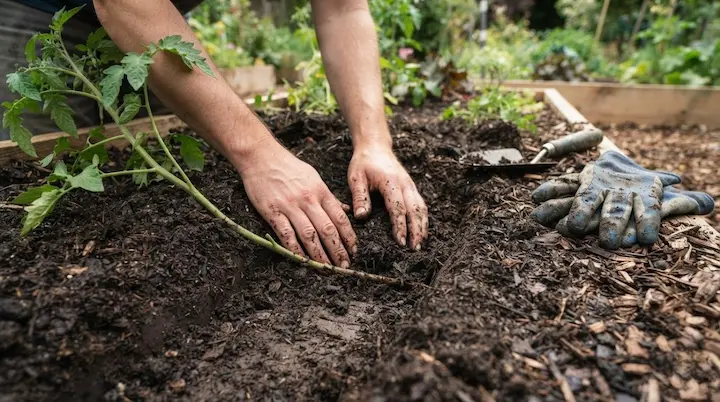
- Pinch off the lower leaves and bury the stem deep. Roots form all along the buried part.
- Leggy plant? Dig a trench about 4 inches deep and lay the stem sideways, with the top curving up.
- Grafted plants are the exception. Keep the graft line about 1 inch above the soil.
- Push in stakes or tomato cages at planting, not later.
My rule is to bury the stem up to the first set of leaves, every single time.
The First Two Weeks After Planting
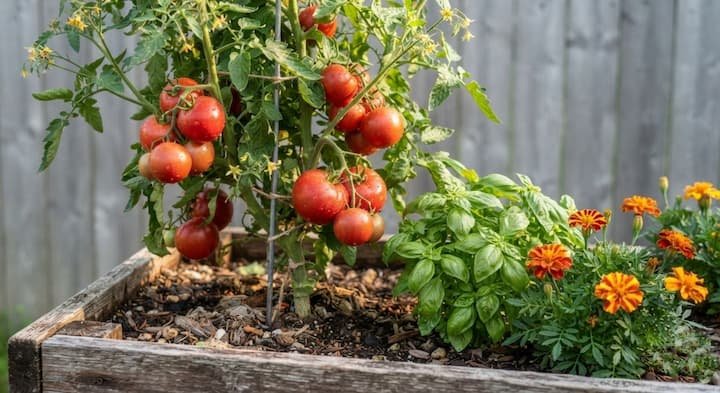
Water deeply right after planting, then keep the soil evenly moist. Spread 2 inches of straw once the ground has warmed. Go easy on nitrogen, because too much makes leaves instead of fruit. Once plants settle in, try basil and marigolds nearby (more on companion planting).
- Midday wilting for a few days is normal transplant shock.
- Pale leaves or purple undersides point to cold soil, not shock.
- Planted too early? Cover if frost threatens, mulch to warm the soil slowly, ease off heavy watering, and be patient.
- Check the 10-day forecast every few days.
- Red flags: soil under 55°F, nights under 50°F, a cold front on the way, or small unhardened seedlings.
Common Timing Mistakes
- Planting because the air feels warm.
- Trusting the calendar instead of a soil thermometer.
- Treating the average last frost date like a promise.
- Starting seeds too early and letting them get leggy.
- Skipping hardening off.
- Ignoring days to maturity versus first fall frost.
- Mixing up hardiness zone and frost date.
I once set plants out on a warm April weekend, and a 29°F night took every one.
Free Tools and a Go/No-Go Checklist for Your Tomato Planting Calendar
- The NGA frost date calculator gives local US frost dates.
- The USDA Plant Hardiness Zone Map shows your zone.
- Community gardener groups and county extension offices post frost warnings.
- Copy the zone chart above into your phone notes, or use your browser’s print-to-PDF for a printable copy. Swap in your own frost date and you have a personal tomato planting calendar.
Go only if all are true:
- Soil is 60°F or higher at 4 inches deep.
- Nights have stayed above 50°F for 10 days.
- No frost is in the 10-day forecast.
- Seedlings are hardened off.
- Ground drains well.
Soil under 60°F? Wait. Frost in the forecast? Wait. Seedlings not hardened off? Wait. Otherwise, plant.
Final Thoughts:
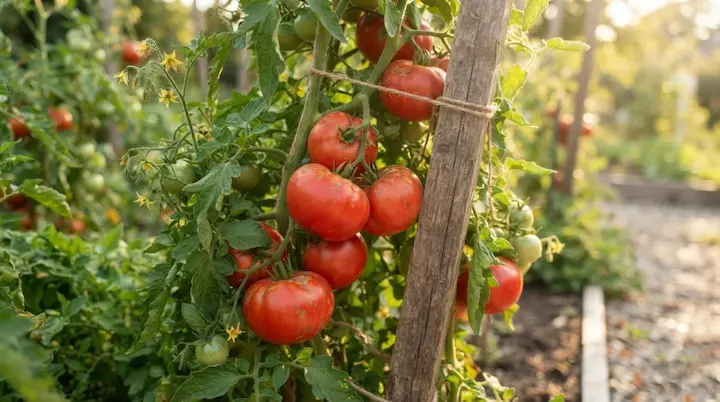
Nailing when to plant tomatoes comes down to patience and a 60°F soil reading. Find your last frost date, start seeds 6 to 8 weeks ahead, harden them off, and wait for warm nights. If the weather turns, cover the plants and wait it out. A slightly late tomato in warm soil beats an early one in cold soil almost every time. Happy planting.
Pingback: How to Prune Tomato Plants: 5 Proven Steps for Big Harvests
Pingback: Tomato Companion Plants: 30 Best Picks for Bigger Harvests!
Pingback: Growing Tomatoes in Pots: 7 Easy Wins for Big Harvests
Pingback: Determinate vs Indeterminate Tomatoes: Proven Pick Guide
Pingback: When to Pick Tomatoes: Proven Signs, Stages & Easy Tips