Ever wonder why your neighbor’s ZZ plant looks almost black while yours stays plain green? That difference isn’t luck it’s a specific cultivar, and getting raven zz plant care right is exactly what turns those leaves from lime to jet black in the first place. I’ve grown houseplants for years, and this one still gets more “what plant is that?” comments than almost anything else on my shelf.
Quick Care Specs
If you’re wondering how to care for a Raven ZZ plant before diving into the details, this chart covers the essentials.
| Requirement | Details |
|---|---|
| Light | Bright, indirect light |
| Water | Every 2-4 weeks, let soil dry fully |
| Soil | Well-draining succulent/cactus mix |
| Temperature | 60°F to 85°F |
| Humidity | Average room humidity |
| Fertilizer | Diluted, spring through fall |
| Toxicity | Mildly toxic if chewed or ingested |
What Makes a Raven ZZ Different From a Regular ZZ Plant
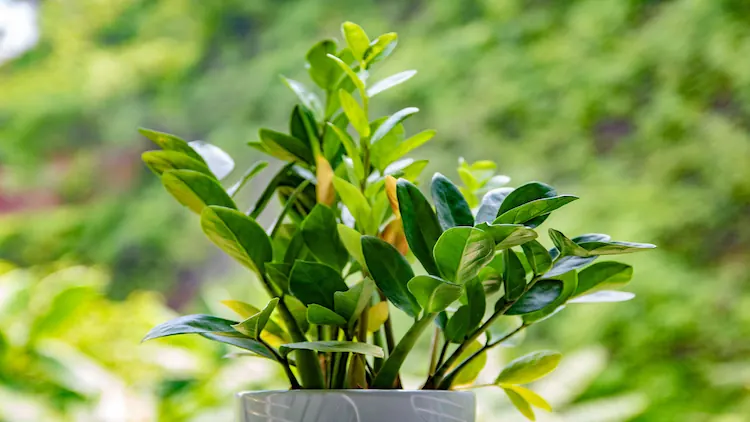
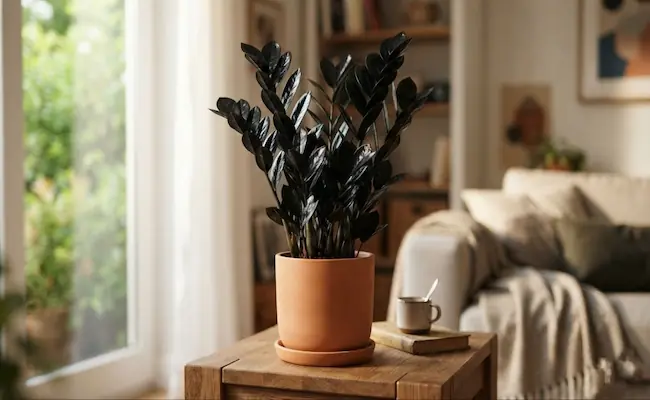
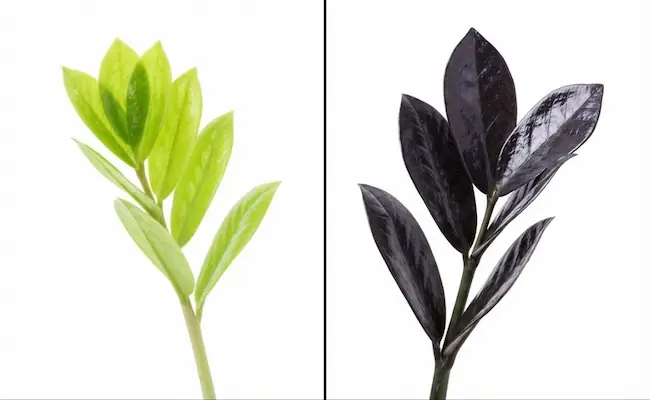
The Raven ZZ (Zamioculcas zamiifolia ‘Dowon’) is a cultivar of the standard ZZ plant, first released around 2019. New leaves come in bright green, then slowly shift to a deep purple-black over 6 to 8 weeks. Everything else the thick rhizome, the drought tolerance, the slow growth matches a regular green ZZ. The color is really the only trade you’re making, and in my experience, it’s worth it.
It isn’t cold hardy. If you garden in USDA Zones 4, 5, 6, 7, or 8, this plant needs to stay indoors or in a container you carry into the yard/backyard for summer and bring back in before the first frost of fall. Gardeners in warmer zones sometimes leave it in a shaded bed year-round, but for most of the country, container life is the safer bet.
The Raven ZZ also grows noticeably slower than a lot of other houseplants. Don’t expect fast, bushy growth like you’d see from a pothos or a snake plant.
A single new shoot can take weeks to unfurl, and the whole plant might only add a few new stems in a season. That slow pace is part of the appeal it’s a plant you check in on rather than one that demands constant attention.
Light and How to Keep It Jet Black
This plant tolerates low light, but it won’t stay black there the leaves fade toward green and growth slows way down. Give it bright, indirect light near an east-facing window, or 2 to 3 hours of filtered sun daily. Keep it out of direct afternoon sun, which scorches the leaves and leaves brown patches behind.
Beyond light, a few small habits make the biggest difference in black ZZ plant care:
- Buy a plant that already shows dark leaves instead of an all-green one.
- Skip frequent pruning new growth always starts out green, so trimming often just adds more green.
- Wipe dust off the leaves every couple of weeks with a damp cloth so they can photosynthesize properly.
- Keep it slightly rootbound rather than upsizing the pot too often I like giving mine a snug fit.
- Be patient; the full color shift takes weeks, not days.
Watering and Soil
Good raven zz plant care really comes down to restraint with watering. Let the top 2 inches of soil dry out completely before you water again usually every 2 to 4 weeks, less in winter.
I check mine with a wooden skewer before I even think about the watering can. If your tap water is heavily chlorinated or very hard, letting it sit out overnight before use helps avoid the leaf-tip browning that hard water sometimes causes. For a deeper breakdown of frequency by season, this guide on how often to water a ZZ plant is worth a look.
Use a well-draining mix roughly 2 parts regular potting soil to 1 part perlite and 1 part coarse sand works well, or you can buy a ready-made cactus/succulent blend. Skip regular potting soil on its own; it holds too much moisture and invites root rot.
If you’re already composting kitchen scraps from things like zucchini or eggplant, that same organic matter can be worked lightly into a houseplant mix. This piece on how to make compost at home walks through the basics if you want to build your own.
Temperature, Humidity, and Fertilizing
Raven ZZ plants like 60°F to 85°F, and they struggle below 50°F. Keep them away from cold drafts near doors and windows once fall settles in. Average household humidity is fine for this plant no misting or humidifier required, though it won’t hurt.
Feed it a balanced liquid fertilizer diluted to half strength every 6 to 8 weeks, starting in spring and tapering off by fall.
Skip fertilizer entirely in winter, when growth slows to almost nothing. Watch for crusty white buildup on the soil surface or leaf tips turning brown and crisp both point to over-fertilizing, and the fix is simply flushing the pot with plain water and easing off the feeding schedule for a while.
Pruning and Repotting
Pruning is minimal here this is one plant your pruners can mostly stay in the drawer for. Trim only yellow or damaged stems at the base, and toss anything showing rot straight in the trash/garbage rather than the compost pile.
Avoid trimming healthy growth just to shape the plant, since that only encourages the new green shoots you’re trying to avoid.
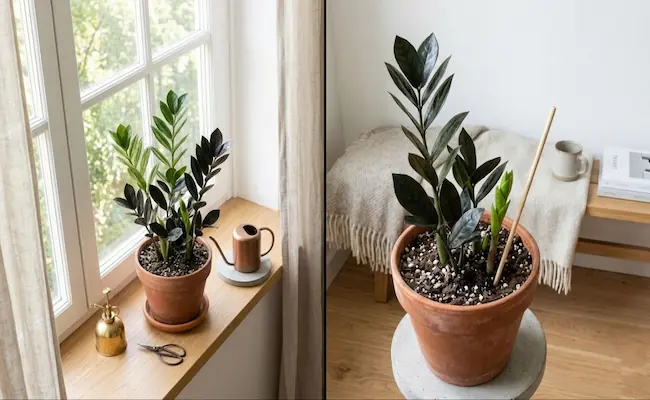
Repot every 2 to 3 years, or once roots start pushing through the drainage holes. Move up only 1 to 2 inches in pot size at a time a bigger jump holds too much wet soil around the roots and raises the risk of rot. A terracotta pot is a smart choice since it wicks away extra moisture, though a plastic or ceramic pot works fine too as long as it has a solid drainage hole and you’re careful not to overwater.
How to Propagate a Raven ZZ Plant
Division is the most reliable method: separate the rhizome into sections with roots attached, then repot each one in fresh soil. Stem and leaf cuttings work too, though they’re slower rooting can take a couple of months. For the full step-by-step process, this guide on how to propagate a ZZ plant covers all three methods.
One thing worth knowing before you gift or sell cuttings: this cultivar is patent-protected, so propagating it for resale isn’t legal. Rooting a few for yourself or a friend is generally fine.
Pests, Problems, and Troubleshooting
Watch for mealybugs, spider mites, and scale a strong spray of water or a light coat of insecticidal soap handles most infestations. Mealybugs show up as small white, cottony spots along the stems, while scale looks more like tiny brown bumps stuck to the leaves.
Both are treatable if you catch them early, so it’s worth checking the undersides of leaves every few weeks. Root rot from overwatering is the biggest disease risk on this plant, and it’s usually the reason a healthy-looking Raven ZZ suddenly goes downhill.
A quick troubleshooting rundown for growing a Raven ZZ plant:
- Yellow leaves: usually low light or inconsistent watering.
- Mushy stems: root rot; trim the damaged parts and repot in dry soil.
- Drooping plant: either too little light or uneven watering.
- Not turning black: the plant is likely young or not getting enough indirect light; give it another 6 to 8 weeks.
Toxicity and Safety Around Pets and Kids
Like most aroids, Raven ZZ contains calcium oxalate crystals, which can irritate skin and mouth tissue if chewed.
According to North Carolina State University’s plant database, this species carries medium-severity poison characteristics, meaning exposure typically causes irritation rather than serious harm (source: NC State Extension). Still, I’d keep it well out of reach. If pets or young children share your home, these guides go into more detail on whether ZZ plants are toxic to dogs, toxic to cats, or toxic to babies.
Indoor vs Outdoor Growing
Indoors, this plant adapts to nearly any room, from a dim bathroom to a bright living room, which is part of why it’s shown up so often in offices and lobbies over the past few years. Outdoors, it only really works in warm climates or as a seasonal container plant you move into a shaded corner of the yard/backyard during summer, then bring back inside before temperatures drop.
If you do move it outside for the season, ease it into direct sun gradually rather than placing it straight into a sunny spot even filtered light indoors is much gentler than a full day outdoors.
Flowering and Rarer Varieties
ZZ plants occasionally produce a small, pale spadix flower, though it’s uncommon indoors and easy to miss among the foliage.
University of Florida’s IFAS Extension notes that this plant’s naturally glossy leaves have been studied for their unusual shine, a trait fairly unique among common foliage houseplants (source: UF/IFAS Extension). You’ll also occasionally come across variegated Raven types with faint white or pink streaking, though they’re harder to track down than the standard black form.
Buying Tips and Where It Fits in Your Home
Pick a plant that already shows some dark leaves rather than one that’s still all green that tells you the color is already established. It’s become a genuine garden center favorite over the past few years, common enough now that community gardener groups and plant swaps often have divisions available.
If you’re building out a wider collection, this roundup of best indoor plants for every home is a solid next stop.
Final Thoughts:
Solid raven zz plant care isn’t complicated once you understand the pattern: bright indirect light, minimal water, and patience while the leaves darken. I think that’s exactly why it’s earned a spot as a favorite among low-maintenance houseplant lovers you get a dramatic, near-black centerpiece without babying it every week. Get the light and watering right, and the color takes care of itself.