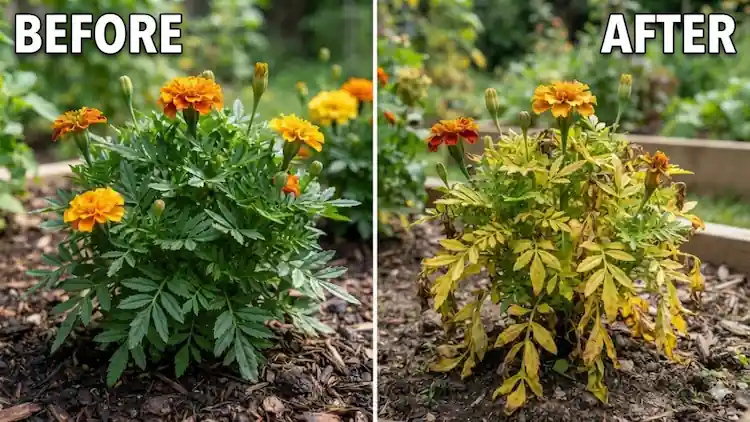
You walk out to the backyard with your coffee, and there it is a patch of yellow spreading across your sunflower’s leaves.
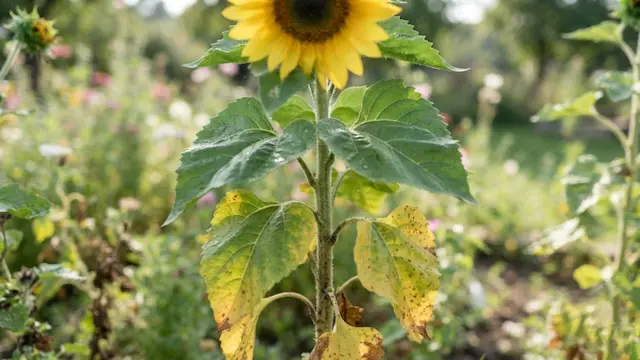
Before you panic, here’s the truth: why are my sunflower leaves turning yellow is probably the single most common question I hear from fellow gardeners every summer, and in my six years of growing them, almost every case traces back to one of a handful of fixable causes.
Let’s walk through them one by one.
What Yellow Leaves Are Actually Telling You
Yellowing, called chlorosis, isn’t a disease on its own it’s a signal that chlorophyll production has slowed down. Nitrogen is a “mobile” nutrient, meaning the plant pulls it from older leaves to feed new growth first.
That’s why deficiency symptoms typically show up on the bottom leaves before anywhere else, according to Iowa State University Extension’s research on nutrient deficiencies in field crops. I find this one fact explains half the yellow-leaf questions I get.
And honestly, the same science applies to houseplants too mobile nutrients move the exact same way whether it’s a sunflower in your yard or a leafy plant on a windowsill.
Normal Aging vs. a Real Problem
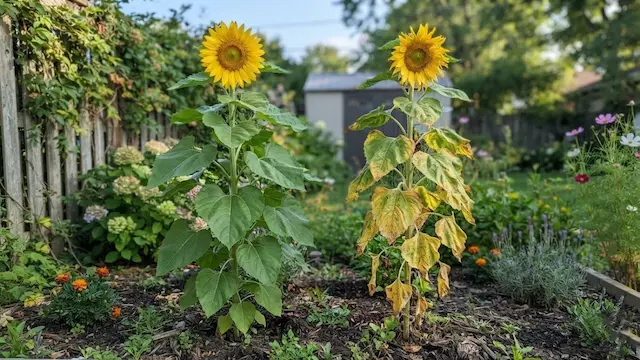
Not every yellow leaf is bad news. As sunflowers mature, the bottom three to five leaves naturally yellow and drop as the plant redirects resources into the flower head. In my own yard, I stopped worrying about this years ago.
| Yellowing Pattern | Where It Shows | Likely Cause |
|---|---|---|
| Bottom 3–5 leaves only | Lower plant | Natural aging no action needed |
| Fast bottom-up spread | Lower to mid plant | Nitrogen deficiency |
| Yellow between green veins | Upper, newer leaves | Iron or magnesium deficiency |
| Wilting + yellow + soggy soil | Anywhere | Overwatering or root rot |
| Spots, fuzz, or streaks | Anywhere | Fungal or viral disease |
Why Are My Sunflower Leaves Turning Yellow? Diagnosing by Stage and Symptom
The stage of growth changes what yellowing means:
- Seedling stage: Almost always watering or shallow-root stress seedlings have no reserves to fall back on.
- Vegetative stage (before budding): Usually nitrogen deficiency or early pest pressure.
- Budding to flowering stage: Some bottom-leaf yellowing is expected as the plant favors the bloom over old foliage.
Look at leaf color and position together that tells you more than either alone. If you’re unsure, snap a photo in daylight and compare it against the table above; color and pattern are easier to judge in a still image than standing over the plant.
One thing I always mention: not every sunflower yellows the same way. Dwarf and branching varieties shed lower leaves earlier and more visibly than tall, single-stem types like ‘Mammoth’ or pollen-free cultivars grown for cut flowers.
If yours is bushier, don’t be alarmed by extra lower-leaf drop.
Watering Mistakes Behind Sunflower Leaves Turning Yellow
Watering is, by far, the biggest driver of sunflower leaves turning yellow. Sunflowers evolved in deep, fast-draining prairie soil, so heavy clay or a pot without drainage holes causes trouble fast.
- Overwatering: Roots sit in saturated soil, lose access to oxygen, and start to rot.
- Underwatering: Common during a July heat wave; leaves droop, curl, and yellow at the edges.
The University of Georgia Cooperative Extension notes that above-ground yellowing and wilting are classic symptoms of waterlogged, oxygen-starved roots and the mistake most of us make is watering more, not less, when we see it.
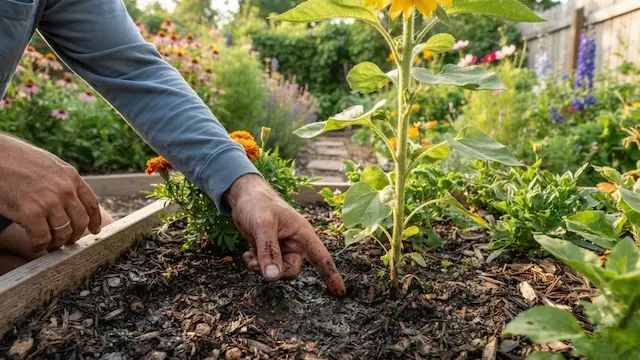
Fix: Check soil moisture 2 inches down before watering. In-ground plants need roughly 2 gallons a week; potted sunflowers dry out faster and need more frequent watering since roots can’t stretch out looking for moisture.
| Factor | In-Ground | Container |
|---|---|---|
| Watering frequency | Weekly, deep soak | Every 2–3 days in summer |
| Amount | ~2 gallons/week | Small drink until it drains out the bottom |
| Biggest risk | Poor drainage in clay soil | Pot with no drainage holes |
| Yellowing shows up | Slower, more gradual | Faster swings happen in days, not weeks |
Light, Heat and Cold Stress
Sunflowers want 6 to 8 hours of direct sun and temperatures between 70°F and 78°F. Push past that, especially with dry soil, and leaves scorch and yellow.
Cold matters too. Research shows sunflowers struggle once temperatures drop below 44°F, and gardeners in USDA Zones 4, 5, 6, and 7 should watch for a surprise spring or early Fall cold snap stressing young transplants.
Nutrient Deficiencies Causing Yellow Leaves on Sunflowers
Nitrogen shortage yellows the plant from the bottom up. Iron or magnesium shortage does the opposite it shows up on new, upper leaves as yellow tissue between still-green veins, and it’s almost always tied to alkaline soil above pH 7.2.
- Nitrogen fix: Side-dress with about ½ cup of blood meal (12-0-0) per plant, or ¾ cup of alfalfa meal, worked 2 inches into the soil and watered in.
- Iron/magnesium fix: Test soil pH first, then apply chelated iron or an Epsom salt drench.
- Over-fertilizing: Causes its own yellowing, plus browning leaf tips less is often more here.
If you’re already composting, I always tell people to pair that habit with a slow-release fertilizer rather than dumping on more nitrogen at once.
Soil and Drainage Problems
Even correct watering can’t fix bad soil. Heavy clay traps moisture around the roots and starves them of oxygen the same way overwatering does. Aim for a soil pH between 6.0 and 7.5, and work 2 to 3 inches of compost or composted bark into the top 6 to 8 inches of soil before planting.
Pests That Trigger Sunflower Leaf Yellowing
Several common pests cause the same yellow-and-stressed look:
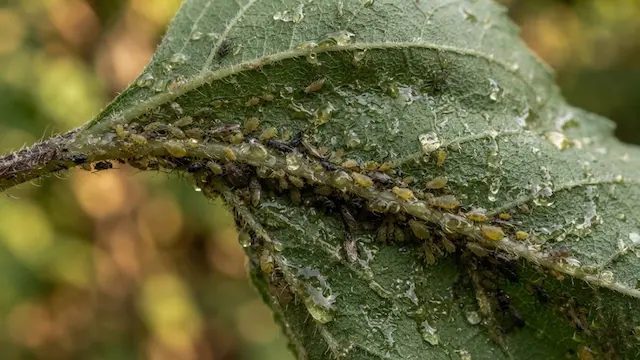
- Aphids: cluster on new growth, leave sticky honeydew behind.
- Spider mites: fine webbing, stippled yellow spots, worse in hot weather.
- Thrips: mottled, drought-like yellowing.
- Japanese beetles: chew lacy holes that lead to yellowing around the damage.
Neem oil mixed at one to two tablespoons per gallon of water, sprayed on both sides of the leaf, handles most of these. I spray mine early morning so it doesn’t burn in direct sun.
Fungal, Bacterial and Viral Diseases
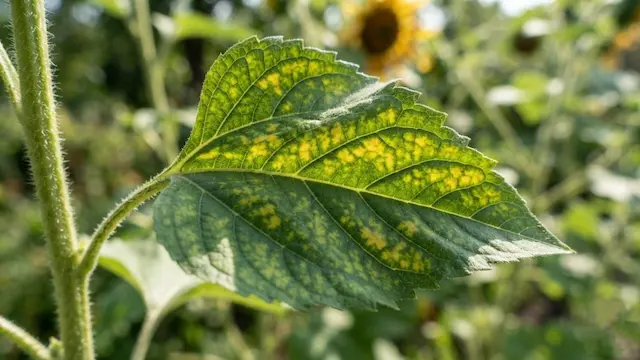
This is where sunflower leaf yellowing gets more serious. Downy mildew shows yellow patches with white fuzz underneath. Rust leaves orange, powdery spots.
Verticillium wilt causes one-sided yellowing and wilting with no cure pull and bag that plant. Bacterial leaf spot and viruses like Sunflower Chlorotic Mottle Virus create irregular yellow blotches instead of clean patterns.
- Remove infected leaves right away and put them in the trash, not the compost pile.
- Sterilize your pruners between cuts with rubbing alcohol.
- Space plants at least 12 to 18 inches apart for airflow.
- Rotate sunflowers out of the same bed for a few years I swap that spot with zucchini or eggplant instead, since rotation breaks the fungal and pest life cycle that builds up in soil where the same crop grows year after year.
If you share plots as a community gardener, sanitation matters even more, since disease moves quickly between neighboring beds.
A quick pest-vs-disease check: pests almost always leave physical evidence webbing, sticky residue, visible bugs, or chewed edges while disease tends to show clean patches, fuzz, or a one-sided pattern with no insects in sight.
If neither matches and the yellowing keeps spreading after you’ve ruled out water and nutrients, it’s worth sending a leaf sample to your local extension office rather than guessing at a fungicide.
Other Environmental Stressors
Herbicide drift from a neighbor’s lawn treatment can twist new growth and streak leaves yellow. Container-grown sunflowers swing between wet and dry faster than in-ground ones, so check those pots more often. Wind abrasion in exposed yards can also scuff leaves enough to trigger yellowing.
More than one cause at once? It happens an underwatered plant is more prone to pests, and rotting roots invite fungal disease. If your fix doesn’t slow the yellowing in a week, go back through the list.
My Step-by-Step Diagnosis Process
Here’s the order I actually check things, in my own experience:
- Soil moisture, 2 inches down.
- Which leaves are affected bottom, top, or scattered.
- Undersides of leaves for pests or webbing.
- Recent weather heat wave, cold snap, or heavy rain.
- A basic soil pH test if nothing else explains it.
How to Fix It and How Long Recovery Takes
Once you match the cause to the fix above, be patient. Damaged yellow tissue rarely turns green again your goal is healthy new growth, not repairing old leaves.
Nitrogen and watering fixes usually show improvement in new leaves within 1 to 2 weeks; soil pH corrections for iron or magnesium can take 3 to 4 weeks since they work through the root system gradually.
What Diagnosis and Treatment Actually Cost
You don’t need to spend much here. A home soil pH meter runs about $10–$15, and a lab test through your local extension office is usually $10–$20. Neem oil, chelated iron, and fertilizer each cost roughly $8–$15 small change next to losing a season’s plants.
When to Pull the Plant Entirely
If you’re seeing one-sided yellowing with vascular browning inside the stem, that’s likely Verticillium wilt, and there’s no fix. Pull the plant, bag it for the trash, and avoid planting sunflowers in that same soil for several years.
Preventing Yellow Leaves Next Season
A little prep goes a long way toward keeping your sunflowers a backyard favorite at the center of the flower bed instead of a problem child:
- Work compost into the soil before planting.
- Space plants 12 to 18 inches apart.
- Mulch 2 to 3 inches deep to steady soil moisture.
- Check plants twice a week for pests or early disease.
- Water based on soil feel, not a fixed schedule.
- As Fall approaches, read up on sunflower winter care so late-season stress doesn’t carry into next year.
If houseplants are more your thing, the same chlorosis logic works indoors I’ve used it on orchid leaves turning yellow, peace lily leaves turning yellow, pothos leaves turning yellow, a ZZ plant leaves turning yellow, and snake plant leaves turning yellow at home.
Final Thoughts:
So, why is my sunflower turning yellow, in one sentence? It’s almost always watering, nutrients, or something you can catch early with a five-minute soil check. Once you know why are my sunflower leaves turning yellow in your specific case, the fix is usually simple, and healthy new growth follows within a couple of weeks.