
A sunflower can send one root down as deep as 6 feet, yet a plant that tall still droops after two hot afternoons. Why?
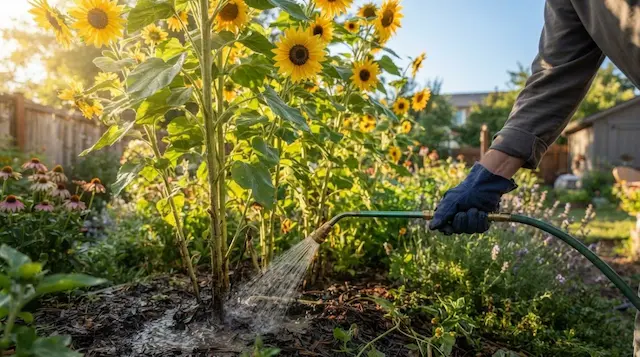
The answer changes how often to water sunflowers more than any calendar does. I’ll break down the schedule from seed to bloom, using extension research and my own backyard trial and error.
How Much Water Do Sunflowers Need?
Most backyard sunflowers do best on 1 to 2 inches of water per week, rain included.
Guides disagree because the number moves with conditions: closer to 1 inch in cool, mild weeks and closer to 2 inches in heat, sandy soil, or with tall varieties. One inch of water over 1 square foot is about 0.6 gallons.
Quick math: plant spacing in feet, squared, times 0.6 equals gallons per inch. A plant with 18 inches of room takes roughly 1.4 gallons per inch, and a giant spaced 2 feet apart takes about 2.5 gallons.
- Set a straight-sided tuna can or rain gauge near the row to see what rain and sprinklers really deliver.
- Count 1 inch of rain as one full deep soak.
- Ask first: how much water do sunflowers need in this spot, with this soil and this much sun?
Deep Roots Make Sunflowers Tough, Not Bulletproof
A sunflower builds a long taproot plus a wide, branched root network that pulls moisture from deep soil. Texas A&M AgriLife Extension says that big root volume lets short dry spells pass without much loss, but it also marks the 20 days before and after flowering as the stretch that decides yield.
That toughness has conditions. Shallow daily sprinkling keeps roots near the surface, and small pots or compacted soil block the taproot altogether.
How Often to Water Sunflowers at Each Growth Stage
| Stage | Water rhythm | What to check |
|---|---|---|
| Germination (first 7 to 10 days) | Light water daily | Seedbed stays evenly damp |
| Seedlings (weeks 1 to 3) | Every 1 to 2 days | Top 1 to 2 inches damp, never soggy |
| Vegetative growth | 1 to 2 deep soaks a week, about 1 to 1.5 inches | Top inch dry, deeper soil still cool |
| Bud formation | 2 to 3 soaks a week in heat, about 1.5 to 2 inches | Soil damp 8 inches down |
| Flowering | 1 to 2 deep soaks a week, steadiest in the 20 days around bloom | Base soil damp after a soak, never muddy |
| Seed fill | 1 soak a week, then ease off | Back of the head starts turning yellow |
Seedling advice runs from daily to every third day. I go by the soil, and warm weather pushes it toward daily. Treat this sunflower watering schedule as a starting point and let the soil overrule it.
Direct sow seeds where they will grow, since the taproot hates being moved, and give any transplant steady moisture until it perks up.
Bud to bloom is the stretch not to skimp on. NDSU Extension reports that sunflower yield is most sensitive to moisture stress during flowering, and heavy soil water loss then cut yields by 50% in research trials. These are farm-field numbers, but the biology carries over to a backyard row.
Watering Sunflowers in Pots vs. Backyard Beds
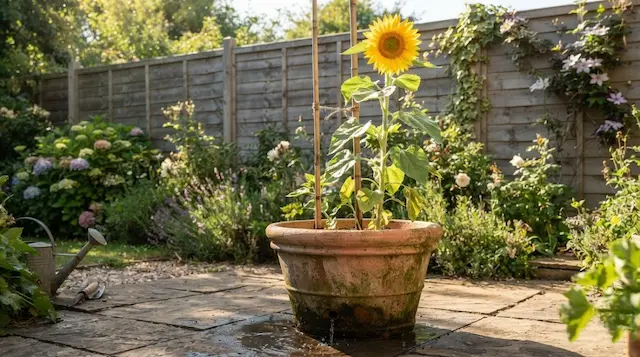
Watering sunflowers in pots is a different game because roots cannot reach deep moisture. A tall variety in a 14-inch pot can need a drink every day in July, sometimes twice.
- Pots: water every 1 to 3 days in summer, until it runs out the drainage holes.
- Terracotta and dark plastic dry fastest on a sunny patio.
- Bigger pots dry slower: use 5 gallons or more for tall types, or a 20-gallon garbage can with drilled holes, filled with loose potting mix instead of packed garden dirt.
- Self-watering pots suit dwarfs if the reservoir runs dry between fills.
- Never leave a pot sitting in a full saucer.
- Raised beds drain faster than yard soil, so check them more often.
- In-ground beds: one deep soak, then wait.
Giant, Dwarf, and Branching Types
Leaf area sets water use: A 10-foot Russian Mammoth drinks about twice what a 2-foot Teddy Bear does in the same conditions, and giants may need a deep soak twice a week in hot weather.
Dwarfs manage on one weekly soak in the ground but dry out fast in small pots. Branching types keep opening flowers for weeks, so their thirsty stretch lasts longer. Pollen-free cut-flower types follow the same rule.
What Changes the Schedule
- Heat and wind: a 90°F week can double how often the hose comes out.
- Soil: sandy soil wants smaller, more frequent soaks, and clay needs slow application.
- Sun: 8 hours of full sun pulls more water than part shade.
- Mulch: 2 to 3 inches slows evaporation, and often-cited savings run 30% to 50%.
- Spacing: give tall types 18 to 24 inches so taproots do not fight over the same water.
- Rain: subtract it from the weekly total before turning on the hose.
Zone-by-Zone Adjustments
Summer heat matters more than the calendar. Sow once nights stay above 32°F, then let the local weather set the rhythm for the yard.
| USDA Zones | Summer pattern | Watering rhythm |
|---|---|---|
| 2 and 3 | Short, cool season | About 1 soak a week |
| 4, 5, 6, 7 and 8 | Warm days, rain most weeks | 1 soak when rain is under 1 inch, up to 2 soaks past 90°F |
| 9, 10 and 11 | Long heat, little rain | Every 2 to 3 days at peak summer, heavy mulch |
Region matters too. The arid Southwest needs heavier mulch and more frequent soaks. The humid Southeast gets rain help, so watch drainage, mildew, and rot. Cool Northeast summers usually need one soak a week.
How to Water Sunflowers the Right Way
Slow and deep beats quick and often. Aim water at the base, about 3 to 4 inches from the stem, and soak the soil 8 to 12 inches down. Morning is best, since leaves dry out before night.
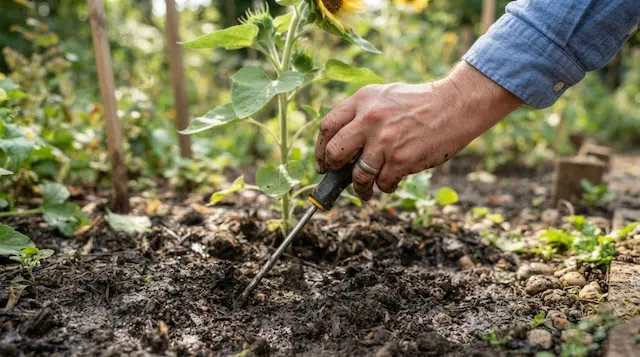
- Learn how to water sunflowers by feel: push a long screwdriver into the soil. It slides easily in damp ground and stops where the dirt turns dry.
- Skip overhead sprinklers: Wet leaves invite mildew and rust.
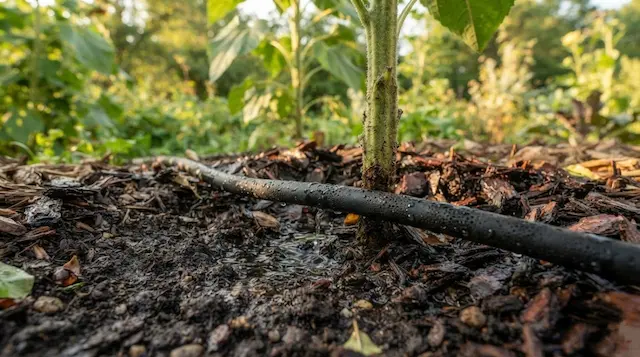
- Keep the soaker or drip line running until the screwdriver test reaches 8 to 12 inches.
| Method | Best for | Cost | Downside |
|---|---|---|---|
| Soaker hose | Rows in beds | Low | Slow to move around |
| Drip line | Big plantings | Medium | Setup work |
| Olla (buried clay pot) | Dry climates | Medium | Needs burying and refilling |
| Hose wand on low | A few plants | Low | Easy to rush |
| Watering can | Pots and seedlings | Low | Lots of trips |
Signs of Too Little Water
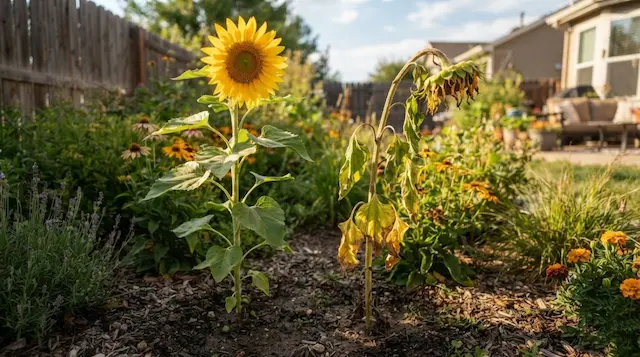
- Leaves still limp the next morning.
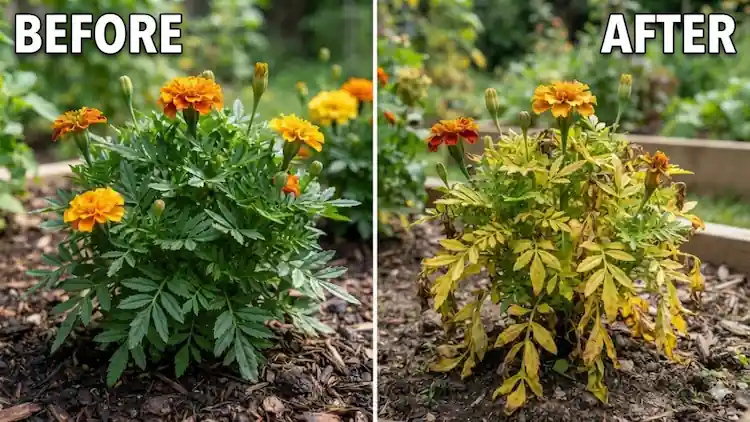
- Lower leaves turn yellow and crispy first.
- Tall stems lean or bend.
- Buds shrivel before opening, and petal color looks washed out.
- Small heads with few seeds.
Signs of Too Much Water
Soggy roots wreck sunflowers the same way they wreck houseplants. The rule behind orchid winter watering and peace lily watering applies here too.
Check first, pour second:
- Yellow leaves all over the plant, not just at the bottom.
- A soft, dark stem base near the soil line.
- Slow growth in warm weather.
- Soil that stays wet for days or smells sour.
Trim dead lower leaves with clean pruners so air can move through the row.
Wilting Sunflowers: Heat Stress or Thirst?
In my experience, most afternoon droops are just heat and fix themselves by dinner. Check the soil before grabbing the hose.
| What it looks like | Soil check | What to do |
|---|---|---|
| Droops at 3 p.m., perks up by evening | Damp 2 inches down | Nothing, it is normal heat stress |
| Still limp the next morning | Dry 2 to 3 inches down | Deep soak now |
| Droop plus yellow leaves | Soggy, sour smell | Stop watering and improve drainage |
Common Watering Mistakes
- Daily light sprinkling that keeps roots shallow.
- Watering by the calendar. The same trap shows up with pothos watering and snake plant watering, where the soil should decide, not the date.
- Evening watering that leaves foliage damp all night.
- Mulch piled against the stem.
- Pots with no drainage holes.
Mulch, Fertilizer, and Disease
Spread 2 to 3 inches of mulch once seedlings reach about 6 inches, and keep it 2 inches off the stem. Go easy on fertilizer. Extra nitrogen grows tall, soft stems that snap, and compost worked into poor soil is usually enough.
I like to fork compost into the row before sowing. If sunflowers share a bed with zucchini or eggplant, all three run fine on roughly 1 to 2 inches a week, but check the soil under big zucchini leaves since they shade and hold moisture.
- Mildew and rust: keep leaves dry, water in the morning, and give plants room.
- Stem and root rot: fix drainage before adding more water.
- Falling over: deep watering builds the taproot that anchors the plant, and giants still need a stake at planting.
Heat Waves, Heavy Rain, and Time Away
- Heat waves above 95°F: soak in the morning, then check pots again by mid-afternoon.
- Heavy rain: skip watering and tip water out of saucers.
- Drought and shared hose days: a community gardener can soak deeply the day before the plot goes dry, mulch heavily, and save water for bud to bloom.
- Time away: in-ground plants cope with 5 to 7 days after a deep soak, much like the neglect-friendly ZZ plant care routine indoors. Pots and seedlings need a sitter.
When to Stop Watering in Fall
Once petals drop and seeds fill, ease back to one soak a week. I stop watering once the back of the head turns yellow-brown, and fall rain usually covers the rest.
A hard frost at 32°F ends the season, and pruners make quick work of the old stalks. For what comes next, read sunflower winter care.
Printable Sunflower Watering Schedule Cheat Sheet
- Poke the soil 2 inches down before every watering.
- Seedlings: daily.
- Established plants: 1 to 2 deep soaks a week.
- Bud to bloom: add one soak in heat.
- Pots: check every day in summer.
- Morning, at the base, slow.
- When the soil and the calendar disagree, the soil wins.
Final Thoughts:
So, how often to water sunflowers? Daily for seedlings, one or two deep soaks a week once they are established, and every day or two for pots in July. Watch the soil, count the rain, and never skimp during bloom. I have killed a few plants with too much kindness, so my rule is simple: poke the soil first.
Pingback: How Often to Water Spider Plant in Winter: 7 Easy Care Tips
Pingback: How Often to Water Tulips: 7 Proven Tips for Healthy Blooms