
Why do some backyard gardeners pull a bunch of thick-walled bell peppers off one bucket while others get three sad little ones?
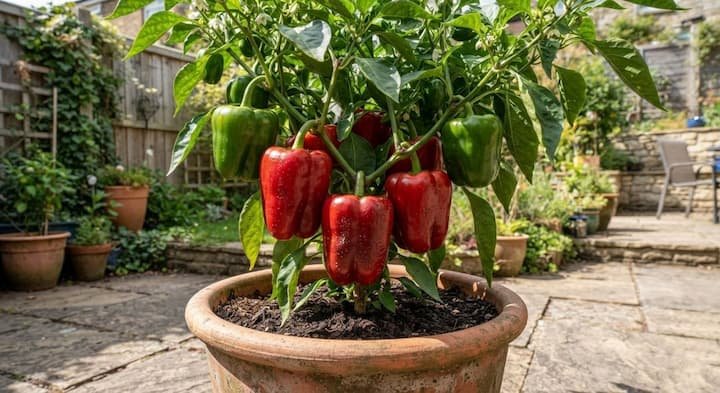
It usually comes down to a handful of small choices made before the plant ever flowers. Growing bell peppers in pots gives you control over soil, sun, and water, but only if you get those choices right. Here is how to do it.
Is Growing Bell Peppers in Pots Worth It? Pros and Cons
I think pots are worth it for most people, but they take a bit more attention than a bed in the ground.
The good:
- Space: a deck, balcony, or driveway is enough.
- Mobility: move pots into full sun, or indoors before a freeze.
- Soil control: you pick the mix, so no heavy clay.
- Fewer pests: fresh mix and a raised pot dodge many soil problems.
The catch:
- More watering, since pots dry out fast.
- Smaller yield than a well-fed plant in the ground.
- Size: plants reach 3 to 4 feet, so you need a big pot.
If you rent, share a community garden plot with poor soil, or only have a concrete patio, pots are the easiest way in.
Best Bell Pepper Varieties for Containers
Not every bell is happy in a bucket. For bell peppers in containers, look for compact or “patio” types that stay short and still fruit well. Days are rough catalog numbers counted from transplant, so check your packet.
| Variety | Height | Color | Days to maturity |
|---|---|---|---|
| Mini Bell Mix | about 2 feet | red, yellow, orange mix | 65 to 75 |
| Redskin | about 18 inches | red | 65 to 75 |
| Fiesta | about 2 feet | yellow to orange | 70 to 80 |
| Sweet Chocolate | about 2 feet | brown-purple to red | 70 to 80 |
| California Wonder | 2 to 3 feet | green to red | 70 to 80 |
Baby Bell is another small, quick option. Seeds give you more variety choices, while garden center seedlings save about 8 weeks.
Pick seedlings with a stocky stem, deep green leaves, and white roots, and skip plants already carrying tiny peppers. Pinch off any early flowers, since a small plant that fruits early stays small.
Pot Size, Material, and Drainage
Bell peppers have deep roots, so go bigger than you think. Some guides say 3 gallons and others say 3 to 5, but 3 works while 5 pays you back with bigger harvests.
- Minimum: 3 gallons per plant.
- Best: 5 to 10 gallons and 12 to 16 inches deep.
- Under 3 gallons, potted bell peppers give smaller fruit.
- One plant per pot. In a long planter box, space plants 12 to 18 inches apart.
Material changes how fast the mix dries:
- Plastic: cheap, light, holds moisture.
- Terracotta: breathes but dries fast and is heavy.
- Fabric grow bag: great drainage and cooler roots, but thirsty in July.
- Glazed ceramic: holds moisture well, so check the drain hole.
- 5-gallon bucket: drill holes in the bottom and go.
Dark pots soak up heat, which helps in a cold spring but can cook roots in July across USDA Zones 7 and 8, so go lighter or shade the side. Always use drainage holes, and scrub old pots with hot soapy water so last year’s diseases do not carry over. A self-watering container with a reservoir suits travelers and hot climates.
Plan space and budget before you shop. A 5-gallon pot is roughly 12 inches wide, so a 4 by 6 foot balcony holds three or four with room to walk. Roughly, a pot costs $10 to $25, a bag of mix $10 to $15, and a seedling $3 to $5.
Best Soil and Potting Mix
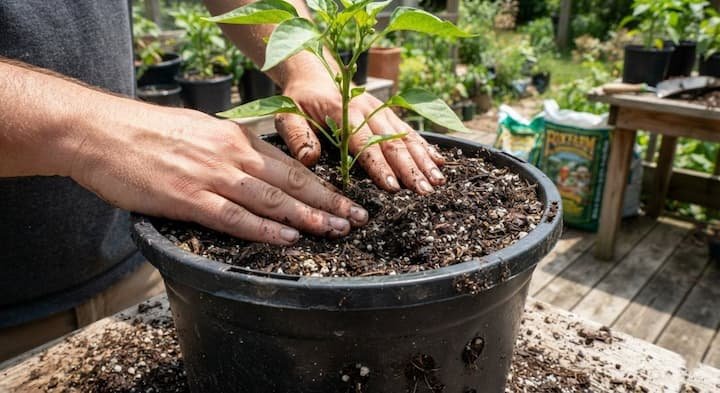
Garden soil turns hard in a pot and can carry disease, so use potting mix. Seed starting mix is fine for sprouts but has no nutrients. For pH, some sources say 6.0 to 6.5 and others 6.5 to 7, and peppers handle 6.0 to 7.0 fine.
A simple homemade mix:
- 2 parts peat moss or coconut coir
- 1 part perlite
- 1 part finished compost
The longer breakdown is in this soil mix guide.
Starting Bell Peppers from Seed
Sow indoors 6 to 8 weeks before your last frost. For the full walkthrough, see bell pepper seeds. If you bought nursery seedlings instead, skip ahead to transplanting.
- Wet the starting mix until it clumps but does not drip.
- Fill seed cells and sow 2 to 3 seeds ¼ inch deep.
- Keep the mix at 75°F to 85°F. A heat mat helps in a cool room.
- Cover with a humidity dome and open it daily.
- Seeds sprout in 7 to 14 days. Keep the strongest seedling per cell.
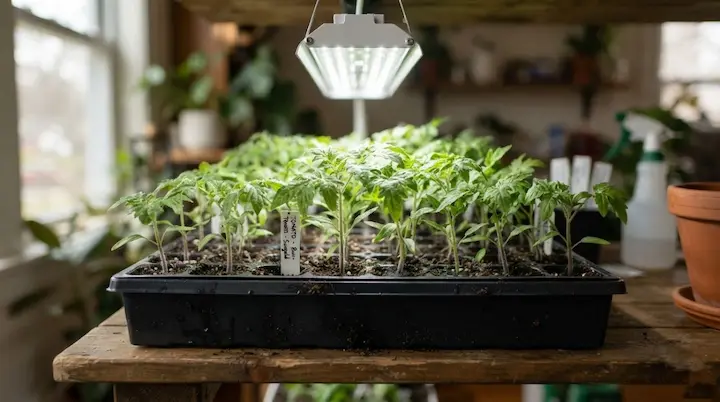
Once they sprout, give them 12 to 15 hours of LED light about 12 to 15 inches above the leaves. A sunny window works but makes floppy plants. Feed at half strength, and water from the bottom when the top ½ inch dries, dumping extra water from the tray.
Transplanting and Potting Up
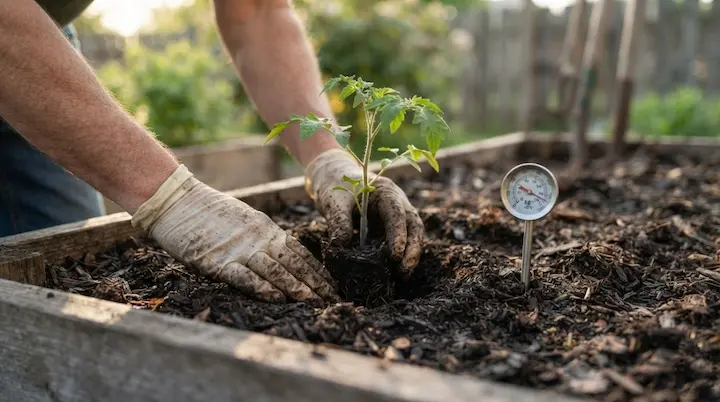
When seedlings hit 3 to 4 inches tall, usually 2 to 3 weeks after sprouting, move them to 3.5-inch pots first. I like to pot up in stages because the plants seem to grow faster and sturdier. Moisten the mix, fill the new pot, slide the seedling out with its root ball whole, plant it at the same depth, and water well before it goes back under the light.
For the final pot, do the same and leave about 1 inch below the rim. Growth may stall for a week, which is normal. Then switch to full-strength fertilizer.
Hardening Off and Moving Outdoors
Wait until nights stay above 55°F. Some guides say 50°F is fine, but I go with 55°F since growth stalls below that. Last frost runs from late March in Zone 8 to late May in Zone 4, so check when to plant for your area.
Sun outside is far stronger than a grow light, so ease them in over 4 weeks:
- Week 1: 20 minutes of sun, or about 1 hour of shade.
- Week 2: 1 hour of sun, or 3 to 4 hours of shade.
- Week 3: 1.5 to 2 hours of sun, or all day in shade.
- Week 4: move out for good.
Skipping this step causes sunscald, those pale papery patches on leaves. If the forecast drops below 40°F, bring the pots back inside.
Where to Put Your Pots: Sunlight
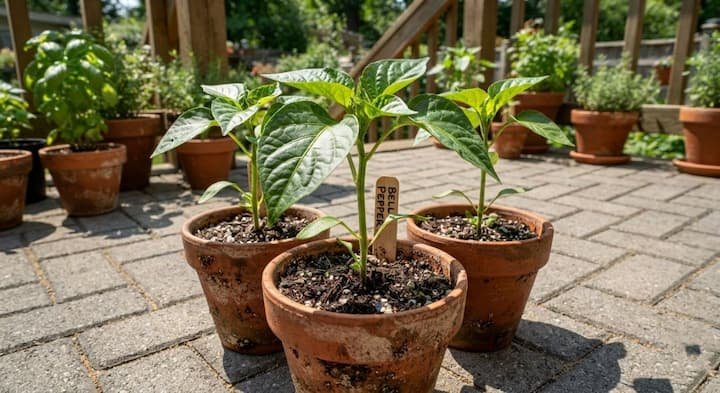
Peppers want 6 to 8 hours of direct sun, and potted bell peppers on a south or west-facing deck or patio do best. In hot areas, give them shade around 3 to 4 PM. Morning sun only still works, but fruit comes slower. Indoors, use a south-facing window plus a grow light.
Watering Bell Pepper Plants in Pots Without Overdoing It
Some guides say peppers like to dry out and others say keep them steady.
Both are right: let the top inch dry, then water deep. In my experience, lifting the pot to feel its weight works better than any finger test.
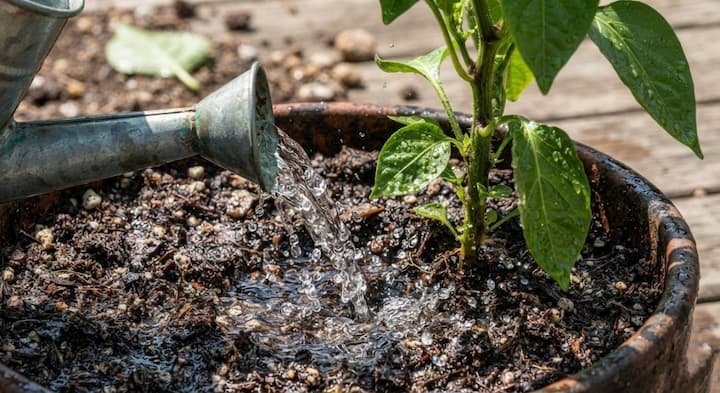
Water until it runs out the bottom, then empty the saucer. On 90°F days expect daily watering, even twice a day for small pots, while cool weather needs water every 2 to 3 days. Add 1 to 2 inches of straw or shredded bark on top to keep roots cool.
Signs you got it wrong:
- Too much: yellow lower leaves, soft stem base, soggy smell.
- Too little: wilting in the morning, crispy leaf edges.
Going away? For a weekend, water deeply, add mulch, and slide pots into light shade. For a week or longer, use self-watering pots, drip spikes, or a bottle-and-wick setup, or hand a neighbor a simple schedule. For more detail, see the watering schedule.
Fertilizing Schedule
Bell pepper plants in pots cannot reach out for nutrients, so you have to bring the food to them.
- At planting: mix in slow-release granules.
- First month in the pot: balanced 10-10-10 every 2 weeks.
- First flowers: switch to a tomato-type fertilizer every 2 to 4 weeks.
- Once fruit sets: skip heavy nitrogen.
Too much nitrogen gives you a big leafy plant with no peppers. The best fertilizer for fruiting has more phosphorus and potassium.
Calcium keeps fruit bottoms from rotting, so add a little dolomite lime to your mix and keep water steady. Epsom salt only helps if older leaves yellow between the veins, which points to low magnesium, so skip it as a routine feed. Compost coffee grounds first, since fresh ones compact and slow drainage.
Temperature and Weather Protection
The University of Maryland Extension says night temperatures below 60°F or above 75°F, or daytime highs above 95°F, can make pepper flowers and tiny fruits drop.
- Ideal: 70°F to 85°F.
- Below 50°F: growth slows. Frost at 32°F kills the plant.
Protection is easy with pots. Hang shade cloth during heat waves, slide pots into afternoon shade, and on cold nights drape a bed sheet over stakes so it does not crush the leaves.
Pruning, Pinching, and Support
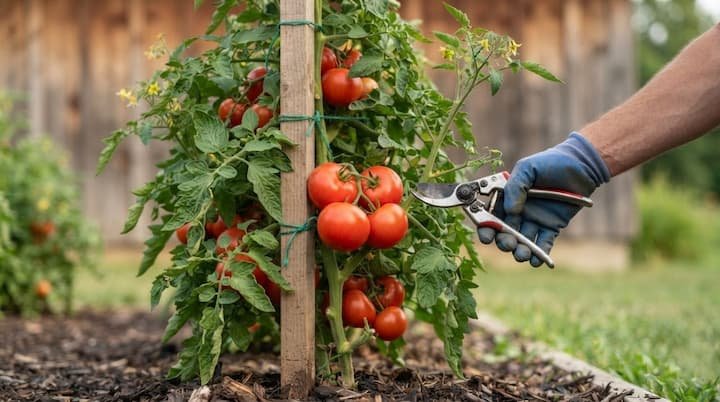
Grab clean pruners. Pinch off the first flowers for 2 to 3 weeks after moving outside so roots build first, then top the plant at about 1 foot tall to get two main stems. Remove yellow or damaged leaves and thin a few inside leaves for airflow.
Stake or cage early and tie with soft cloth or Velcro, not wire, because heavy fruit snaps unsupported branches. For more, see how to prune pepper plants.
Pollination and Fruit Set
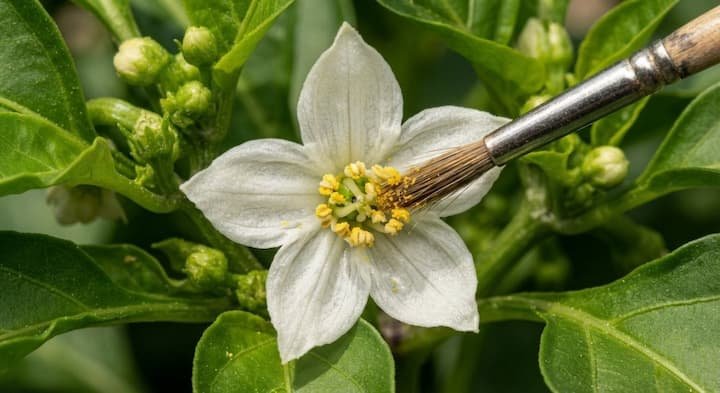
Bell peppers pollinate themselves, since each flower carries both male and female parts. The catch is that pollen has to shake loose, and on a windless balcony or indoors it often stays put.
Heat makes it worse: very high temperatures can kill pollen, and night lows below 60°F or above 75°F can drop flowers too.
- Tap the plant or flick the flower stems mid-morning, when pollen is dry.
- Use a soft brush or cotton swab to move pollen from flower to flower.
- Skip overhead watering while flowers are open, since wet pollen clumps up.
- Check for fruit set: petals fall off and a tiny pepper starts swelling behind them.
Bees give more fruit and seeds, so keep a few flowering herbs like basil nearby.
Pests and Diseases
- Aphids: blast with water or use insecticidal soap.
- Spider mites: raise humidity or spray neem oil.
- Thrips and whiteflies: use sticky traps and neem.
- Bacterial leaf spot, mosaic virus, powdery mildew: keep plants spaced, water at the base, and clip sick leaves.
- Bell peppers in containers get fewer soil diseases when you use fresh mix every year.
Mosaic virus has no cure. Pull the plant and put it in the trash, not the compost.
Common Problems and Fixes
Curling leaves are the number one question I hear, and most of the time heat and uneven water are the cause. See curling leaves for more.
| Symptom | Likely cause | Fix |
|---|---|---|
| Curling leaves | Heat, wind, uneven water | Steady water, afternoon shade |
| Yellow leaves | Overwatering, poor drainage, low feed | Check holes, ease off water, feed |
| Flowers dropping | Above 90°F or wrong nights | Shade cloth, move pot |
| Lots of leaves, few peppers | Too much nitrogen | Switch to tomato-type feed |
| Small peppers, slow growth | Under 6 hours of sun, small pot | Move to more sun, size up |
| Midday wilting | Heat stress | Shade; recovers by evening if it is heat stress |
| Leaves falling off | Cold, low nitrogen, disease, soggy soil | Check temps, feed, clip sick leaves |
| Pale papery patches | Sunscald | Shade, keep leaves on |
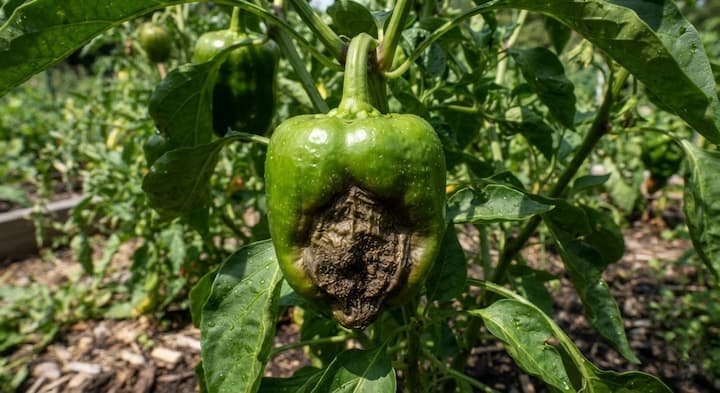
| Sunken dark spot on fruit bottom | Blossom end rot from uneven water and low calcium | Steady water, mulch |
Flower and fruit drop has a few usual suspects: heat above 90°F, cold nights, soil that swings between bone dry and soggy, too much nitrogen, too much shade, and weak pollination.
Rootbound plants stall, with roots circling or poking from the drain holes. To repot, water the day before, slide the plant out, loosen the outer roots, and set it in a pot one size up, say from 3 to 5 gallons, at the same depth. Water well and keep it out of hot afternoon sun for a few days.
Companion Planting
Basil keeps aphids down and takes little space, onions and garlic deter pests, carrots cover the ground in a wide planter box, and lettuce shades the soil around the roots.
Tomatoes share blight, so do not crowd them in one pot. In a single 5-gallon pot, keep it to one pepper and one low herb. More ideas are in this companion plants guide.
Harvesting Container-Grown Bell Peppers
Most plants give fruit about 60 to 90 days after transplanting. Pick when the pepper is full size, firm, and glossy. Some varieties show small stretch lines on the skin called corking, which means ripe.
Green is mature but not fully ripe. Turning red, yellow, or orange takes about 2 to 4 more weeks on the plant, and the taste gets sweeter. If color is stuck, read why peppers are not turning red.
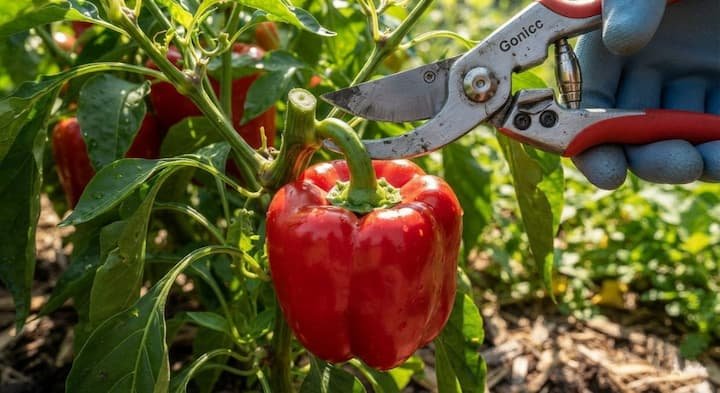
- Cut with pruners and leave a short stem. Pulling snaps branches.
- A green pepper will not turn red once picked unless color had started.
- Container-grown bell peppers keep flowering longer if you pick on schedule.
How Many Peppers Per Plant?
One guide says 5 to 10 peppers per plant and another says 8 to 12. The gap comes from variety, sun, pot size, and feeding, so expect somewhere in that range over the season. Mini bells give more, just smaller. In Zones 4 and 5, expect the lower end because summers are short.
To push toward the top, use a bigger pot, give it 8 hours of sun, keep water steady, switch to tomato-type feed once flowers show, pick often, and shade the plant during heat waves.
After the Harvest: Storing, Cooking, and Overwintering
- Fridge: whole, unwashed peppers last 1 to 2 weeks.
- Freezer: slice, freeze flat on a tray, then bag.
- Dried: dry red ones and grind into a paprika-style powder.
- Cooking: stuffed peppers, stir fry, fajitas, salsa, roasting.
Before the first fall frost, bring pots inside. Here is how to overwinter pepper plants. In USDA Zones 9 to 11 they can often stay out.
In my backyard I save seeds from a fully ripe red pepper, but hybrids will not grow true to the parent, so stick to open-pollinated varieties. Dry the seeds on a paper towel for a week or two, then store them cool and dry.
Common Mistakes to Avoid
The mistake I made my first summer was a 1-gallon pot.
- Using a pot under 3 gallons.
- Filling it with garden soil.
- Skipping hardening off.
- Too much nitrogen after flowering starts.
- Letting the pot bone dry, then flooding it.
- Setting plants out before nights hit 55°F.
Month-by-Month Care Calendar
This fits USDA Zones 5, 6, and 7. Shift earlier in Zone 8 and later in Zone 4.
- 8 weeks before last frost: sow seeds.
- 6 weeks before: pot up seedlings.
- 3 to 4 weeks before: start hardening off.
- 1 to 2 weeks after last frost: move outside, pinch early flowers.
- June: stake plants and start the fruiting feed.
- July to August: water deep, add shade cloth, start picking.
- Sept to Oct: final harvest, bring pots in, save seeds.
Final Thoughts:
Growing bell peppers in pots comes down to a big pot, a loose potting mix, 6 to 8 hours of sun, and steady water and food. Start with a compact variety, harden off your seedlings, and pick peppers on time. Do those things and a backyard patio can feed you well into fall. Grab a 5-gallon pot this weekend and get your first plant going.
Pingback: Pepper Plant Leaves Curling: 11 Causes & Fixes