Most roses that struggle in a new bed were doomed before the first root touched the dirt. Sun, drainage and soil pH decide almost everything, and all three take one afternoon to check.
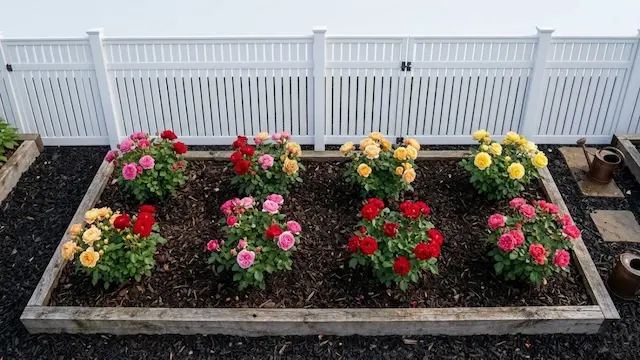
Here is how to prepare a rose garden bed the right way, from picking the spot to the last inch of mulch, so your plants bloom hard in year one.
Know Three Things About Roses Before You Dig
Roses want at least 6 hours of sun, soil that drains, and a pH near 6.5. A good bed also adds color, fragrance and resale value to a backyard. Preparing a rose bed takes a full weekend.
Pick your rose type first, since each needs different room:
- Hybrid teas: big blooms, fussier to grow
- Floribundas: flower clusters, long bloom season
- Climbers: fences and trellises, need 6 to 8 feet
- Shrub and Knock Out types: tough, disease resistant, best for a first bed
The form you buy matters too:
- Bare-root: cheapest, but must go in fast during early spring.
- Potted: costs more, plants almost any time.
- Grafted: tougher roots, but bud union depth matters.
Then the bed style:
| In-ground | Raised | |
|---|---|---|
| Cost | Lower | Higher |
| Drainage | Depends on your yard | Easy to control |
| Best for | Loam | Clay or slow drainage |
Pick the Right Spot in Your Backyard
- 6 to 8 hours of direct sun, morning sun first because it dries leaves fast.
- Open airflow and room for the full grown width, away from tree roots and drip lines.
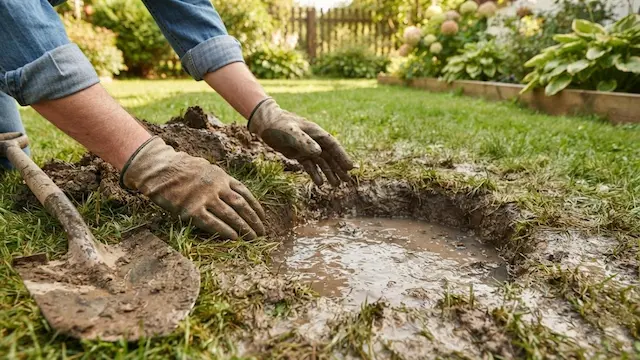
- Drainage test: dig a hole 18 inches deep, fill it with water, and time the drain.
University of Illinois Extension says roses need at least six hours of sun, and that hole should drain in about 5 to 6 hours. Slower than that means a raised bed. Light afternoon shade is fine, and in hot Southern backyards it helps.
Plan the Layout and Count Your Roses
Ribbons, arcs, keyholes, islands and borders all work, but curves and keyholes are easiest to reach. Keep the bed 3 to 4 feet wide so you can work from the edge without compacting the soil.
- Formal: straight lines, one color per block.
- Cottage: curves, mixed heights.
- Tall roses in back, short ones in front.
- Repeat one or two colors and mix bloom times.
- Leave a path wide enough for a wheelbarrow.
| Rose type | Spacing |
|---|---|
| Miniature | 18 inches |
| Hybrid tea, floribunda | 30 to 36 inches |
| Shrub | 3 to 4 feet |
| Climber | 6 to 8 feet |
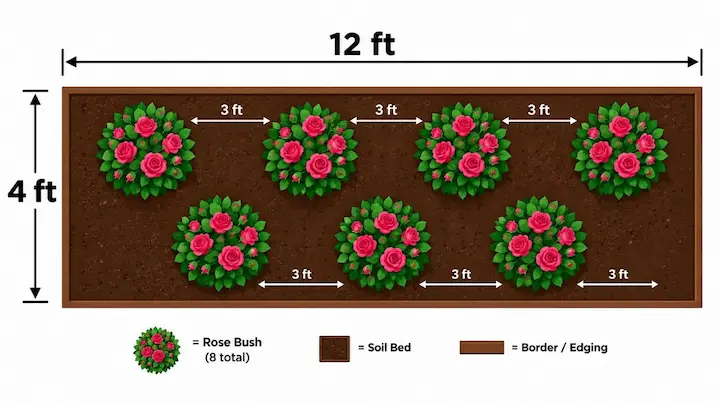
Divide bed length by spacing, then multiply by the number of rows. A 3 ft by 8 ft ribbon fits 3 hybrid teas, a 4 ft by 12 ft bed fits 8, and a 5 ft by 20 ft border fits about 12.12 ft4 ft
Tools, Materials and Budget
- Tools: digging fork, flat spade, hose, soil test kit, gloves, pruners.
- Materials: compost, bark mulch, drip line with a timer, sulfur or lime if your test says so.
Plan one weekend of easy to moderate work. Rough costs for a 4 ft by 8 ft bed:
| Level | What you get | Cost |
|---|---|---|
| Budget | In-ground, bare-root roses | $150 to $250 |
| Mid | Adds drip line and edging | $300 to $450 |
| Premium | Raised frame, potted roses | $600 to $900 |
How to Prepare a Rose Garden Bed: The Order That Works
I like to mark the outline with a garden hose or a line of sand before touching a shovel. Then clear the grass:
- Pull weeds and strip the sod with a flat spade.
- Solarize under clear plastic for 4 to 6 weeks in peak sun.
- Smother with 8 to 12 layers of wet newspaper, topped with compost.
- Lay weed barrier fabric under the mulch for stubborn grass.
Bag the roots as garbage, not compost, or they return. If the spot was a vegetable patch where zucchini and eggplant grew, add extra compost, because heavy feeders leave tired soil.
Loosen the soil 12 to 18 inches deep across the whole footprint, not just the holes. Lift clods with a fork and keep crumbs, not dust.
Rose Bed Soil Preparation: Test, Adjust, Feed
Test first. I think a lab report from your county extension office beats a cheap kit, since it gives real numbers. Roses favor a pH from 6.0 to 6.8, with 6.5 the sweet spot.
- For a lab test: mix 6 inch soil slices from three spots.
- Too high: elemental sulfur, roughly 2 lb per 100 square feet to drop about one point.
- Too low: follow the lab’s lime rate.
- Change pH in small doses and retest in 6 to 8 weeks.
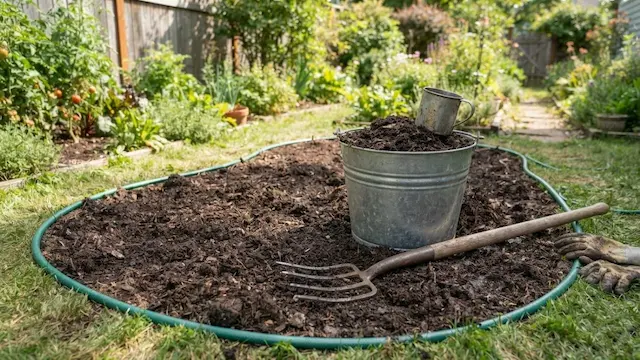
- Fork 2 to 3 inches of compost into the top 8 to 12 inches.
- Skip raw manure and half-rotted leaves before planting.
Good rose bed soil preparation covers the whole bed, not just the hole.
| Soil type | Add | Watering |
|---|---|---|
| Clay | 2 to 3 inches of compost, coarse bark | Slow, deep, when the top inch is dry |
| Loam | 1 to 2 inches of compost | Deep, about weekly |
| Sand | 3 inches of compost, aged manure | More often, thick mulch |
Build a Raised Rose Bed When Drainage Is Poor
In my experience, clay yards that hold water for hours kill more rose beds than any pest. Raised beds fix that:
- Height: 6 to 12 inches, top sloped slightly so rain sheds.
- Frame: untreated timber, cinder blocks or stone, set in a shallow trench.
- Soil: 2 parts topsoil to 1 part compost, never compost alone.
- A gravel channel to a lower spot where water pools.
- Fill with the mix, water, and let it settle a few days.
Once you build a raised rose bed, plant and mulch it like any other. It dries faster in summer, so read how to winterize raised beds before Fall.
Set Up Irrigation Before Any Plant Goes In
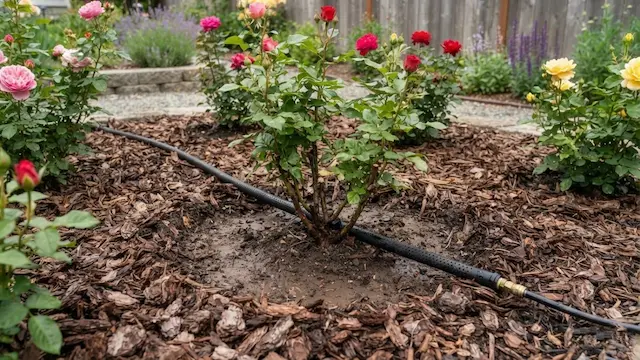
Lay a soaker hose or drip line in loose loops, then add a timer set for early morning.
- Soaker hose: cheap, good for straight beds.
- Drip line: best for curved beds.
- Run it once and fix leaks before planting.
Planting Roses in a New Bed, Step by Step
Plant bare-root roses in early spring and potted ones in spring or Fall. In USDA Zones 4, 5, 6, 7 and 8, wait until after the last frost. Hot Southern yards do better with Fall planting.
- Bare-root: soak roots 2 hours, trim broken tips.
- Potted: rough up circling roots.
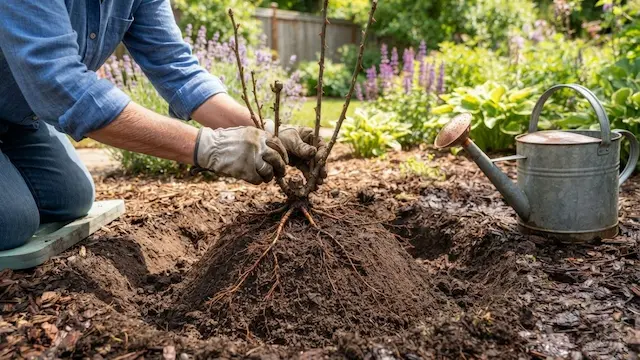
- Dig a wide, shallow bowl about twice the root spread.
- Build a small soil mound in the center for bare-root plants.
- Center the plant, backfill, press out air pockets.
- Flood the basin twice, about 2 gallons each time.
- Label every plant, because planting roses in a new bed means forgetting names by spring.
Depth matters on grafted roses. Oregon State University Extension says to set the bud union 2 to 4 inches below the soil in cold climates (Zones 3 to 6) and at soil level in warmer regions (Zones 7 to 11).
Never plant where an old rose or shrub grew for years. Swap out 18 to 24 inches of that soil or pick a fresh spot.
Mulch the Bed Right
Add mulch right after the second watering to lock in moisture.
- 2 to 3 inches of shredded bark, leaf mold, straw or cocoa shells.
- Keep it a hand-width back from the canes to prevent rot.
- Top up each Fall; it also blocks weeds.
Water, Feed and Prune Through Year One
Water deep, let the top inch dry, and check with a finger. New roses get about 2 gallons per plant twice a week, and established ones 1 to 2 inches of water a week (more in heat), at the base in the morning.
Feed after new growth shows, then every 4 to 6 weeks with a balanced rose fertilizer like 10-10-10 or an organic blend, and stop six weeks before your first frost.
- Prune in early spring while dormant, cutting dead, diseased and crossing wood back to healthy tissue.
- Aim for an open center, use clean, sharp pruners, and deadhead all summer.
Companions, Edging and What to Skip
Lavender pulls in pollinators, marigolds help deter nematodes, and catmint and salvia add color. Skip aggressive spreaders like mint and anything that shades roses or drinks their water.
Stone, wood or metal edging keeps grass out. A community gardener I know swears by steel edging, and I think it beats plastic.
Pests, Diseases and Troubleshooting
Check leaves weekly, Neem oil, insecticidal soap and beneficial insects handle most aphids, spider mites and Japanese beetles. Airflow, base watering and raking fallen leaves prevent powdery mildew and black spot.
| What you see | Likely cause | Fix |
|---|---|---|
| Black spots, dropping leaves | Black spot fungus | Remove leaves, water at the base |
| White powder | Powdery mildew | Thin canes, neem oil |
| Yellow leaves, green veins | High pH | Sulfur by soil test, foliar chelated iron |
| Few blooms | Too much shade or nitrogen | Move the bed or thin branches, cut nitrogen |
| Water pools after rain | Slow drainage | Raise the bed, add a gravel channel |
An 8 foot fence stops deer, and a 2 foot chicken wire cage keeps rabbits off young canes.
Year-One Care Calendar
| Season | Task |
|---|---|
| Early spring | Plant bare-root, prune broken wood |
| Late spring | First light feeding, train canes |
| Summer | Deep weekly water, deadhead |
| Early Fall | Ease off fertilizer |
| Late Fall | Top up mulch, clear leaves |
| Winter | Check for wind rock, add ties |
After a hard frost near 28°F, mound 6 to 8 inches of mulch over the crown of tender types, and pull most of it back once the ground stays above 32°F. Here is how to winterize roses. In Zones 9 and 10, skip the mound, add mulch above 90°F, and watch for black spot.
Common Mistakes to Avoid
- Planting too deep or too shallow for your climate.
- Prepping only the holes, not the bed.
- Piling mulch on canes.
- Rushing through preparing a rose bed and skipping the soil test.
- Overwatering in clay.
- Picking a shady spot or the wrong variety.
My worst mistake was feeding a brand-new rose too early. It pushed soft growth, and aphids showed up within a week.
Weekend Plan for a Small Yard
- Day 1: mark the outline, clear weeds, loosen the soil 12 to 18 inches, blend in compost.
- Day 2: lay drip line, plant, water in twice, mulch 2 to 3 inches.
Print this plan for your shed door.
Final Thoughts:
Now you know how to prepare a rose garden bed from outline to mulch. Spend your time on sun, drainage and pH, because that work pays off every June. I like to keep a small notebook of what bloomed where, then adjust spacing next year. Test pH each spring and the bed gets easier.