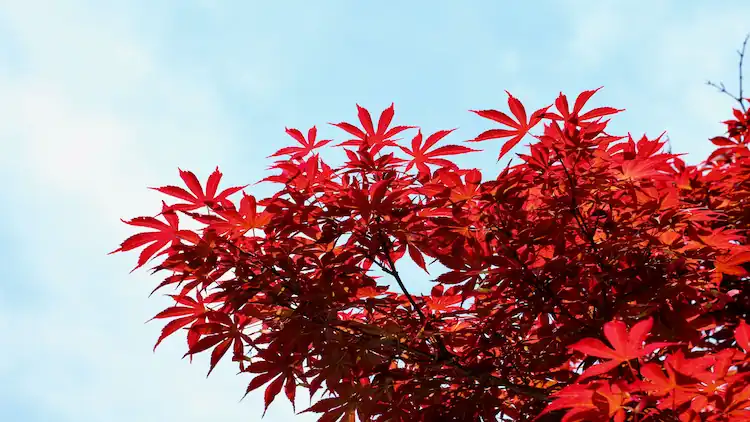
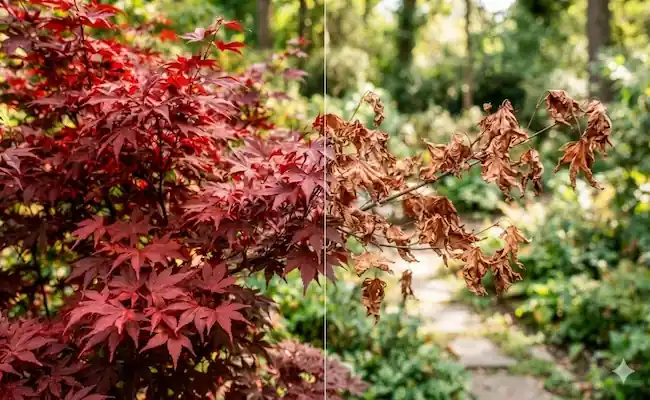
You walk out to the yard on a warm afternoon, coffee in hand, and there it is that graceful, reddish canopy that’s been the pride of your backyard all summer now has crispy, brown patches creeping across the leaves. Is the tree dying? Did you do something wrong?
I get asked about Japanese maple leaves turning brown more often than almost any other tree problem, and the honest answer is that it’s rarely just one thing. It’s usually your tree telling you, in the only language it has, that something in its environment needs adjusting.
I’ve grown these trees in my own yard for years, and if I’m honest, they’re one of my favorite specimens precisely because they’re a little dramatic. I still remember panicking the first time one of mine went crispy in July. It turned out to be nothing dramatic just too much afternoon sun and not enough water.
But not every case is that simple, so let’s walk through what actually causes this, how to tell the difference between a real problem and normal fall color, and what you can do about it.
Common Causes Behind Japanese Maple Leaves Turning Brown
Japanese maples (Acer palmatum) are woodland trees by nature. In their native habitat they grow under a canopy of taller trees, which means they never evolved to handle full, blazing sun for eight hours straight.
When you plant one as a centerpiece near a patio or driveway, in exchange for that gorgeous color you’re asking it to tolerate conditions it wasn’t built for. Depending on the cultivar, a mature tree can top out anywhere from 6 to 25 feet, so the amount of shade it gets and gives itself changes as it grows. Here’s what typically goes wrong.
Leaf scorch from heat and sun:
This is, by far, the most common reason for Japanese maple leaf scorch. When temperatures climb above 90°F and the tree can’t pull water up through its roots fast enough to replace what’s lost through the leaves, the tissue along the edges and between the veins dries out and turns brown. Wind makes it worse by pulling even more moisture out of the foliage. In my experience, this single cause is behind at least half the worried messages I get every August.
Underwatering:
Even drought-tolerant, established Japanese maples need consistent moisture, especially in their first two to three years. A newly planted tree needs roughly 1.5 to 2 gallons of water two or three times a week during hot stretches, tapering off as the root system matures.
Overwatering and poor drainage:
This one surprises people. Soggy soil suffocates the fine roots that absorb water, so the leaves brown out looking almost identical to a drought-stressed tree except the cause is too much moisture, not too little. If a hole you dig fills with water and drains slower than about 1 inch per hour, your soil needs help before it needs more water.
Fertilizer or chemical burn:
Over-fertilizing, or letting lawn fertilizer drift onto the root zone, can scorch leaf margins within days. The same goes for de-icing salt runoff or herbicide overspray from a neighboring bed.
Transplant shock:
A tree moved within the last one to two seasons hasn’t rebuilt enough root mass to keep up with its canopy’s water demand, so browning shows up even with a perfectly good watering routine.
Pests and disease:
Verticillium wilt, anthracnose, and certain borers can all cause brown, curling foliage. These cases usually come with extra clues sudden branch dieback, sticky residue, or discoloration that shows up on just one side of the tree.
Planting depth:
If the root flare was buried when the tree went into the ground, roots can’t breathe properly, and leaf tips browning is often the first visible sign.
Japanese Maple Leaf Browning at a Glance
| Cause | What You’ll Notice | What To Do |
|---|---|---|
| Sun/heat scorch | Brown, crispy edges; worse on the side facing afternoon sun | Add afternoon shade or a shade cloth; water deeply |
| Underwatering | Whole leaves droop, then brown and curl | Water 1.5–2 gallons, 2–3x weekly in heat |
| Overwatering | Yellowing before browning; soggy soil | Improve drainage; let soil dry between waterings |
| Fertilizer/salt burn | Browning starts at leaf margins, appears fast | Flush soil with water; stop feeding for the season |
| Transplant shock | General wilting in the first 1–2 years | Keep watering consistent; avoid pruning that season |
| Pests/disease | Dieback on one side, sticky spots, cankers | Contact a certified arborist or extension office |
| Planting too deep | Slow decline, brown leaf tips, thin canopy | Expose the root flare; remove excess soil/mulch |
Is It Stress, or Just Fall Color?
Here’s where a lot of community gardener questions come in every October: how do you tell brown leaves on Japanese maple trees from a tree that’s simply going dormant for the season?
Fall color happens gradually, starting at the top of the canopy and moving down, with reds, oranges, and golds mixed in before the leaves drop cleanly. Stress-related browning tends to be patchy, shows up out of season (mid-summer especially), and leaves often stay stuck to the branch, curled and crisp, instead of falling off on their own.
If your tree is dropping color early alongside other fall garden cleanup while your zucchini and eggplant plants are winding down and you’re already bagging up trash bags of spent annuals that’s likely just the season doing its thing. If you’re seeing this browning happen in July while the rest of the yard is thriving, that’s your cue to look closer.
How to Help a Japanese Maple With Brown Leaves
Unfortunately, once a leaf has gone fully brown, it won’t turn green again that tissue is done for the season. But you can absolutely stop the problem from spreading and set the tree up for a healthier year ahead:
- Water deeply, not frequently. A slow soak that reaches 12–18 inches down encourages deep roots, which handle heat far better than shallow ones.
- Mulch the root zone. A 2–3 inch layer of organic mulch, kept a few inches back from the trunk, keeps soil temperatures even and holds moisture. My own best mulch choices for winter protection work just as well for buffering summer heat stress.
- Provide afternoon shade. Potted trees can simply be moved. In-ground trees benefit from a nearby taller plant, a pergola, or even a temporary shade cloth during heat waves.
- Skip the pruners during a stress event. Wait until the tree has recovered before doing any corrective pruning; cutting a stressed tree adds another wound to manage.
- Check the root flare. If soil or mulch is piled against the trunk, pull it back so the flare is visible at ground level.
- Hold off on fertilizer. A stressed tree can’t process a fresh dose of nitrogen feeding it now often makes leaf browning worse, not better.
If the damage looks severe or the tree seems to be declining season after season rather than just showing surface scorch, it’s worth reading through the fuller breakdown in my article on what it really means when a Japanese maple looks like it’s dying, since the causes and the recovery timeline overlap quite a bit with this topic.
Preventing Japanese Maple Leaf Scorch Before It Starts
Prevention is a lot less stressful than damage control, and most of it comes down to picking the right spot and staying consistent:
- Plant in a location with morning sun and afternoon shade whenever possible.
- Choose a site sheltered from strong, drying winds a spot along a fence line or near the house often works well.
- Water new trees consistently through their first two full growing seasons.
- Test your soil’s drainage before planting, not after.
- Avoid planting directly beside a driveway, trash or garbage bin storage area, or anywhere heat reflects off concrete or asphalt.
- If frost and cold snaps are more of a concern where you garden, my guide to protecting plants from frost covers the flip side of this same stress response once temperatures drop toward 32°F, tender new growth and shallow roots can struggle just as much as they do in a summer heat wave.
USDA Hardiness Zones and Why Location Matters
Japanese maples grow reliably across USDA Zones 5, 6, 7, and 8, with some cultivars pushing into Zone 4 with extra winter protection and a few tolerating the warmer edge of Zone 9 if they get consistent afternoon shade.
Research summarized by the USDA Forest Service on long-term drought stress in urban trees documents how drought-weakened root systems struggle to keep pace with canopy water demand precisely the mechanism behind most cases of scorched, browning foliage. You can look up your specific growing zone through the USDA Plant Hardiness Zone Map before choosing a planting site or cultivar.
Zone matters because it tells you what your tree can survive over winter, but summer siting sun exposure, wind, and soil drainage is what actually determines whether you’ll be dealing with why is my Japanese maple turning brown questions come July and August. A tree perfectly hardy for your zone can still scorch badly if it’s planted in the wrong spot.
If fall cleanup is already on your list once the true dormant season colors show up, it’s worth pairing this with a look at which perennials to cut back before winter so your whole bed goes into the cold months on the same footing.
Final Thoughts:
Japanese maple leaves turning brown is almost never a mystery once you slow down and look at the pattern where it’s showing up, when it started, and what the soil and weather have been doing. Most of the time, it traces back to sun, water, or soil drainage, all of which you can adjust. Give the tree a season to recover, keep your watering steady, and don’t be afraid to move a potted maple to a kinder spot in the yard.
I think most of us over-worry the first year we own one of these trees and under-water every year after so trust the process, and remember these trees are tougher than that first crispy leaf makes them look.