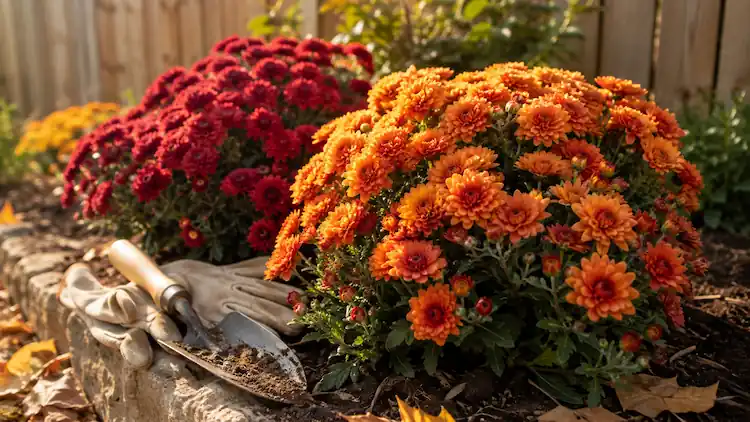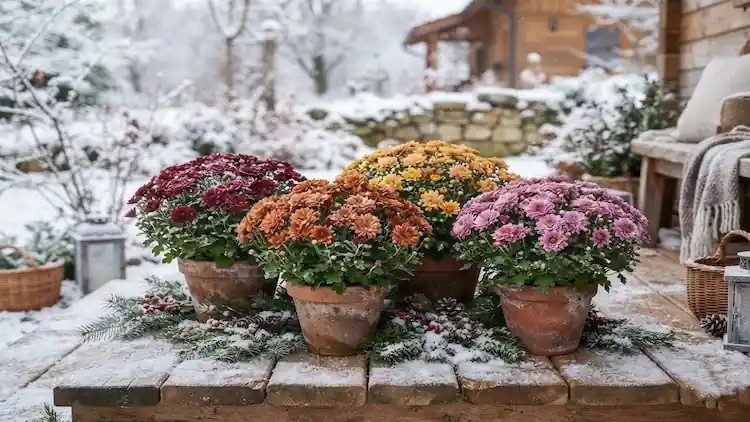
You picked out a full, colorful mum for the porch a couple of weeks ago, and now half the leaves are brown and the blooms are drooping. If you’re asking yourself why are my potted mums dying?
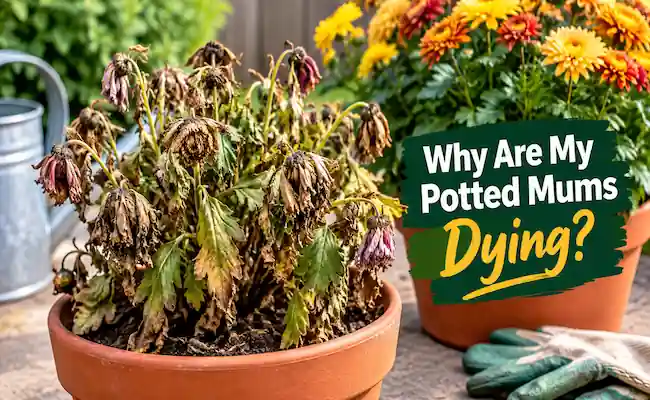
You’re not alone I get this question from neighbors every single Fall. The good news is that the cause is almost always one of a handful of things, and most of them are fixable if you catch them early. Let’s go through what’s actually going wrong.
Is It Dying, or Just Going Dormant?
Before you panic, do a quick scratch test: gently scrape a fingernail across a stem. Green underneath means the plant is alive, even if it looks rough on top. Brown and dry all the way through means that part is gone.
Many store-bought Fall mums also fade naturally once their bloom cycle ends, so some browning is just the plant winding down for the season, not a sign you did anything wrong.
Why Are My Potted Mums Dying? It Usually Starts With Water
In my experience, more container mums are lost to bad watering habits than to anything else. Chrysanthemums need about 1 inch of water a week during active growth, and a small pot dries out fast, sometimes within a day or two in warm weather.
Watering slowly at the soil line, rather than a quick splash over the top, also helps water actually reach the roots instead of running straight out the drainage hole.
Here’s what to look for:
- Dry, crumbly soil that pulls away from the pot’s edge, plus wilted, papery leaves the plant is thirsty.
- Soil that stays wet for days, with a musty smell you’re overwatering.
- Wilting that doesn’t bounce back after a good soak that’s often root damage, not thirst.
A simple comparison helps here:
| Symptom | Soil Feel | Likely Cause |
|---|---|---|
| Crumbly, dry leaves | Bone dry | Underwatering |
| Yellow, mushy leaves | Soggy, heavy | Overwatering |
| Wilted even after watering | Stays wet, smells sour | Root rot |
If you’re dealing with potted mums dying despite regular watering, the pot itself may be the problem that’s next.
Root Rot and Drainage Are Usually Behind Potted Mums Dying
Push your finger about 2 inches into the soil. If it’s still damp down there, hold off on watering you could be drowning the roots. Mums in a pot with no drainage hole, or in a heavy plastic container that traps moisture, are prime candidates for root rot.
You’ll also want to check the pot itself:
- Make sure there’s at least one drainage hole, and that it isn’t blocked.
- A terracotta pot dries out faster than plastic, which can actually help prevent overwatering.
- Mix in some perlite or coarse sand with your potting soil so extra water moves through instead of sitting around the roots.
- If roots look brown and mushy when you tip the plant out, trim them with clean pruners and repot into fresh, well-draining mix.
Sun, Temperature, and That First Fall Frost
Mums are sun lovers. They need at least 6 hours of direct light a day to hold their color and shape too little light, and you’ll get a leggy, sparse plant instead of the full, rounded look most gardeners want.
Temperature swings matter just as much. Mums do best between 60°F and 70°F. Once nighttime lows dip toward 32°F, tender growth can blacken overnight. If a hard freeze is coming, move your pots into the backyard shed or garage, or cover them a good frost blanket makes this a lot easier than plastic sheeting.
One thing that trips people up: not every mum is built to survive winter outdoors. Florist mums are bred for short-term color, not cold tolerance, while garden mums are generally hardy in USDA Zones 5 through 9.
If you’re in Zones 4, 5, 6, 7, or 8 and hoping your potted mum comes back next year, it’s worth reading up on whether potted mums can survive winter in your specific zone, and whether chrysanthemums are perennial or annual where you garden it changes how much effort is worth putting in.
Why Is My Chrysanthemum Dying From Disease?
If watering and light check out fine, disease is the next suspect. A few fungal issues show up again and again in potted mums:
- Pythium: root rot that shows up fast in overwatered, cool soil.
- Verticillium wilt: yellowing veins and sudden wilting. According to Michigan State University Extension, this fungus can survive in the soil for years and can’t be treated with fungicide once it takes hold, so an infected plant needs to be removed and the soil discarded.
- Septoria leaf spot: brown or yellow spots that appear after water sits on the leaves.
- Powdery mildew: a gray-white dusty coating, worse in crowded plants with poor airflow.
Chrysanthemums are generally hardy in USDA Zones 5 through 9, but that hardiness doesn’t protect them from soil-borne fungus, which is exactly why drainage matters as much as watering does.
If your plant matches one of these patterns and you’re wondering why is my chrysanthemum dying even with decent care, a fungal issue is a strong possibility treat it with an appropriate fungicide and always water at the base, not over the leaves.
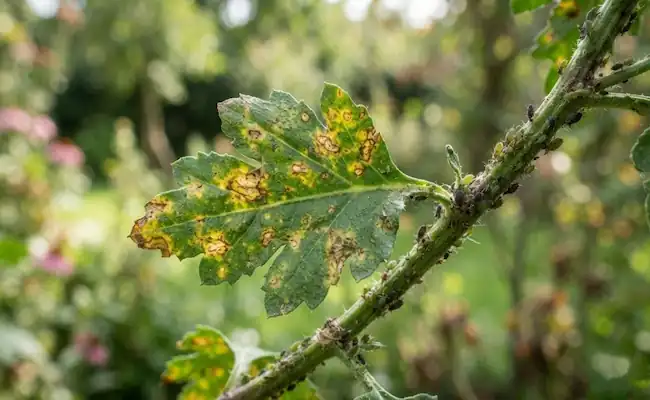
Pests Hiding on Mums Dying in Pots
Insects are easy to miss until the damage is done. Check the undersides of leaves and new growth for:
- Aphids: small, soft-bodied, clustered on tender stems, leaving a sticky residue behind.
- Spider mites: fine webbing and a stippled, bronze look on leaves.
- Leaf miners: thin, winding tunnels inside the leaf itself.
- Thrips and whiteflies: tiny flying or slender insects that scatter when you brush the foliage, leaving silvery streaks or a fine speckling behind.
Just like you’d check your zucchini or eggplant for bugs before things get out of hand, a quick weekly look at your mums catches most infestations early. A strong blast of water knocks off light populations; for anything persistent, neem oil or insecticidal soap works well when applied in the early morning or evening, since spraying in full sun can burn the leaves.
Root-Bound Roots and Transplant Shock
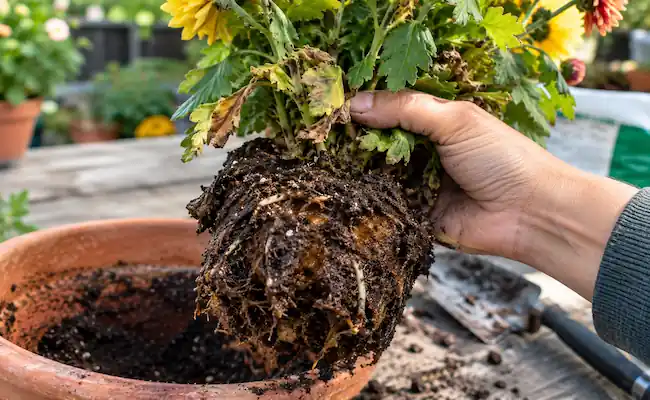
Here’s one people miss: mums bought from a nursery are often root-bound, meaning the roots have circled tightly inside the small growing pot. Even with perfect watering, a root-bound plant can’t take up water or nutrients properly.
Tip the plant out and look. If you see a dense tangle of roots with barely any soil visible, gently loosen them with your fingers, trim off any circling or blackened roots, and move the plant into a container just 1 to 2 inches wider, with fresh potting mix.
Going too big too fast just leaves excess soil holding water the roots aren’t ready to use yet, which brings you right back to a drainage problem.
How to Save Dying Mums Step by Step
Once you’ve figured out the cause, here’s how to bring the plant back:
- Fix the watering deep soak if dry, ease off if soggy.
- Confirm drainage and repot if the roots are rotting or root-bound.
- Move the pot to a spot with 6+ hours of sun and steady temperatures.
- Prune off dead or diseased growth with clean pruners.
- Treat any disease or pest you’ve identified.
- Deadhead spent blooms so the plant puts energy into new growth instead of seed.
If you want your plant to stay a centerpiece favorite through the whole season, it helps to read up on how to keep mums blooming through Fall rather than just reacting once trouble shows up. I’ve found that a little routine care goes a lot further than emergency fixes.
Feeding Mums Without Overdoing It
A weak, pale plant sometimes just needs food, not a diagnosis. During active growth, a balanced fertilizer such as a 5-10-10 blend gives mums the potassium and nitrogen they need to build strong stems and full blooms. Feed lightly every 2 to 4 weeks, and never on completely dry soil, since that can scorch the roots.
Watch for the opposite problem too crispy brown edges on otherwise healthy-looking leaves, or a white crust forming on top of the soil, usually mean you’ve fed the plant too much.
When that happens, flush the pot with a couple of gallons of plain water to rinse out the excess salts, then hold off on fertilizer for a few weeks. And skip feeding altogether once the plant slows down for the season; pushing new growth right before a freeze does more harm than good.

Keeping Mums Alive Once Fall Ends
After the first hard frost blackens the foliage, don’t cut the plant all the way down that signals new growth at the wrong time. Instead, leave the dead stems in place and mulch around the crown with 2 to 3 inches of material for insulation.
Many community gardener friends of mine also cut back other perennials around this time, and it’s worth reading which perennials to cut back before winter so you’re not doing it to the wrong plants. A good layer of the best mulch for winter protection can make the difference between a mum that returns next Fall and one that doesn’t.
Always throw diseased leaves and stems in the trash or garbage, not the compost pile fungal spores can survive composting and reinfect your yard next season.
Final Thoughts
So, why are my potted mums dying? Nine times out of ten, it comes down to water, drainage, temperature, or a fungal issue that snuck in when conditions were damp. Walk through each cause, fix what applies, and give the plant a couple of weeks to respond. I think most gardeners give up on a mum right before it would’ve bounced back a little patience and the right diagnosis usually saves it.