
Ever notice how a grocery store basil pot looks great for a week and then collapses, while basil on a neighbor’s counter keeps going for months?
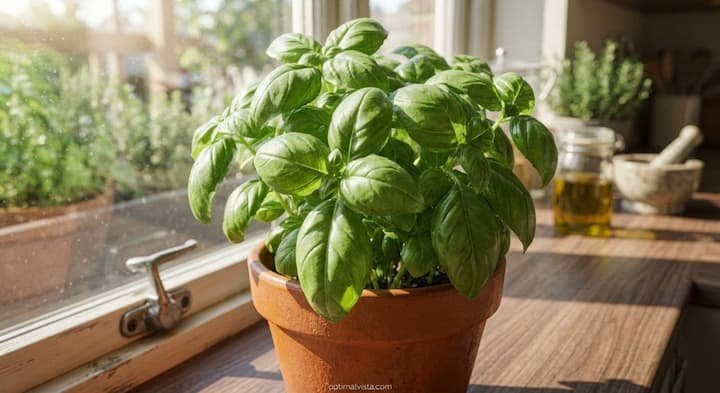
The difference is rarely luck. Growing basil in pots indoors works when the plant gets 6 to 8 hours of light, a pot with real drainage holes, and a room that stays above 50°F.
Short answer: give it a bright window, a pot that drains, a warm spot, and a weekly trim. Everything below builds on those four things, one step at a time. No special gear needed.
Why Growing Basil in Pots Indoors Works So Well
Basil is a tender annual from warm parts of the world, so it hates cold nights and soggy roots. A pot lets you fix both problems.
You pick the mix, you decide how much water it gets, and you can slide it away from a cold window in minutes. Indoor basil care is also simpler than garden care, because bugs, slugs, and surprise frost mostly stay outside.
- Fresh leaves sit a few steps from the stove.
- You can move the pot to chase the light.
- No yard or backyard needed, just one sunny spot.
- The ASPCA lists sweet basil as non-toxic to dogs and cats.
Best Basil Varieties for Containers
Not every basil fits a pot the same way. Compact types suit basil on a windowsill best, since they stay short and bushy without much fuss. Big-leaf types need more root room and more light.
- Genovese: the classic pesto basil with big sweet leaves, often 18 to 24 inches tall outdoors but smaller when you keep it trimmed.
- Spicy Globe: a tiny rounded plant, about 6 to 12 inches tall, great for tight sills.
- Thai basil (Siam Queen): anise and clove flavor that holds up in cooked dishes, 1 to 2 feet tall, and its needs differ a bit, so read this Thai basil care breakdown.
- Lemon basil: bright citrus scent, 12 to 24 inches tall.
- Mammoth or Napoletano: huge leaves that want a 3 to 4 gallon pot.
I like Spicy Globe for a small kitchen sill because it never gets out of hand.

Best Pot Size for Basil
A pot that is too small dries out in hours and cramps the roots. One that is too big stays wet and invites root rot. Aim for the middle.
| Setup | Pot width | Pot depth | Volume |
|---|---|---|---|
| One compact plant | 8 inches | 8 inches | about 1 gallon |
| One standard plant | 8 to 10 inches | 8 inches or more | 1 to 2 gallons |
| Two or three plants | 12 inches | 8 to 10 inches | 2 to 3 gallons |
| Large-leaf varieties | 12 inches | 10 inches or more | 3 to 4 gallons |
Whatever size you pick, the pot needs drainage holes. If your favorite planter has none, use it as a cover and set a plain nursery pot inside it.
Terracotta vs Plastic vs Fabric Pots
Gardeners disagree on this one, and both sides have a point. Terracotta breathes and forgives heavy watering, but it dries fast. Plastic and glazed ceramic hold water longer. Fabric bags drain well and grow strong roots, though they can leak onto a shelf.
- Terracotta: good if you tend to overwater, needs watering more often.
- Plastic or glazed ceramic: good if you forget the plant for a few days.
- Fabric (3 to 4 gallons): best for big-leaf types on a floor or tray.
I think terracotta is the safer pick for beginners who love watering. Use a saucer under any indoor pot, and empty it within 15 to 20 minutes after watering.
Climate matters too. In a hot, dry room or on a sunny deck, plastic or glazed pots keep roots from drying out, and a light pot color reflects heat better than a dark one. Dark plastic in direct summer sun can cook the roots.
Best Potting Mix for Basil
Skip garden soil. It packs down in a pot and chokes the roots. Basil favors a light mix that drains fast but still holds a little moisture.
- 2 parts soilless potting mix (peat or coco based).
- 1 part perlite for drainage.
- 1 part compost for slow nutrients.
- If a bagged mix feels heavy, add perlite until it makes up 20 to 30 percent of the volume.
Don’t put gravel in the bottom of the pot. It sounds helpful, but it actually lifts the soggy layer closer to the roots.

Seeds, Transplants, or Cuttings: How to Grow Basil Indoors
Each starting method has a trade-off, so pick the one that matches your patience.
- Seeds: the cheapest way to grow basil indoors, and one packet gives you several varieties to try. Sow ¼ inch deep and keep the soil at 75°F to 85°F. Sprouts show up in about 5 to 10 days.
- Transplants: save 4 to 6 weeks and cost a few dollars each, but check the roots for crowding before you buy.
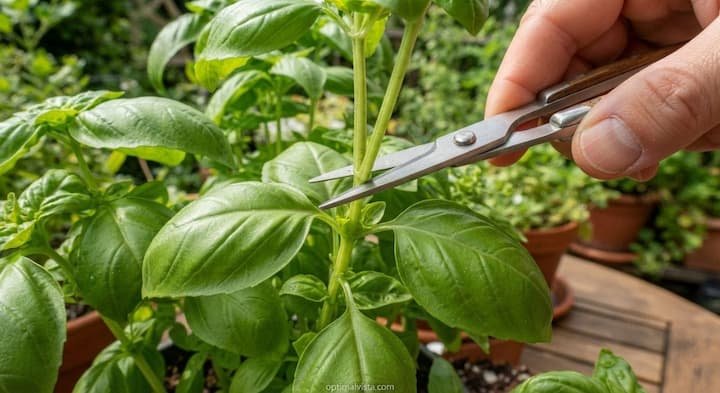
- Cuttings: snip a 4 to 6 inch stem just below a node, strip the lower leaves and any buds, then root it in moist mix or a jar of water. Here’s the full walkthrough on basil cuttings.
Timing matters for seeds. Sow them 6 to 8 weeks before your last spring frost if the pots will go outside later. Mist the surface with a spray bottle so the seeds stay put, and keep the tray warm, but not on top of a heater.
How to Plant Basil in a Pot Step by Step
- Fill the pot with mix and leave 1 inch of space at the top.
- Sprinkle seeds thinly and cover lightly, or set starts at the same depth they grew in the nursery pot.
- In an 8 to 10 inch pot, plant one or two basil plants. In a 12 inch pot, plant two or three in a loose triangle.
- Water until it runs out of the bottom.
- Thin seedlings once they have two or three sets of true leaves.
Crowding is the classic mistake. Six plants in one 10 inch pot look great for two weeks, then mildew shows up. If you share a pot, pair basil with parsley, which likes the same steady moisture, and skip dry-soil herbs like rosemary. More pairing ideas are in this list of companion plants.

Hardening Off and When to Move Pots Outside
A deck or patio gives basil more sun than any window, but moving it too fast scorches the leaves. Wait until nights stay above 55°F. That date swings a lot across USDA Zones 4, 5, 6, 7 and 8, so go by the thermometer, and check when to plant for timing in your area.
Start with one hour in shade on day one, add an hour or two each day for 5 to 7 days, and shift to morning sun first, then full sun. Move pots on a cloudy day or in the evening to cut the shock.
How Much Light Does Basil on a Windowsill Really Get
Basil wants 6 to 8 hours of direct sun, and most windows give less than you think, especially in fall and winter. A south or west window is best. An east window can work if the pot sits right against the glass.
Tall, pale, thin stems stretching toward the light mean the plant is short on sun. When the window falls short, a basil grow light fixes it.
- South or west windows give the longest direct light.
- Keep leaves from pressing against cold glass.
- Turn the pot a quarter turn every few days so all sides get light.
Where summer highs run past 90°F, a pot on a deck or in a south window can scorch by mid-afternoon. Give it morning sun and afternoon shade, or hang a thin curtain on the hottest days.

Best Temperature for Basil
Basil likes it warm. Researchers at Rutgers report that basil starts showing cold injury below about 54°F, and damage turns severe at 50°F or lower, with leaf spotting, browning, and wilting (Brindisi and Simon, Frontiers in Plant Science).
That makes cold window glass at night a real risk.
- Ideal range: 70°F to 85°F.
- Above 90°F, growth slows, leaves shrink, and flowers show up early.
- Below 50°F, expect black or brown patches.
- Keep it away from drafts and heat vents.
Using a Basil Grow Light When the Window Isn’t Enough
A basic LED or fluorescent fixture is plenty for a few pots. Put it on a timer so the plant gets a steady day length.
- Run it 12 to 16 hours a day.
- Hang fluorescent tubes 6 to 12 inches above the leaves, and follow the maker’s distance for LEDs.
- Raise the light as the plant grows.
- Best setup: basil on a windowsill facing south, with the pot pulled back from the glass at night, then a light added on dark days.
How Often to Water Basil in Pots (Indoor Basil Care Basics)
Water when the top 1 to 2 inches of mix feel dry. Push a finger in to the second knuckle to check. Then water until it runs out of the holes and dump the saucer.
My rule is simple: check every day, water only when dry. In a warm room that usually means two or three times a week, and less in a cool, dim one. Patio pots dry out faster, so read up on outdoor basil watering if yours go outside in summer.
- Yellow lower leaves with wet soil: too much water.
- Limp, dull leaves with dry soil: too little water.
- Tiny flies around the pot: soil staying wet too long.
Pot size and season change the schedule:
- A small pot can dry out in a day during a heat wave, while a big pot may hold water for days in winter.
- On hot days, check in the morning and again in the evening.
- Add a thin layer of bark or compost on top to slow evaporation.
- Water at the base, not over the leaves, to keep mildew down.
- Self-watering pots help when you travel, but let the top inch dry now and then.
How to Fertilize Basil in Pots
Watering flushes nutrients out of a pot, and leafy growth burns through nitrogen. Still, too much food makes bland leaves, so go light.
Use a liquid feed at half the label strength every 4 to 6 weeks indoors, or every 3 to 4 weeks on a sunny patio. Slow-release granules mixed in at planting also work. Seaweed or fish emulsion are good organic picks, though fish emulsion smells indoors, and this rundown of the best organic fertilizer options covers more.
Pruning and Pinching for Bushy Basil
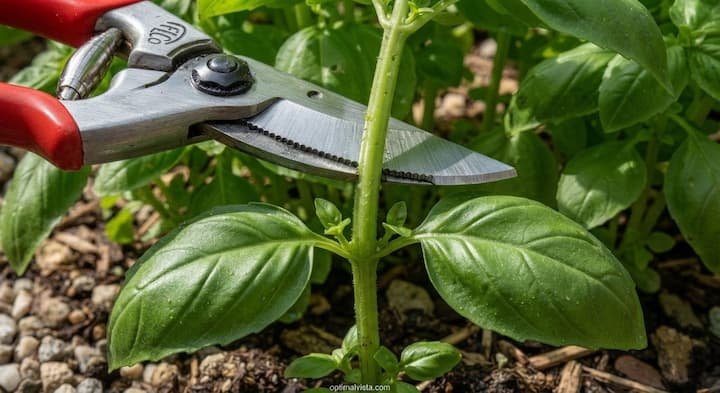
Pruning is what turns one tall stem into a full plant. Cut just above a pair of leaves and two new shoots grow from that spot. Full details are in this guide to pruning basil.
- Make the first cut when the plant is 6 to 8 inches tall.
- Use clean pruners or your fingers.
- Never take more than one-third of the plant at once.
- Pinch flower buds the day you spot them.
- Make weekly pinching your main indoor basil care habit.
How to Harvest Basil and Stop Bolting
Harvest from the top, not the bottom. Pick in the morning once the leaves are dry for the strongest flavor. When basil bolts, it sends energy into flowers and seed, and the leaves shrink and turn bitter. Heat, thirst, and a tiny pot all push it that way.
In my experience, a weekly trim delays flowers better than anything else. For more, see how to harvest basil without hurting it.
- Freeze chopped leaves in ice cube trays with olive oil.
- Blend extra leaves into pesto.
- Give bunches to neighbors.
- Learn the rest of the tricks in this post on storing fresh basil.
- Dry small bunches upside down in a warm, shaded spot, then crumble them into a jar (freeze instead for pesto and sauces).
- Let one backup plant flower late in the season, since bees and other pollinators love the blooms.
Common Basil Problems in Pots and Fixes
| Problem | Likely cause | Fix |
|---|---|---|
| Yellow lower leaves | Too much water, blocked drainage | Let the top 1 to 2 inches dry, clear the holes |
| Black or mushy patches | Cold night or cold glass | Trim damage, keep the room above 50°F |
| Tall, pale stems | Not enough light | Move to a brighter window or add a light |
| Drooping | Dry soil or root rot | Check moisture, repot if roots are brown |
| Curled leaves | Heat, thirst, or aphids | Water deeply, move from heat, rinse leaves |
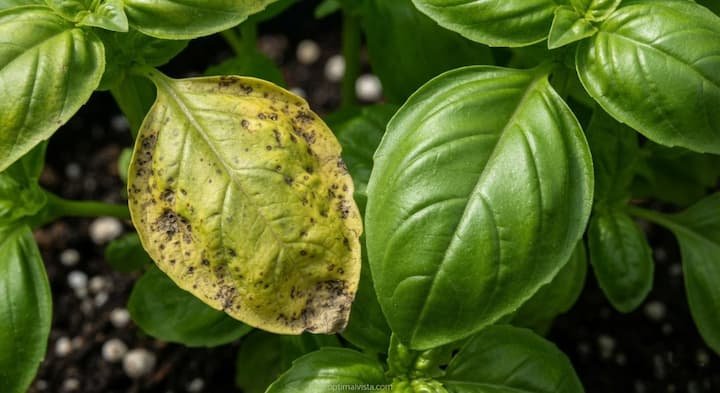
| Gray fuzz under leaves, yellow patches | Downy mildew | Remove leaves, add airflow, don’t wet foliage |
| Sticky leaves, tiny bugs | Aphids | Rinse with water or wipe, neem oil if they persist |
| Tiny flies near the soil | Fungus gnats | Let the soil dry between waterings |
| Fine webbing, speckled leaves | Spider mites in dry, hot air | Rinse leaves, wipe the undersides, raise humidity |
| White powdery coating | Powdery mildew | Thin crowded stems, skip wetting leaves, add airflow |
| Ragged holes, slime trails | Slugs on pots set outside in summer | Pick them off at dusk, move pots off damp ground |
Downy mildew spreads fast. I always toss infected leaves in the trash, not the compost pile. Want the full breakdown on yellow basil leaves or curling basil leaves? Those posts go step by step.
Keeping Basil Going Through Fall and Winter
Fall is when many people decide to grow basil indoors for the first time, and that works fine. Bring outdoor pots inside before nights drop under 60°F, which leaves a safe cushion above the cold-injury line and still comes before the first frost.
Quarantine them for a week, rinse the leaves, and check the undersides for pests. A store-bought basil pot is really a clump of crowded seedlings, so split it into two or three pots with fresh mix soon after you get home. I start a few cuttings every fall as backups, or you can start from seed in a tray.
- Give it 6 to 8 hours of window sun, or run a basil grow light 12 to 16 hours a day.
- Keep the room between 65°F and 75°F.
- Water less when growth slows in the dim months.
- Keep pots off cold sills at night.
Repot when the plant gets root-bound. Here’s what to look for:
- Roots poking out of the drainage holes or circling the surface.
- Water running straight through without soaking in.
- Growth that stalls even with regular feeding.
Go up one size, like 8 inches to 10 inches wide, and use fresh mix.
Conclusion:
Growing basil in pots indoors comes down to light, drainage, warmth, and steady trimming. Pick a pot 8 to 10 inches wide, use a loose mix, give the plant 6 to 8 hours of light, keep the room above 50°F, and pinch it back every week. Do that and one plant keeps your kitchen stocked well into winter. Start with one pot this week.



Pingback: How to Propagate Basil From Cuttings in 14 Days: 7 Steps