A pinch of petunia seed holds thousands of seeds, so why do so many first-timers end up with mold, stretched stems, or empty trays? It usually comes down to timing, light, and a few small habits nobody mentions, and every one of them is easy to fix.
The short answer: sow on top of damp mix 10 to 12 weeks before your last frost, keep it warm, then give seedlings strong light. This guide to growing petunias from seed indoors covers every stage, from picking seed to planting out in the backyard once frost is behind you.
Growing Petunias From Seed Indoors: Is It Worth the Effort?
For one or two planters, buy nursery plants and move on. For a whole border, seed wins on price, and the color choices are way better. Garden centers carry a handful of types, while seed catalogs list hundreds.
Petunias bloom from spring to late fall, so the wait pays off. I think seed is the smarter route once you need more than a dozen plants.
- Cheaper per plant when you need a lot.
- Hundreds of varieties and colors.
- Rare types you won’t find at a garden center.
- Slower, so plan on about 10 to 12 weeks before planting out.
Which Petunia Types Grow From Seed
Petunias split into five groups: grandiflora, multiflora, milliflora, floribunda, and trailing types. Pick mounding or trailing first. Mounding types stay compact, fit beds and vegetable gardens, and look great planted in masses.
Trailing ones spill over baskets and walls, clean themselves up as they go, and stay shorter with a little pruning. Easy spreaders like wave petunias are a good example. Check the packet first, because some popular series are sold only as cuttings, and seed saved from a hybrid will not match its parent.
Pelleted Petunia Seeds vs Raw Seed
Pelleted seed wears a thin coating that makes each seed bigger and easier to see, and the coating dissolves as it gets wet. Raw seed costs less but looks like fine dust.
I like pelleted seed for beginners. Either way, how to sow petunia seeds stays the same: on top of the mix, pressed in, never buried.
- Pelleted: easy to place, costs more.
- Raw: cheaper, harder to spread evenly.

When to Start Petunia Seeds Indoors
Count back 10 to 12 weeks from your average last frost date. Petunias grow slowly at first, so a late start means a late show. Start too early and seedlings stretch out while they wait for warm weather.
These are heat lovers, so rushing them outside early gets you nothing. Planted into cold ground, they just sit and sulk or rot, and they are delicate in their first weeks anyway.
Start Dates by USDA Zone
Here is when to start petunia seeds in each zone, based on a typical last frost. Treat it as a rough guide for USDA Zones 4, 5, 6, 7 and 8, then adjust to your own date.
| USDA Zones | Typical last frost | Sow seed |
|---|---|---|
| 4 and 5 | Late April to early May | Early to mid February |
| 6 and 7 | April | Late January to February |
| 8 and 9 | February to March | December to early January |
Not sure of your date? Count back from your last frost. If it lands on May 1, sow between February 6 and February 20. In colder spots where the last frost comes around mid May, late February or early March works.
Petunias are tender perennials that live on only in frost-free USDA Zones 9, 10 and 11. Everywhere else they get replanted each year.
Seed to Bloom Timeline
Here is a rough calendar. Yours will shift with the weather and your setup.
| Week | What is happening |
|---|---|
| 0 | Sow on damp mix, cover, keep warm |
| 1 to 2 | Seed sprouts, cover comes off |
| 3 to 5 | First true leaves, thin to one per cell |
| 5 to 8 | Pot up and start light feeding |
| 9 to 11 | Slow growth, pinch tops |
| 11 to 12 | Harden off, plant out after frost |
Supplies and Containers
Grab everything before you open the seed packet, and decide how many plants you want first.
- Seed starting mix for petunias.
- Trays, cells, or small pots with drainage holes.
- Clear dome, plastic wrap, or a clear bag.
- Spray bottle for misting.
- Heat mat.
- Thermometer to check mix temperature.
- Grow light or a very bright window.
- Labels and a marker.
- Small scissors.
Depth matters more than width. About 2.5 to 3 inches is enough for early roots, so cells, plug trays, 3-inch pots, peat pots, reused cups with holes punched in the bottom, and even eggshells all work. Later, plants move to bigger homes, and the guide to petunias in pots covers that stage.
Seed Starting Mix for Petunias
A good seed starting mix for petunias is light, fine, and holds water without going soggy. Skip heavy garden soil and compost-rich blends, which pack down and stay wet indoors. A store-bought seed mix such as Jiffy Mix works great.
To make your own:
- 2 parts fine potting soil.
- 1 part perlite or coarse sand.
- 1 part coco coir or peat moss.
Once seedlings get bigger, switch to a richer blend, covered in the petunia soil mix guide.
Clean Containers and Moisten the Mix
Dirty containers invite fungus, so use new or sterilized trays when you can. Wash reused cups and trays in warm soapy water, then rinse them in a solution of 1 part bleach to 9 parts water. Then wet the mix before any seed goes down.
- Fill containers to within 1 inch of the top.
- Firm the mix lightly with your palm.
- Set the tray in a shallow pan of water until the surface looks wet, or wet it with a fine spray.
- Let it drain for 15 to 20 minutes before sowing.
How to Sow Petunia Seeds Without Wasting Them
Petunia seed is tiny. Iowa State University Extension says one ounce holds about 250,000 to 300,000 seeds, so a small pinch goes a long way. Overplanting is easy, and you end up with dozens of seedlings you don’t need.
In my experience, tapping seed off a folded piece of paper gives the most even spread. Mixing the seed with dry sand works too, and so does a damp toothpick.
- Scatter seed over the damp mix, about 1 to 2 inches apart.
- Press lightly with a fingertip, pencil, or small wood block.
- Do not cover the seed, because petunias need light to sprout (some guides say to push seed just below the surface, but leaving it on top is safer).
- Mist gently, since pouring water moves the seed.
- Label every tray, since seedlings of different varieties look the same.

Warmth, Humidity and Petunia Seed Germination
Good petunia seed germination needs steady warmth and even moisture. The sweet spot is 75°F to 80°F, though seed still sprouts anywhere from 70°F to 85°F. A heat mat helps a lot in a cold basement.
Cover trays with a clear dome, loose plastic wrap, or a clear bag held above the surface to hold humidity, and keep them out of direct sun, since heat can build up under the cover and stop seed from sprouting.

How Long Seeds Take to Sprout
Don’t panic if the first week looks empty.
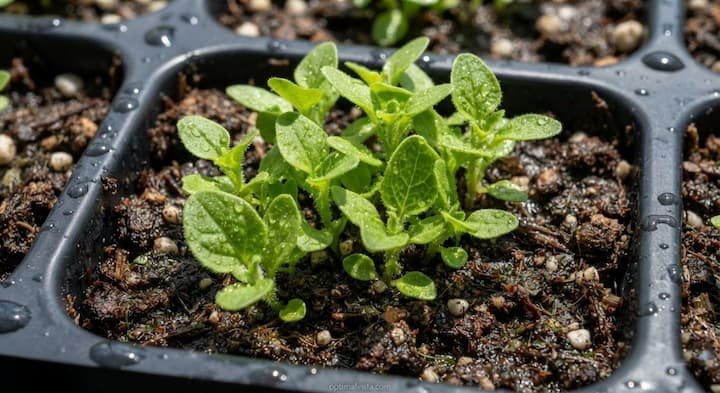
- Most seed sprouts in 7 to 10 days.
- Cool mix can stretch that to 14 days.
- Petunia seed germination slows a lot below 70°F.
- Nothing after 14 days? Dig gently and look for sprouts.
- If the mix dried out, got cold, or the seed was buried, resow a fresh batch.
- Old seed sprouts poorly, so check the date on the packet.
Uncover, Cool Down and Stop Damping Off
Remove the cover the day green shoots appear, and move trays off the heat mat. Leaving it on keeps the air wet and invites mold and damping off, a fungal rot that collapses seedlings at the soil line. Then move trays to a cooler spot around 65°F to 70°F.
Gentle airflow keeps leaves dry, so I run a small fan on low, about 2 to 3 feet away, for 2 to 4 hours a day, aimed so the breeze hits indirectly. No fan? Brush your hand over the tops once a day.
Tiny black flies hovering over the mix are fungus gnats. Let the top layer dry out and try sticky traps, and check the natural pest control guide for more. Toss any tray with fuzzy mold into the trash and start fresh.
Grow Light Setup
Light decides whether seedlings come out short and sturdy or tall and floppy. Hang tube lights about 2 to 6 inches above the tops, depending on the light type, and raise them as plants grow. Run them 12 to 16 hours a day.
LED and regular fluorescent shop lights both work fine. My setup is a cheap shop light hung on chains over a basement shelf.
- A sunny window works for a few plants, but stems tend to stretch.
- Lights hung too high cause leggy petunias.
Watering Seedlings Without Rot
Check trays daily. Seedlings dry out fast, but soggy mix kills them faster. Water when the surface feels slightly dry, ideally from the bottom so sprouts stay put, and let the mix dry a little between drinks.
Bigger plants have different needs, covered in the guide to watering petunias.
Thin Seedlings the Right Way
Once the first true leaves show, thin to one strong seedling per cell, or two at most in a bigger pot. Snip extras at the soil line instead of pulling, which tears the roots of their neighbors.
- Snip weaker seedlings at soil level with small scissors.
- Keep one sturdy seedling per cell.
- Transplant extras into spare cells if the roots come out whole.
- Hold a few extras in reserve in case of losses.

Pot Up Into Bigger Containers
When seedlings have 2 to 3 true leaves, move each one into its own pot.
- Use 3 to 4 inch pots, cell packs, or peat pots filled with regular potting mix.
- Lift seedlings out with a spoon, stick, or butter knife.
- Hold each one by a leaf, never the stem.
- Water in, then put them back under lights in the cool spot.

Feed Seedlings Lightly
Start feeding after the second set of true leaves.
- Use liquid fertilizer at about one-third strength once a week, or every 2 weeks for a lighter touch.
- Skip it if your mix already has slow-release fertilizer.
- Too much food harms young plants.
- As plants grow bigger, raise the strength a little at a time.
- Pale or yellow leaves usually point to a feeding or watering problem, so see yellow petunia leaves.
Once plants head outside, switch to a proper petunia fertilizer.
Pinch Tops and Fix Leggy Stems
Once seedlings have a few sets of true leaves, pinch off the growing tip with clean scissors or small pruners. That forces side branches and builds bushier petunias.
Stems already stretched? Fix the cause, then pinch.
- Lower the light closer to the tops.
- Cool the room to about 65°F.
- Add a fan for stronger stems.
Harden Off in 10 Days
Indoor plants can’t handle full sun, wind, and temperature swings all at once. Start only when nights stay above 50°F. Rushing it can cause transplant shock, which fades leaves and slows growth. Greenhouse-grown plants can often skip this step.
- Days 1 to 3: 1 to 2 hours in bright shade
- Days 4 to 6: 3 to 5 hours, add gentle morning sun
- Days 7 to 8: 6 to 8 hours, avoid harsh midday sun and strong wind
- Days 9 to 10: most of the day outside

Plant Seedlings Outside
Wait until after your last frost. Pick a full-sun spot with well-draining soil in your yard, and mix in compost if drainage is poor. The petunia sun needs guide covers shade questions.
Work slow-release fertilizer into the soil, since petunias eat heavily and liquid feed washes out fast. Water well after planting, check the soil daily so it never dries out, and space mounding types roughly 8 to 12 inches apart.
- Pair them with petunia companion plants.
- Keep blooms coming with regular deadheading petunias.
- For containers, use fresh potting mix.
Winter Sowing: The Outdoor Option
Winter sowing means sowing seed in vented, lidded containers, like a clear 1 gallon milk jug with drainage holes, and leaving them outside. Seed sits through the cold and sprouts when spring warms up.
It is low effort and skips grow lights. Sprouting comes later, though, and petunias like heat, so it works best in colder zones.
Save Seeds From Your Own Plants
Seed saving is easy and free.
- Leave a few flowers on the plant so they form seed pods.
- In fall, pick pods once they turn brown and dry.
- Store the seed in a paper envelope somewhere cool and dry.
- Expect surprises, since hybrid seed will not match its parent plant, while open-pollinated types usually come true.
Extra seed makes a nice swap with a community gardener.
Common Seed-Starting Mistakes
- Burying the seed instead of following how to sow petunia seeds: surface only.
- Ignoring when to start petunia seeds for your zone.
- Leaving the dome on after sprouts appear.
- Soggy mix or standing water.
- Weak light plus a warm room, which stretches stems.
- Using heavy garden soil.
- Skipping hardening off.
- Planting out before nights stay above 50°F.
Conclusion:
Growing petunias from seed indoors takes patience, but the steps are simple: sow on the surface, keep trays warm, give strong light, and harden plants off before they hit the yard. Do that and you get cheap plants and more color choices than any garden center offers. Pick your start date this week, mark the calendar, and enjoy those first tiny sprouts.