
Most backyard gardeners lose their first basil plant to one small mistake, and it has nothing to do with water or soil. It comes down to a single number on the thermometer. Miss it and a healthy seedling stalls, turns black overnight or just sits there for weeks.

Here is the short answer on when to plant basil: move it outside about two weeks after your last frost, once nights stay above 50°F and the soil reaches 60°F. The rest of this guide shows how to hit that window in your zone and keep the plant producing until fall.
Basil Growing Needs at a Glance
Basil is a tender annual, so the first frost kills it and you replant every spring. It only lasts a season or two in USDA Zones 10 and 11.
Here is what it wants:
- Sun: 6 to 8 hours of direct light a day.
- Soil: fertile, well-drained, pH around 6.0 to 7.0
- Warmth: soil at 60°F or more, nights above 50°F.
- Spacing: 12 to 18 inches apart, or 6 to 8 inches for compact types.
- Water: about 1 inch per week.
- Days to harvest: 50 to 75 from seed.
Basil Varieties and Which One to Pick
Most seed packets labeled sweet basil are Genovese types, the pesto standard, and they mature in 65 to 75 days. I like Genovese for pesto, but my go-to for pots is Spicy Globe because it stays under 12 inches tall.
| What you need | Variety | Why it works |
|---|---|---|
| Pesto | Genovese | Big cupped leaves |
| Pots and tight spots | Spicy Globe, Emerald Towers | Compact mound or narrow column |
| Hot summers | Thai, Mrs. Burns lemon | Small leaves that handle heat better |
| Humid weather | African Blue | Holds up when the air stays sticky |
| Color | Dark Opal | Deep purple leaves, milder flavor |
| Salads and wraps | Lettuce Leaf | Huge crinkled leaves |
Thai basil is anise-scented with purple stems, lemon basil adds a citrus note and cinnamon basil a warm, spicy one, and those last two draw a wider mix of pollinators.
Holy basil (tulsi) is a different species that needs more heat and grows slower. Variety matters most for downy mildew, which any community gardener has seen wipe out a sweet basil row.
Thai, lemon and purple types resist it better, and Prospera and Amazel are bred for it. Resistant sweet types exist for Fusarium wilt too. Our Thai basil care guide covers the tougher types.

When to Plant Basil in Your Zone
The rule worth pinning to the fridge: nights above 50°F, soil at 60°F or warmer, and about two weeks after your last frost date. Some guides say wait for 70°F nights. Basil grows fastest there, but 50°F is the floor. In USDA Zones 4, 5, 6, 7 and 8, that puts the outdoor date between mid-April and mid-June.
Not sure of your zone? Check the USDA Plant Hardiness Zone Map and ask your county extension office for your last frost date.
| USDA Zones | Start seeds indoors | Move outside | First light harvest |
|---|---|---|---|
| 3 and 4 | Late March to mid-April | Mid-May to mid-June | Mid-June to mid-July |
| 5 and 6 | Mid to late March | Early to late May | Late May to late June |
| 7 and 8 | Mid-February to early March | Mid-April to early May | Mid-May to early June |
| 9, 10 and 11 | January to early February | Late February to March | Late March to April |
These are typical ranges. Shift them a week for your own yard and check the forecast first.

Basil Planting Dates for Cold and Hot Climates
Your basil planting dates change a lot with the length of summer, so the cold and hot ends of the map need their own plan.
- Zones 2 to 5: pick varieties under 70 days, start seeds 6 weeks before your last frost, and keep row cover handy.
- Zones 6 to 8: follow the table, then start a second round in late June.
- Zones 9 to 11: basil planting dates stretch from February into August in the Arizona low desert, and some warm areas get a second window in fall.
Afternoon shade helps Genovese down south, while Thai, Siam Queen and African Blue favor the heat. In humid states like Texas and Florida, add wider spacing and base watering to head off mildew.
Best Time to Plant Basil Seeds vs Transplants
Either way, the best time to plant basil outdoors stays the same: after frost danger passes and the soil warms.
- Seeds: a packet costs a few dollars and gives you dozens of plants and more varieties. Expect 60 to 70 days to first harvest.
- Transplants: a nursery pot costs a few dollars, skips the grow lights and gives a first light harvest 3 to 4 weeks after planting.
- Direct sowing: works 2 weeks after your last frost, at 1/4 inch deep and 12 inches apart.
I think transplants make sense for two or three plants, and seeds win once you need a dozen or a specific variety.
When to Start Basil Seeds Indoors
Knowing when to start basil seeds matters because starting too early gives you leggy, root-bound seedlings. Our indoor seed starting has the full walkthrough.
- Timing: when to start basil seeds comes down to your last frost date, so count back 4 to 6 weeks.
- Depth: 1/8 to 1/4 inch, kept moist.
- Warmth: germination is best at 70°F to 85°F and takes 5 to 14 days.
- Light: 12 to 14 hours from a south window or grow lights.
- Fixes: leggy seedlings need more light, bleached spots mean lights are too close.
Harden seedlings off for 5 to 7 days before transplanting, leaving them in a sheltered spot a little longer each day. One night below 50°F can blacken leaves and set plants back for weeks.

Planting Basil Outside: Sun, Soil and Spacing
Planting basil outside in cold soil is the fastest way to stall it. Pick a spot with 6 to 8 hours of direct sun, since eight or more gives the most flavorful leaves, plus light afternoon shade in Zones 9 to 11, and good airflow. Stay away from busy roads, where exhaust settles on leaves.
Work a few inches of compost into the bed and aim for a pH of 6.0 to 7.0. If your yard holds water, use a raised bed to avoid root rot.
- Water the seedlings first, then dig each hole as deep as the nursery pot.
- Pick a cloudy afternoon, since planting basil outside under hot sun stresses the roots.
- Space plants 12 to 18 inches apart and water them in.
- Spread straw mulch to hold moisture and cut weeds.
Watering Basil the Right Way
Aim for 1 to 1.5 inches of water a week, roughly 0.6 to 0.9 gallons per square foot. Water deeply once or twice a week and let the top inch of soil dry between rounds. Basil wilts when thirsty but bounces back fast, and dry spells turn the leaves bitter.
Water at the base in the morning, because wet leaves invite downy mildew. Our outdoor basil watering guide breaks schedules down by climate.
Feeding Basil Without the Guesswork
Guides disagree here. Some say basil loves nitrogen, others warn it hurts flavor.
Both are right: it wants some, but heavy doses cost you taste. In my backyard, compost worked in at planting carries basil most of the season.
- In the ground: feed lightly with a balanced organic fertilizer only if growth is slow or leaves look pale.
- In pots: nutrients wash out the drainage holes, so feed every 2 to 4 weeks with compost or an organic liquid.
- Compost tea: a diluted splash every few weeks works too.
Our pick for organic basil fertilizer has specifics.
Pruning and Pinching for Bushy Plants
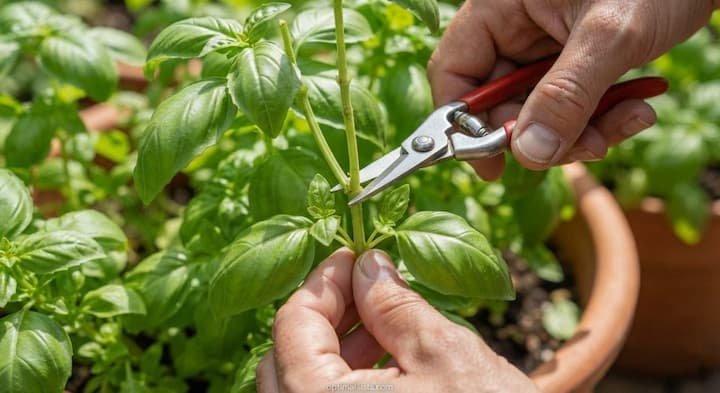
Pinching separates bushy basil from tall, sparse stems. Start when the plant is about 6 inches tall or has its first six leaves. Cut the center stem just above the second set of leaves, and two new stems grow back in its place. Our guide to pruning basil properly shows each cut.
- Cut each branch back to the second set of leaves as it grows.
- Remove the center shoot to discourage blooming.
Stopping Basil from Bolting
Basil bolts when heat, water stress or age push it toward flowers, and buds usually show around six weeks in. Once it blooms, leaf flavor drops. Pinch buds the moment they appear, keep watering steady and give afternoon shade during heat waves. A slow-to-flower type like Emerald Towers helps too.
If one plant bolts anyway, cut it back hard and it leafs out again
Grow one extra plant just for flowers: let it get big and bushy first, then stop harvesting. Bees, hoverflies, butterflies and hummingbirds visit the blooms, and the dried spikes hold seed.
Growing Basil in Containers
Basil is a natural pot plant. Use a container with drainage holes at least 8 inches deep and fill it with quality potting mix, not garden soil.
A 12-inch pot holds one standard plant, and a 5-gallon container fits two compact ones spaced 6 to 8 inches apart, though 12 is better for airflow.
Keep it sunny and sheltered, push a finger in daily during hot weather and water when the top inch or two is dry, and feed every 2 to 4 weeks. An olla buried in the pot also takes out the guesswork.
Growing Basil Indoors
Indoor basil needs the light and steady warmth it gets outside, ideally 70°F or higher. A south-facing window sometimes works, but most homes need a grow light. Our guide to potted indoor basil covers the full routine.
- Run grow lights 12 to 14 hours a day, a few inches above the plants.
- Keep pots away from drafty windows and doors.
- Rotate the pot each time you water so growth stays even.
- Thin plants to about 6 inches apart and start picking above 4 inches tall.
Have a cat or dog? The ASPCA lists basil as non-toxic to dogs and cats.
Companion Plants: What Helps and What Doesn’t
Here is the short version of our basil companion plants list.
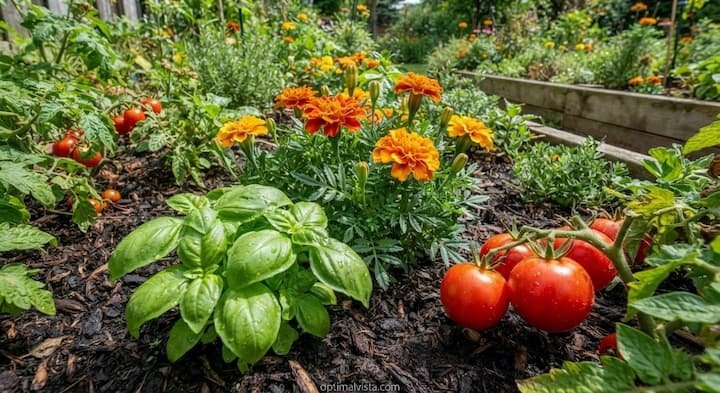
- Good partners: tomatoes, peppers, oregano and marigolds, whose scent also puts off whiteflies.
- Keep apart: sage by 3 to 4 feet, plus rue and common fennel.
The tomato pairing gets oversold. Mississippi State Extension points to studies where basil and marigolds cut thrips on tomatoes, but the evidence that basil repels hornworms or changes tomato flavor is weaker.
I plant it next to my tomatoes anyway because they want the same sun and water, then check for hornworms by hand.
Propagating Basil from Cuttings
Cut stems root easily in water, so a late-summer cutting gives you a free plant for next year. Our basil cuttings guide has more.
- Take a 4 to 6 inch cutting just below a leaf node.
- Strip the lower leaves so none sit in the water.
- Stand it in a jar in bright, indirect light and change the water every few days.
- Roots show in 1 to 2 weeks, so pot it up once they reach 1 to 2 inches.
Common Basil Problems and Leaf Symptoms
- Japanese beetles and slugs: skeletonized or ragged leaves, plus slime trails. Hand-pick them.
- Aphids and spider mites: rinse with water, then use insecticidal soap in the early morning.
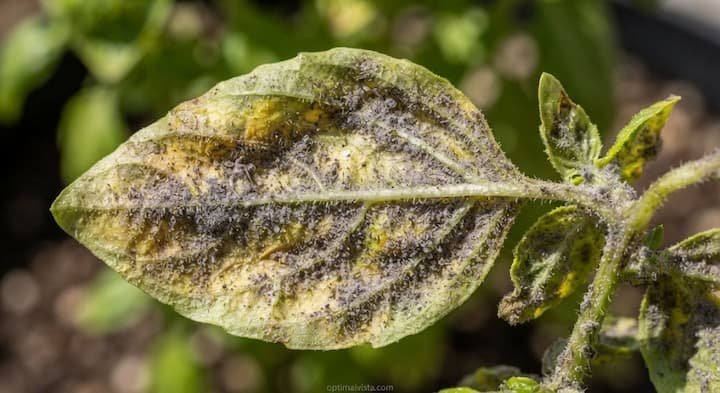
- Downy mildew: yellowing from the center out with gray-purple fuzz underneath. No cure, so bag the plant and put it in the garbage, not the compost.
- Fusarium wilt: sudden wilt and brown streaks inside the stem. Pull the plant and move basil to a new spot for two seasons. Resistant varieties exist.
- Root rot: yellow lower leaves and a mushy stem base, so fix drainage first.
- Yellow leaves, no fuzz: usually water, drainage or hunger, covered in our yellow basil leaves post.
- Curling or wilting: water, heat, pests or disease, covered in curling basil leaves.
- Black leaves: cold damage. A few can be pruned off, but a hard frost is fatal.
- Brown or black spots: often fungus from wet foliage, so water at the base.
Harvesting Basil So It Keeps Producing
Start picking at 6 to 8 inches tall, about 3 to 4 weeks after transplanting. I cut mine in the morning after the dew dries, when the oils are strongest.
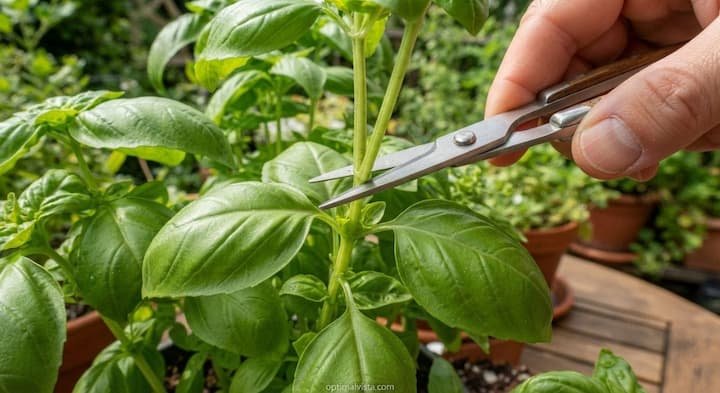
Use clean pruners, work from the top down, cut just above a leaf pair, leave at least two sets of leaves and never take more than one-third at once. Check for flower buds weekly. Our guide to harvest basil safely adds more detail.
Succession planting keeps leaves coming all season:
- Round one: sow or transplant at your outdoor date.
- Rounds two and three: 3 and 6 weeks later.
- Stop: about 8 to 10 weeks before your first fall frost, since basil needs 50 to 75 days to harvest.
Storing and Preserving Fresh Basil
Basil hates cold, even in the fridge. Penn State Extension reports that temperatures below 40°F discolor the leaves, so keep cut stems in a glass of water at room temperature. Our storing fresh basil page has more.
- Freeze leaves: wash, air dry on a towel, freeze flat on a sheet pan, then bag them.
- Freeze cubes: purée with olive oil and pour into ice cube trays.
- Dry it: a dehydrator or freeze-dryer works, and pesto freezes well.
- Cook smart: add fresh basil at the end to keep color and flavor.

Frost Protection and Overwintering
Frost kills basil, so harvest everything you want before it hits. If a cold night sneaks in early, cover plants with row cover or frost cloth, or bring pots inside. You can also dig up a healthy plant or take cuttings for a windowsill.
In USDA Zones 9, 10 and 11, cover plants during frost and wait for new growth in spring. Then cut them back to 6 to 8 inches above the soil and feed lightly. After a season or two, plants turn woody and slow, so replace them.
10 Common Basil Mistakes to Avoid
In my experience, one of these ten sits behind nearly every basil plant that dies.
- Planting too early: the best time to plant basil is after nights hold above 50°F, not the first warm weekend.
- Too little sun.
- Skipping the first pinch.
- Letting buds open.
- Soggy soil or pots without drainage holes.
- Wetting the leaves.
- Overfeeding nitrogen.
- Crowding plants so air cannot move.
- Stripping stems bare instead of leaving two sets of leaves.
- Composting mildewed plants or replanting basil in a Fusarium bed.
Final Thoughts:
Basil rewards patience more than skill. Nail when to plant basil, keep the soil warm and evenly moist, pinch early and harvest often, and one backyard plant will keep your kitchen stocked until the first frost. Start with the 50°F night rule, check it against the zone table, and adjust for your own yard.


Pingback: How to Harvest Basil Without Killing the Plant: 8 Easy Steps
Pingback: 5 Best Organic Fertilizer for Basil: Feeding Tips
Pingback: How Often to Water Outdoor Basil: 8 Mistakes to Avoid Now
Pingback: Growing Basil in Raised Beds: 7 Layout & Spacing Tips