
Ever notice how one basil plant stays green and bushy all summer while the one right next to it sulks, droops, and turns yellow, even though both got the same hose? The difference usually comes down to timing, not luck. So, how often to water outdoor basil?
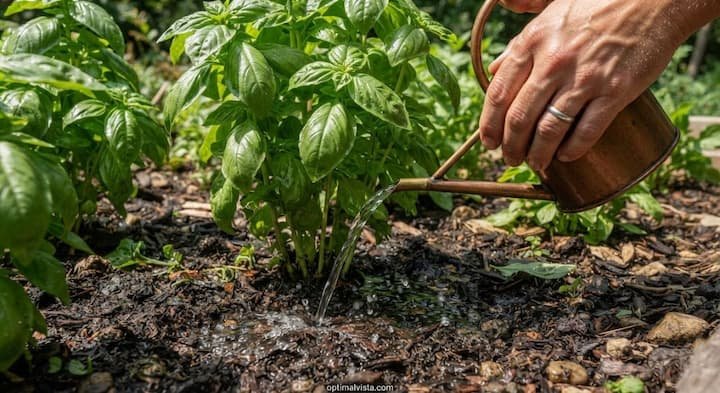
Short answer: every 2 to 4 days in the ground and every day in pots, adjusted for heat, soil, and rain. That range sounds loose, but it gets tight once you read your own yard. Below, I break down the exact signs, soil types, and tricks that tell you when your basil actually wants a drink.
Why Basil Is So Fussy About Water
Basil is a soft herb with no woody frame, so it stands up because its cells are packed with water. That water pushes against the cell walls, a force called turgor pressure. When the soil dries out, the pressure drops and the stems flop within hours.
Thin leaves lose moisture fast on a hot afternoon, and every wilt leaves a little damage behind. Repeated dry spells also push the plant to bolt, and once basil flowers, the leaves turn bitter. Steady watering keeps leaves tender and full of flavorful oils, while uneven watering gives you tough ones.
Too much water causes the opposite problem. Roots need air, and soggy soil pushes it out, which leads to rot. Think wrung-out sponge, not puddle.
How Often to Water Outdoor Basil by Setup
Here is the schedule I use as a starting point. Treat it as a range.
| Where it grows | How often | Notes |
|---|---|---|
| Small pot (under 10 inches) | Every day | Twice a day in a heat wave |
| Large pot or half barrel | Every 1 to 2 days | Check the weight of the pot |
| Garden bed, loam soil | Every 2 to 4 days | Skip a day after rain |
| Garden bed, sandy soil | Every 2 to 3 days | Water drains fast |
| Garden bed, clay soil | Every 4 to 7 days | Holds water, rots roots easily |
| New transplant (first week) | Every day | Helps the roots settle in |
| Seedlings | Every 1 to 2 days | Bottom water or mist gently |
| Cool, cloudy weeks | Every 5 to 7 days | Soil stays damp longer |
How Much Water Basil Needs Each Time
Most gardens do well with about 1 to 1.5 inches of water per week, rain and hose combined. On a 10-inch pot, that math works out to a little over 1/2 gallon per week, but that is the floor, since pots lose water out the bottom and sides in summer.
Pots are simpler to handle: water slowly until it runs out of the drainage holes. Here is roughly how much water basil needs by container size.
- 6-inch pot: about 1 cup per watering.
- 10-inch pot: about 1 to 2 quarts.
- 14-inch pot or half barrel: about 1/2 to 1 gallon.
- Garden bed: a slow soak that wets the top 6 inches of soil.
- Rule of thumb: how much water basil needs changes with heat and pot size, so go by drainage and soil feel, not the cup.
How to Tell When Basil Needs Water
The finger test beats any calendar. In pots, push a finger 1 inch down. In garden beds, go 2 inches, since the roots reach deeper. In my own yard, that single habit saved more plants than any schedule.
Dry and crumbly at that depth means water now. Slightly damp means wait a day. Wet and clinging to your finger means hold off.
A few other checks help:
- Weight test: lift the pot. Light means dry, heavy means wet.
- Chopstick test: push a wooden stick 4 inches into the pot. Clean and dry means water, dark and damp means wait.
- Moisture meter: handy, but check it against the finger test for the first week.
Do not wait for the droop. Wilting is the last signal, and repeated wilting stresses the plant and dulls the flavor.
Same goes for the forecast: if the soil is already dry, water now even when rain is coming.

Watering Basil Seedlings and New Transplants
Seedlings need soil that stays moist, since their roots are tiny. Bottom watering works best. In a plug tray, fill the tray under the cells and let the mix pull water up.
For small pots with drainage holes, set the pot in a shallow dish and pull it out once the surface looks damp. Misting works too when you only need to wet the top. Keep it gentle, because a heavy stream floats seeds away and uproots baby plants.
Check seedlings daily, and once they size up, every 2 days is usually plenty. If you started basil from seed indoors, keep that habit until true leaves show up.
When you move a transplant outside, soak the hole at planting and water daily for the first week so the roots settle in. After that, switch to the schedule in the table above.
Watering Basil in Pots and Containers
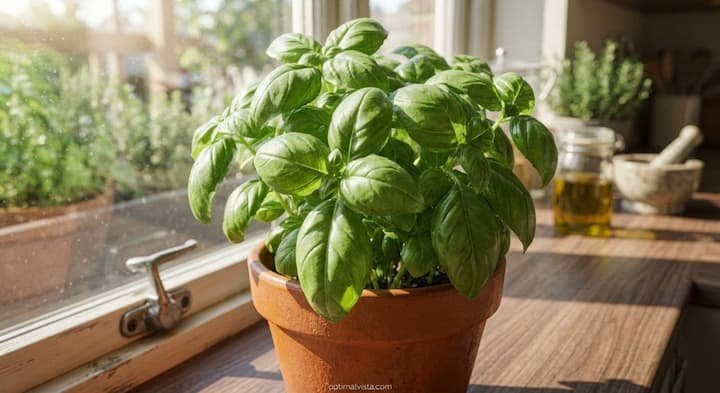
Watering basil in pots is where most people slip, because containers dry out far faster than ground soil. Potting mix, especially the peat-based kind, holds less water than garden soil. Clay pots wick moisture through their sides, while plastic holds it longer.
- Watering basil in pots goes best with drainage holes, a pot at least 10 inches wide, and a saucer you empty after 15 minutes.
- Clay dries quicker than plastic, so check clay pots first.
- If water pools on top after a drink, you are pouring too fast or too often, so check the drainage holes.
- Established pots can be bottom watered: set them in a shallow dish for 10 to 15 minutes.

Watering Basil in Garden Beds and Raised Beds
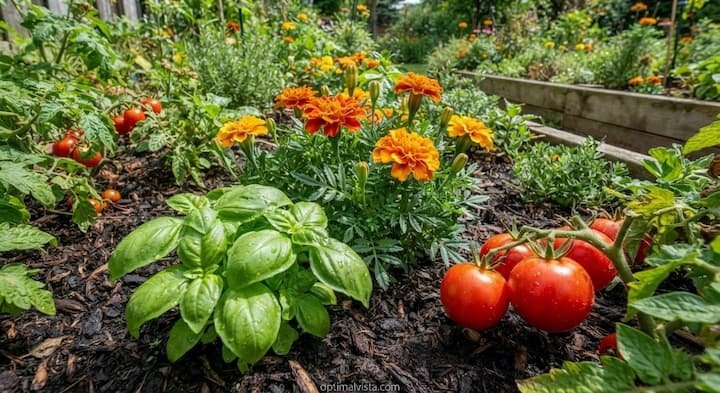
Ground soil holds water longer than potting mix, so garden basil needs fewer drinks. Sandy soil drains like a sieve, so plan on every 2 to 3 days. Loam sits in the middle at every 2 to 4 days.
Clay holds on to water and can stretch to 7 days or a bit more, but it rots roots faster if you overdo it. Raised bed basil drains quicker than flat ground, so lean toward the shorter end. After a real rain, wait a day or two before the next drink.
Timing matters too. If you are still working out planting basil in USDA Zones 4, 5, 6, 7 and 8, wait until the last frost (32°F) has passed and nights stay above 50°F.
Watering Basil Indoors
Folks often pull a pot inside in the fall. Indoor basil uses less water because rooms stay near 70°F and the air is calmer. Plan on every 4 to 5 days under a grow light or in a sunny window, and a bit longer in a cool room with weak winter light.
Empty the saucer after each watering. See our guide to indoor basil pots.
What Changes Your Schedule: Heat, Sun, Wind and Humidity
Use this table to shift the schedule up or down.
| Condition | What to do |
|---|---|
| Over 85°F with no rain | Water every day, check twice on windy days |
| Full sun, 6+ hours | Shorter end of the range (afternoon shade lets you stretch) |
| Windy backyard | Soil dries fast, check daily |
| Humid and cloudy | Stretch to 5 to 7 days |
| After a 1 inch rain | Skip watering for 2 days |
| Fall, nights near 50°F | Cut back and move pots inside |
Watering Basil by Season and USDA Zone
Basil is an annual in most yards, so the schedule shifts as the year moves along:
- Spring: every 2 to 3 days while plants settle in.
- Summer: every day to every 2 days at peak growth, and daily in pots.
- Fall: every 3 to 4 days as cooler air slows evaporation.
Your zone matters too. In cooler USDA Zones 4 and 5, summers run shorter and milder, so you can stay on the longer end most weeks. In Zones 6, 7 and 8, July and August bring heat and humidity, so water pots daily and keep the leaves dry.
In hot, dry spots like desert yards, strong afternoon sun can wilt basil fast, so check twice a day and give it afternoon shade.
How Cultivar, Plant Age and Harvesting Change Water Needs
Young plants with small roots want water every 1 to 2 days. Once established, they stretch to every 2 to 3 days. Variety plays a part as well.
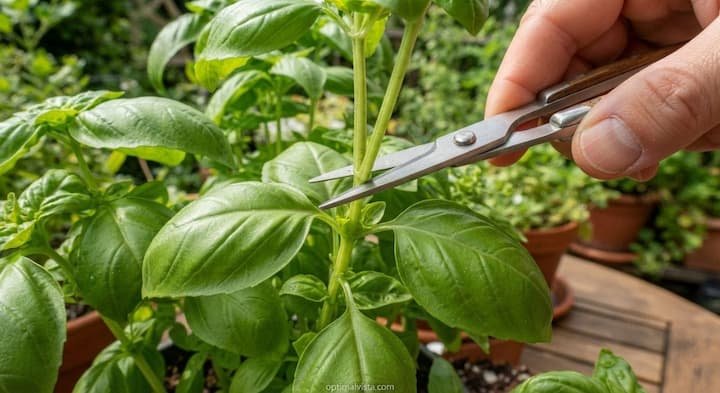
In my experience, Thai and lemon types handle a little dryness better than big-leaf sweet basil, so they forgive a missed day, and purple basil drinks a bit less (see the Thai basil care guide). Regular picking helps too, since a compact, well-trimmed plant uses less water than a leggy one.
The Best Time to Water Basil and the Right Way
The best time to water basil is early morning, before the sun gets strong. The plant is not thirsty through the hottest hours, and the leaves dry off long before the cool, humid night.
Evening watering leaves foliage wet overnight, which invites mildew. UConn Extension reports that basil downy mildew needs at least 4 hours of leaf wetness to infect a plant, so keeping leaves dry is one of the easiest ways to protect yours.
- Aim the water at the base of the plant, not over the leaves, since wet leaves in hot sun can scorch and invite disease.
- Soak slowly and deep, because deep soaks push roots down and make the plant tougher, while quick splashes keep roots shallow.
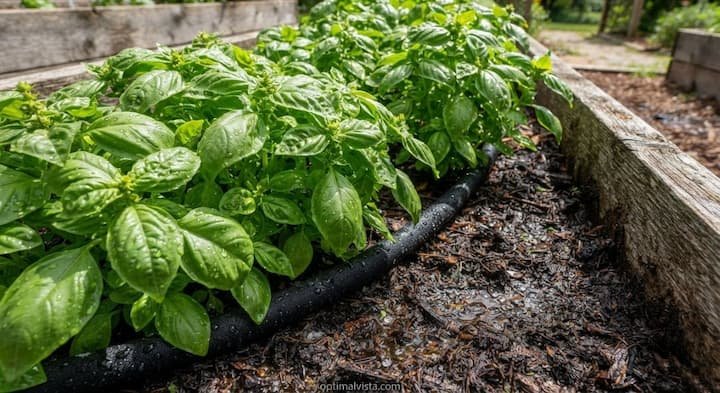
- Use a narrow-spout can, a soaker hose, or a drip line, and keep the flow gentle so soil does not wash out.
- Running late? The best time to water basil after morning is mid to late afternoon, never after dark.
Signs Your Basil Is Underwatered
Thirsty basil tells you fast:
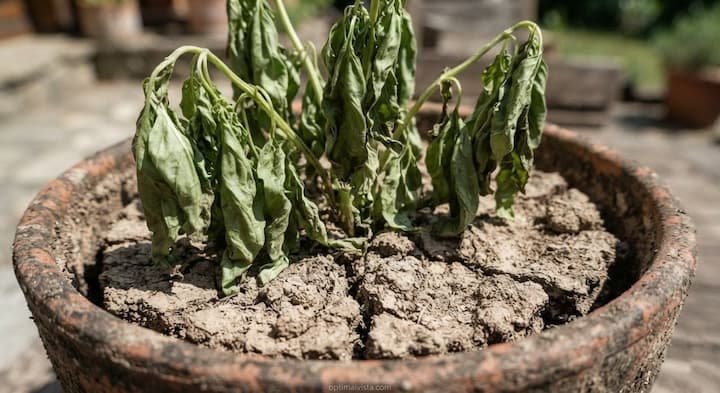
- Limp, drooping leaves that perk up within a couple of hours after a drink.
- Curling basil leaves along the edges as the plant tries to save moisture.
- Dry, crumbly soil pulling away from the pot edge.
- Yellow lower leaves and leaf drop after a long dry stretch.
- Flower buds showing up early, a sign the plant is stressed.
Drought stress is one of the fastest ways to push basil into bolting, so those buds are a warning.
One catch: basil also droops around 2 p.m. and bounces back by evening. If the soil is still damp, that is heat, not thirst. Add shade, not water. For real thirst, give a slow soak, pinch off any flower buds, and keep up with pruning basil so the plant stays bushy.
Signs of Overwatered Basil and How to Fix It
Signs of overwatered basil show up low on the plant first. Yellow basil leaves near the soil, soft or black stems, and a musty smell from the pot all point to wet roots.
Soggy soil also invites pests and fungus, including stem rot at the soil line. I’ve lost a few plants by watering on autopilot during a rainy week.
- Moss or a green haze on the soil, one of the signs of overwatered basil.
- Soil that stays wet more than 2 days after watering.
- Seedlings collapsing at the soil line (damping off).
- Mushy lower stems and yellow leaves all over the plant.
To fix it, stop watering until the top inch dries. If the plant is in a pot, slide it out, trim black or mushy roots, and repot in fresh mix with some perlite. In the ground, pull back the mulch and let the area dry. Badly rotted plants are often easier to replace than rescue.

Mulch and Soil Tricks That Cut Watering
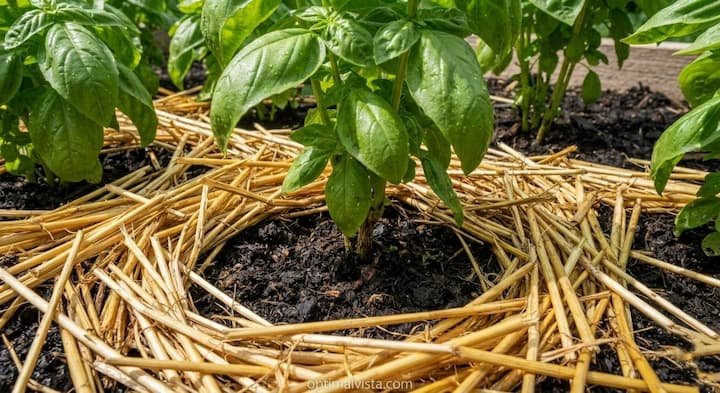
A 2-inch layer of straw, shredded leaves, or wood chips keeps soil cool, steadies its temperature, and slows evaporation. Keep it about 1 inch away from the stems so they stay dry.
I like straw because it breaks down and feeds the soil by fall. Organic basil fertilizer works best in light doses, since heavy feeding can push soft, thirsty growth.
- Mix compost into garden beds, since it helps soil hold water and drain at the same time.
- Blend potting mix with perlite for containers so extra water drains out.
- Plant near tall neighbors from the basil companion plants list for a little afternoon shade.
Does Water Quality Matter for Basil?
For most yards, plain tap water is fine. Rainwater is even better, so a rain barrel pays off. If your water is hard, a white crust on the soil or pot rim means minerals are building up, so flush the pot with a long, slow soak now and then.
Run the hose for a few seconds first on hot days, since water baked in the hose can stress roots, and very cold tap water can shock them too.
Watering Basil While You Are Away
For trips up to 3 days, soak the soil well before you leave and slide pots into part shade.
For anything longer, set up one of these:
- A drip line on a timer for beds and big containers.
- A buried clay olla for raised beds.
- Terracotta watering spikes for pots.
- A neighbor who knows to check the soil, not just add water.
Pick a big batch before you go. Harvesting basil the right way keeps the plant growing, and storing fresh basil properly keeps the leaves from going black.
One mistake to skip: drowning the pot to buy extra days. It usually ends in rot.
Common Basil Watering Mistakes
Most problems trace back to a short list:
- Giving small sips every day instead of a deep soak.
- Spraying the leaves instead of the soil.
- Watering at night.
- Skipping drainage holes.
- Using one fixed schedule from spring through fall.
- Copying a friend’s schedule without checking your own soil and climate.
- Watering again before the top inch dries.
- Waiting for a full droop, or skipping a drink because rain is in the forecast.
Conclusion:
So, how often to water outdoor basil comes down to this: roughly every 2 to 4 days in the ground, daily in pots, and less after rain or in cool weather. Poke the soil, water slowly at the base, and skip the evening hose. Do that and your plants stay full, sweet, and slow to flower. Check the top inch tomorrow morning and adjust from there.


Pingback: How to Store Fresh Harvested Basil: 7 Easy Ways