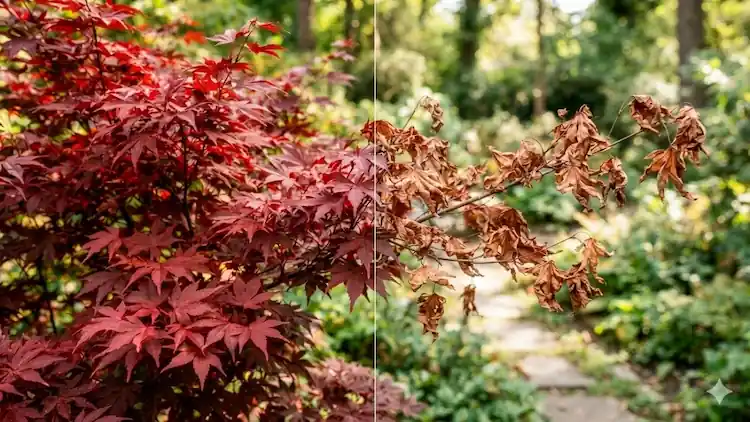
Is your Japanese maple dying right in front of you, and you have no idea which of the ten things you read online is actually the problem? I’ve stood in that exact spot in my own backyard more than once.
I garden across USDA Zones 5, 6, and 7 depending on the property, and after growing Acer palmatum for close to nineteen years, I can tell you a Japanese maple dying is almost never caused by one single thing. It’s usually two or three stresses stacking up at the same time, and once you know what to look for, you can catch it before it’s too late.
Is Your Maple Actually Dead, or Just Stressed?
Before I panic, I scratch a small patch of bark near the base with my thumbnail. If there’s green right under the surface, the tree is alive, even if every leaf on it looks awful. I also snap off a couple of small twigs from different parts of the canopy. A twig that’s dry and snaps clean through with a hollow sound is probably dead wood.
One that bends and shows a hint of green or moisture inside still has life in it. I learned this the hard way after nearly giving up on a five-foot maple in my own backyard that came roaring back the following spring.
Japanese Maple Dying: What the Timing Tells You
The month matters more than most people realize. In my experience, a maple that struggles right after the last spring frost is usually dealing with cold injury, not disease. I lost a few young leaves on mine this past April when temperatures dropped to 32°F overnight after a warm stretch had already pushed out tender new growth.
That’s a completely different problem than a tree that looks fine in June and suddenly scorches in late July, which is almost always heat and drought stress. And a tree that declines slowly over an entire growing season, with no clear trigger, is more often dealing with something happening underground, like root rot or a soil issue that’s been building for months.
The Real Reasons Behind a Japanese Maple Dying
Here’s what I’ve actually seen kill or nearly kill these trees, ranked by how often I run into each one:
- Root rot and fungal disease from soil that stays wet too long.
- Underwatering during a hot, dry stretch, especially trees getting less than 1 inch of rain a week with no supplemental water.
- Too much wind or direct afternoon sun scorching the leaf edges.
- Overfertilizing, which burns the fine feeder roots.
- Alkaline soil that locks up the nutrients the tree needs.
- Planting the trunk flare too deep in the ground.
- Transplant shock from moving the tree during the wrong season.
- Insect pests that most articles never even mention.
A Japanese maple dying isn’t usually caused by one dramatic event. It’s a slow buildup, and the tree usually gives you warning signs for weeks before it actually gives up.
Japanese Maple Root Rot: The Most Common Killer I’ve Seen
If I had to pick the single biggest reason a Japanese maple dies, it’s root rot caused by fungal pathogens like Phytophthora and Verticillium, and it almost always traces back to soil that doesn’t drain.
According to research compiled by the USDA Forest Service on Verticillium wilt fungi, this pathogen survives in soil for years and infects trees through wounds in the root system, gradually blocking the tissue that carries water up through the trunk (source: USDA Forest Service Forest Health report). Once it’s inside the tree, there’s no fungicide that reliably cures it, which is exactly why so many cases of Japanese maple dying trace back to a drainage problem nobody caught early enough.
I’ve found the fix isn’t complicated, even if it takes real digging. Work two to three inches of compost or leaf mold into the top foot of soil before you ever plant, and if you’re dealing with heavy clay, consider growing your maple in a large container instead. A 15 to 20 gallon pot with drainage holes has saved more than one tree in my own yard on a property with clay soil that just wouldn’t cooperate.
Wind, Sun, and Water Stress
Japanese maples grow naturally under the edge of a forest canopy, not out in the open, so a spot with harsh afternoon sun or unbroken wind will scorch the leaves even on a perfectly healthy tree. I plant mine where they get morning sun and afternoon shade, ideally near a fence or a taller shrub that breaks the wind. During a dry summer, I water deeply once a week, giving the tree about 3 to 5 gallons depending on its size, rather than a light sprinkle every day that only wets the top inch of soil.
Mulch matters here too. A 2-inch layer of compost or shredded bark around the base, kept a few inches back from the trunk itself, holds moisture and moderates soil temperature. I’ve written before about the exact mulch that has worked in my own yard through several winters, and the same principle applies during the growing season for a stressed maple.
Soil pH, Fertilizer, and Planting Depth Mistakes
Japanese maples want acidic soil, somewhere between 5.5 and 6.5 pH. If your neighborhood tends toward alkaline soil, a basic pH test kit from any garden center will tell you in minutes. I also see people overfeed these trees out of good intentions. Japanese maples aren’t heavy feeders, and too much fertilizer burns the root hairs and shows up as scorched leaf edges within days.
Planting depth trips up a lot of first-time growers too. The point where the trunk flares out into roots needs to sit right at, or slightly above, ground level. I’ve seen trees planted 3 to 4 inches too deep slowly rot at the base over a couple of years, which looks exactly like disease but is really just a planting mistake.
Pests Nobody Warns You About
Most articles on this topic stop at disease and weather, but I’ve dealt with scale insects and aphids doing real damage to a stressed maple, especially one that’s already weakened by drought.
Look for small bumps along the stems or a sticky residue on the leaves, which is usually honeydew from an aphid colony. A community gardener friend of mine lost a young maple to borers that got in through pruning wounds, which is exactly why I clean my pruners with rubbing alcohol between cuts on any tree showing signs of stress.
Symptom Quick Reference
| What You See | Likely Cause |
|---|---|
| Leaves brown at the tips, soil constantly damp | Root rot |
| Leaves scorched at edges, soil bone dry | Underwatering or wind exposure |
| New growth soft, drooping, burned edges | Overfertilizing |
| Yellowing between leaf veins | Alkaline soil |
| Trunk rotting at soil line | Planted too deep |
| One side dying, olive streaking under bark | Verticillium wilt |
Reviving a Dying Japanese Maple: My Backyard Recovery Steps
Reviving a dying Japanese maple starts with figuring out which of these causes actually applies, because the fixes for overwatering and underwatering are opposite problems with the same brown leaves. Once I know what I’m dealing with, I prune out anything clearly dead using clean pruners, cutting back to healthy wood with a hint of green underneath.
Bag those infected branches and put them straight in the trash rather than the compost pile, since fungal spores can survive composting and reinfect your soil later.
After that, I focus on getting the roots right. If the soil is soggy, I stop watering completely and improve drainage before anything else. If it’s dry, I give it a slow, deep soak rather than fertilizer, since a stressed tree can’t absorb nutrients well anyway. Recovery usually shows up within one to two weeks for minor stress, but a tree recovering from root rot can take an entire growing season to look normal again.
Why Is My Japanese Maple Dying in Different Seasons?
Fall brings its own version of this question. A maple dropping leaves in September, before the usual color change, might just be entering dormancy early due to summer stress rather than actually dying.
I’ve had this happen after a particularly dry July, and the tree came back completely normal the next spring. If you’re prepping your whole yard for the cold months anyway, it’s worth reading through my notes on protecting plants from frost and on using a frost blanket on young or newly transplanted maples, since a tree already stressed from summer has less reserve to handle a hard freeze.
Preventing a Japanese Maple From Dying Again
A few habits have kept every maple in my current yard healthy for years now:
- Water deeply once a week rather than lightly every day.
- Test soil pH every spring, especially in alkaline regions.
- Mulch 2 inches deep, kept off the trunk itself.
- Skip fertilizer unless the tree is in a pot or clearly deficient.
- Inspect for scale and aphids monthly during the growing season.
- Plant with the trunk flare visible, never buried.
I also do a round of fall cleanup every October, which ties directly into the fall pruning routine I follow for the rest of my perennial beds, and I winterize anything sensitive the same weekend I winterize my roses for the cold months ahead.
Final Thoughts:
A Japanese maple dying feels alarming the first time you see it, but in my experience, most trees are more resilient than they look. Match the symptom to the actual cause instead of guessing, fix the soil and water situation first, and give the tree time. I’ve brought maples back from looking nearly dead more than once in my own backyard, and the ones that survive usually reward you with better color the following fall than they ever had before. If you take one thing away from all this, let it be patience. A stressed maple rarely needs more products, it just needs the right diagnosis and a few weeks to prove you right.