
Why do petunias look amazing in May and tired by August, even when you water them every day? Most of the time the plant isn’t the problem. The soil ran out of food, or the wrong kind of food pushed leaves instead of flowers. Picking the best fertilizer for petunias takes less guessing than the labels make it seem.
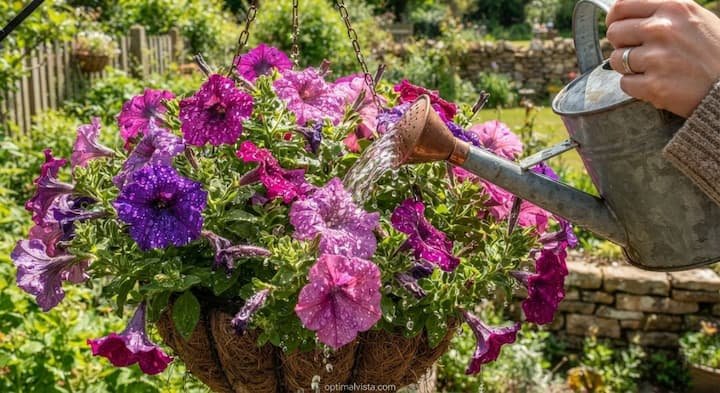
Short answer: a water-soluble feed with iron and an N-P-K near 20-6-22, mixed at half strength every 7 to 10 days, works for most backyard growers. The rest of this guide covers why that works, what to buy, and how to avoid burning roots.
Quick Picks to Grab First
Short on time? Start here.
- Top pick for most people: Jack’s Classic Petunia Feed (20-6-22), a water-soluble powder with iron.
- Best for hard water: Peters Professional Petunia Special (20-3-19).
- Best bloom push: Jack’s Classic Blossom Booster (10-30-20).
- Easiest for baskets: Miracle-Gro Shake ‘N Feed (12-4-8), slow-release.
- Best ready-to-use liquid: Miracle-Gro LiquaFeed Bloom Booster.
- Gentle organic option: Espoma Organic All Purpose (5-5-5).
- Budget pick: Miracle-Gro Water Soluble Bloom Booster (15-30-15).
Why Petunias Eat So Much
Petunias grow fast and bloom nonstop, so they empty a bag of potting mix quicker than almost any other annual. Every watering in a pot also washes a little more food out the bottom. I’ve been gardening for six years, and petunias were the plant that taught me how fast soil runs out of fuel.
They’re also picky. They struggle to pull iron out of the soil, so yellow new leaves often point to an iron problem, not a watering problem.
And they punish a heavy hand: one big dose of nitrogen gives you a leafy plant with few flowers, while long gaps between feedings slow the blooms down too.
Petunia Types and How Often Each One Eats
The type decides how often the feeder comes out, and which form of food fits best.
- Grandiflora: the biggest flowers, but delicate ones; feed monthly, water often, and use slow-release granules.
- Multiflora: compact, with lots of smaller blooms that handle rain better; monthly granules work fine.
- Milliflora: mini flowers for hanging baskets and fence planter boxes; monthly, with slow-release or a weak liquid.
- Spreading or wave: fast growers that drape over pots; weekly feeding with a water-soluble powder, and the wave petunias guide covers the rest.
Those monthly numbers fit slow-release or granular food. With a liquid at half strength, every 7 to 14 days is normal.

Reading the N-P-K Numbers on the Bag
Every label shows three numbers, like 10-30-20. The first is nitrogen (N), which builds leaves and stems. The second is phosphorus (P), which supports blooms and roots.
The third is potassium (K), which helps overall plant health and flowering. So 10-30-20 carries three times more phosphorus than nitrogen, and that tilts the plant toward flowers.
High Phosphorus, Balanced, or Low Phosphorus?
Advice here is split. Bloom boosters like 10-30-20 or 15-30-15 push flowers and suit a mid-summer boost. Balanced feeds like 20-20-20 or 10-10-10 make a safe base.
Pro-style petunia blends like 20-3-19 or 20-6-22 go low on phosphorus and load up on potassium and iron. I think the high-phosphorus craze is a bit overdone for potted petunias, since most yellowing problems trace back to iron and pH.
Tomato food works too, as long as the nitrogen stays under 15, so a 5-10-10 or 8-12-8 is fine.
Water-Soluble, Liquid, Granules or Spikes
The form changes how much control you get. Liquid and water-soluble feeds move through the plant fast, and you can change the strength anytime, which lowers the burn risk.
- Water-soluble powder: the most control and the lowest cost per feeding, but you mix it every time.
- Ready-to-use liquid: no measuring, but it costs more per feeding.
- Granules and slow-release: sprinkle and walk away for 4 to 6 weeks, up to 3 months for some; heavy rain can release them too fast.
- Spikes: easy for pots of 3 gallons or bigger, but they can burn roots in smaller pots.
Iron, Magnesium and the Synthetic vs Organic Call
Look for chelated iron on the label, because it stays available to the plant across a wider pH range. Extra magnesium helps in hard water areas, where calcium tends to crowd it out. Synthetic feeds are fast, easy to dose and usually cheaper, though some contain urea.
Organic feeds are gentler, slower, feed the soil life, and are safer around kids and pets.
Best Fertilizer for Petunias by Category
Here’s the lineup, sorted by what each one does best.
| Product | N-P-K | Form | How often | Best for |
|---|---|---|---|---|
| Jack’s Classic Petunia Feed | 20-6-22 | Synthetic powder | 7-14 days | All-round, iron-hungry plants |
| Peters Professional Petunia Special | 20-3-19 | Synthetic powder | 7-14 days | Hard water, containers |
| Jack’s Classic Blossom Booster | 10-30-20 | Synthetic powder | 7-14 days | A bloom push |
| Jack’s Classic or Fertilome All Purpose | 20-20-20 | Synthetic powder | 7-14 days | Starter and base feed |
| Miracle-Gro Water Soluble Bloom Booster | 15-30-15 | Synthetic powder | 7-14 days | Budget bloom boost |
| Miracle-Gro LiquaFeed Bloom Booster | See label | Synthetic liquid | 2-3 times a week | No mixing |
| Miracle-Gro Shake ‘N Feed | 12-4-8 | Synthetic slow-release | Up to 3 months | Hanging baskets |
| Osmocote | See label | Controlled-release | 2-3 months | Mixing into potting soil |
| Jobe’s Fertilizer Spikes | 8-9-12 | Synthetic spikes | About 2 months | Pots of 3 gallons or bigger |
| Espoma Organic or Dr. Earth Premium Gold | 5-5-5 or 4-5-4 | Organic granules | Slow release | Gentle feeding, beds and pots |
| Miracle-Gro Performance Organics Blooms | 5-7-10 | Organic granules (OMRI) | 4-6 weeks | Organic beds |
| FoxFarm Big Bloom | 0.01-0.3-0.7 | Organic liquid | Per label | Root drench for tired plants |
Quick pros and cons, category by category. Jack’s Petunia Feed packs iron and micronutrients and mixes at about 1 teaspoon per gallon, but it’s pricey and contains urea. Peters Petunia Special adds extra magnesium and three chelated irons, but costs more.
Jack’s 10-30-20 gives the strongest flower push, but you mix it every time, so wear gloves. Miracle-Gro 15-30-15 is cheap and quick, but can leave white residue on leaves. The 20-20-20 powders work as a drench or leaf spray at a low price, with no petunia-specific extras.
Shake ‘N Feed and Osmocote feed for months with no quick fix, and Shake ‘N Feed can burn plants against the stem. Jobe’s spikes need no mixing but harm small pots.
Espoma and Dr. Earth are gentle with no burn risk, just slow. FoxFarm is great as a root drench but expensive, and Neptune’s Harvest (2-4-1) acts fast but smells like fish. LiquaFeed skips mixing but needs a separate feeder, and TPS Nutrients is made for petunias at 2 tablespoons per gallon, with no published N-P-K.
Baicor (5-10-5) is cheap at about 1 ounce per gallon, but its ingredient list is incomplete. A Bonide 10-10-10 liquid also works, though it’s sold for houseplants, so check the label.
My go-to for hanging baskets is Jack’s Classic Petunia Feed, mixed weak and used often. Keep kids and pets off treated areas until the leaves dry. Every product above sits on garden center shelves or ships online.

How to Fertilize Petunias, Step by Step
If you only remember one thing about how to fertilize petunias, make it this: small and steady beats big and rare.
- At planting: mix a starter feed into the potting soil, roughly 2 ounces for a big pot and 1 ounce for a small one.
- Low and slow base: ¼ to ½ cup of worm castings per plant every month, or a light dose of equal N-P-K granules.
- Bloom feeding: a bloom-type liquid at half strength every 7 to 10 days, or slow-release at planting plus a weak liquid on top.
- Know how to fertilize petunias by setup: pots and baskets get fed more often than beds.
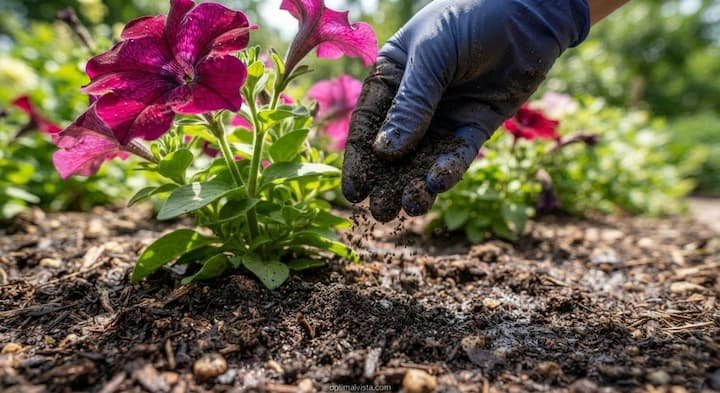
Soak the plant before feeding so the roots aren’t hit dry. A soil drench reaches the roots, and a light leaf spray adds quick uptake. Keep granules away from the stem, wear gloves when mixing powders, follow the label, and never double the dose.
I mix it at half strength and feed on Sundays so the routine sticks.
Feeding Schedule by Setup and Month
Last frost dates swing a lot across USDA Zones 4, 5, 6, 7 and 8, so go by your local date, not the calendar.
| Setup | At planting | Regular feeding |
|---|---|---|
| Hanging baskets and pots | Slow-release or starter mix | Half-strength liquid every 7 to 10 days, or a weak solution at each watering |
| In-ground beds | Worm castings or balanced granules | Monthly granules, plus liquid every 10 to 14 days |
| Raised beds | Same as in-ground | Every 10 to 14 days, since they drain faster |
| Wave or spreading types | Starter plus slow-release | Weekly |
Skip more than two weeks in a basket and you’ll usually see yellow leaves or fewer blooms.
- Planting: soil around 60°F and no frost left; use the starter feed.
- Early summer: start the regular liquid routine.
- Mid-summer: switch to a bloom booster, and cut back tired plants.
- Late summer and fall: keep feeding until frost.
- At 32°F: stop; in frost-free yards, ease off during cooler months.
Container vs In-Ground Petunia Fertilizer Plans
A petunia fertilizer plan for a pot looks different from one for a backyard bed. Pots hold a small supply of nutrients that washes out with each watering, so they need more frequent feeding.
Garden soil holds nutrients longer. Petunias also favor wide pots over deep ones, and wide pots dry out fast, so watch the feeding. For the full pot setup, see the potted petunias guide.
- Pick petunia fertilizer in powder form for baskets, since you can adjust the dose every week.
- Use slow-release or spikes in pots when you travel a lot, and feed beds monthly with granules.
Organic and DIY Petunia Plant Food
Good petunia plant food doesn’t have to come from a bag with a number on it. In my experience, worm castings are too gentle to rescue a struggling plant, but they’re great for maintenance.
If you’re a community gardener sharing a plot with vegetables, OMRI-listed granules keep the whole bed on one organic program. Epsom salt only helps if magnesium is short, and banana peels or coffee grounds shouldn’t be your main feed.
- Worm castings: ¼ to ½ cup per plant every month.
- Fish and seaweed liquid, like Neptune’s Harvest: fast acting, but it smells.
- Homemade petunia plant food, like compost tea, is mild, so use it often.
Reading the Leaves: Hungry or Overfed?
Hungry signs
- Yellow new leaves with green veins: iron or high pH; add chelated iron, and the yellow leaves guide digs deeper.
- Pale green leaves all over: not enough nitrogen, so start a regular feed.
- Small blooms or few flowers: low food or low sun.
- Purplish older leaves: low phosphorus, though cold nights cause it too.
- Plants beaten up by heat, pests or fungus: a micronutrient feed helps them recover.
Overfed signs
- Brown, crispy leaf edges and a white crust on the soil or pot rim.
- Big, floppy leaves with few blooms, or a plant that outgrows its pot.
- Wilting even though the soil is wet, which means root damage.
For an overfed plant, flush the pot with several gallons of plain water, let it drain fully, skip feeding for two weeks, then restart at half strength.

Soil pH, Drainage and Iron Chlorosis
Here’s the fact that explains most yellow petunias. Michigan State University Extension lists a desirable pH range of 5.4 to 5.8 for petunias in potting media, and above that the iron in the root zone becomes hard for them to use.
The result is interveinal chlorosis: yellow leaves with green veins.
Hard or alkaline water pushes pH up over time, so a cheap pH kit is worth the money. Add chelated iron if the leaves keep yellowing, and skip lime. Drainage matters more than rich soil, so a good petunia soil mix does half the work.
- Pot mix: 40% sandy garden soil, 20% coco peat, 40% vermicompost or worm castings.
- Beds: work 2 to 3 inches of compost, peat moss or aged manure in about 8 to 10 inches deep.

Other Care That Boosts Blooms
Food only works if the basics are right.
- Sun: 5 to 6 hours of full sun; check the sun requirements if your yard is mixed.
- Transplanting: wait until the soil hits 60°F and frost is gone, and shade new plants with a thin cloth for a few days.
- Spacing: Milliflora 4 to 6 inches apart, Grandiflora and Multiflora about 12 inches, wave types at least 12 inches; some growers pack plants close in a pot for a fuller look.
- Deadheading: snip spent blooms, because seed pods shut blooming down; the deadheading petunias guide shows the cut.
- Pinching: pinch Grandiflora at about 6 inches tall for bushier plants, and skip wave types.
Keep water steady with a watering schedule instead of guessing. Some growers dissolve 1 tablespoon of a potassium feed in water and pour it on the soil, but read the label first.
Pair petunias with companion plants that share the same sun and feeding needs. A stressed plant invites pests, so keep natural pest control handy.
Cutting Back and Reviving Tired Petunias
By mid-summer, a lot of petunias get long, stringy stems with flowers only at the tips. Use clean pruners to cut them back by about half, feed at half strength, and new growth shows up in a couple of weeks.
If it already looks sprawled out, the leggy petunias guide covers the fix. When fall frost is close, you can also try overwintering petunias indoors.

Common Mistakes When Fertilizing Petunias
I’ve seen new gardeners dump a full scoop on dry soil and wonder why the leaves crisped. Here’s what to avoid when fertilizing petunias.
- Mixing at full strength instead of half.
- Fertilizing petunias on bone-dry soil.
- Piling granules against the stem.
- Using a high-nitrogen feed and getting all leaves.
- Skipping iron and ignoring pH.
- Putting spikes in small pots.
- Feeding after frost has killed the plants.
- Storing powder in a damp shed; if it turns into a hard brick, toss it in the trash.
Conclusion:
Picking the best fertilizer for petunias comes down to your setup. Pots and baskets do well with a weak water-soluble feed every 7 to 10 days, beds with monthly granules, and organic gardeners with worm castings. Watch the pH, keep the dose small, and cut tired plants back by half. Feed them steadily until frost, and the color will hold through fall.


Pingback: Overwintering Petunias Indoors for Spring: 4 Easy Methods